

Reading time: 9 minutes
"Happy name day!": among Orthodox Christians, this wish has a precise meaning. On the feast of their patron saint, people go to church, receive communion, then gather with family or friends. It is also a time for gifts. But which one? This guide helps you choose a meaningful gift, find the right saint and word your wishes well.
What is a name day?
At baptism, every Orthodox Christian receives the name of a saint. This saint becomes their patron saint: a friend in heaven, a model and an intercessor. The day the Church commemorates this saint is the person's name day, also called the "Angel's day" by Russians (Den' Angela) or imen den by Bulgarians.
In many Orthodox countries, such as Greece, Romania, Bulgaria and Russia, this day is celebrated at least as much as a birthday. In Greece, people often keep open house that day for everyone who wants to drop by and wish them "Chronia polla". Our guide to the name day and the calendar of saints explains it all in detail.
Find the person's patron saint
Before choosing a gift, you need to know which saint it is. That is not always obvious:
- The baptismal name may differ from the everyday first name. Someone called Kevin may have been baptised Constantine, for example. Ask the family discreetly.
- Several saints share the same name: there are dozens of Saints John or George. The person celebrates the specific saint chosen at their baptism, and so on a specific date.
- Julian or Gregorian calendar: Russians, Serbs and Georgians celebrate the saints 13 days later than Greeks or Romanians. Saint Nicholas, for example, is celebrated on 6 December or 19 December depending on the Church.
If you cannot find out, the simplest thing is to ask: "Who is your patron saint?" Nobody will be offended; quite the opposite.
The icon of the patron saint: the classic gift
An icon of the patron saint is the most traditional name-day gift. It goes in the icon corner of the home, people pray before it, and it is sometimes passed on to the children. A few tips:
- make sure it is the right saint, not a namesake;
- for a first icon, a medium size to stand or hang works very well;
- you can have it blessed by a priest before giving it, or let the person do so;
- write the date and a short note on the back: the icon will become a family keepsake.
For a Nicholas, Nicole or Nikola, the icon of Saint Nicholas, the best-loved saint of the Orthodox world:
 Orthodox Icon of Saint Nicholas in Carved Wood
28,90€
View product
For a John, Jane or Ivan, the icon of Saint John the Baptist, the Forerunner:
 Orthodox Icon of Saint John the Baptist, Byzantine Style
From 30,90€
View product
For an Anne, Anna or Hannah, Saint Anne, mother of the Mother of God, is the grandmother of Christ:
 Orthodox Icon of Saint Anne and the Virgin Mary – Byzantine Style
From 30,90€
View product
For a Peter or a Paul, the two apostles are celebrated together on 29 June (12 July on the Julian calendar):
 Saints Peter and Paul Icon on Canvas — Orthodox Byzantine Art HD for Church and Home
From 21,90€
View product
Medals, pendants and objects of the saint
A piece of jewellery with the image of the patron saint is worn every day, close to the heart. It is a good idea for someone who already has an icon of their saint, or for a teenager. For a Nicholas:
 Saint Nicholas Pendant in Gold Finish
30,90€
View product
For a George, Yuri, Djordje or Georgios, Saint George, the great martyr:
 Saint George Slaying the Dragon Icon Pendant — 70 mm Stainless Steel, with or without Chain
From 27,90€
View product
For a Michael, Michelle or Mihai, a keyring of the Archangel Michael is a small gift that goes everywhere:
 Saint Michael the Archangel Keychain — 27mm Medallion, 8 Designs or Set of 6
From 20,90€
View product
For a Mary, Maria or Mariana, who celebrates the Mother of God on one of her great feasts (often the Dormition, 15 August), a Panagia pendant:
 Panagia Pendant Necklace, Gold-Tone — Theotokos, Pearls and Red Stones
30,90€
View product
Ideas by person: man, woman, child, grandparents
- For a man: the icon of his saint, a medal or keyring of the saint, a book on his saint's life.
- For a woman: the icon of her saint, a pendant, a vigil lamp or fine candles for her prayer corner.
- For a child or godchild: a small icon of their saint for their bedroom, a prayer bracelet, a book of saints' lives told simply. Tell them the story of their saint: it is the best gift of all.
- For grandparents: beeswax candles, oil for the vigil lamp, a large icon.
- For a priest: his name day is the parish's big day. A joint gift from the parishioners is often the best solution.
For the whole family, a collection of saints' lives lets everyone discover the story of their own saint:
 The Lives of the Saints for Orthodox Christians — 600 Orthodox Saints' Lives, Third Edition
From 69,90€
View product
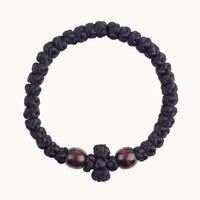
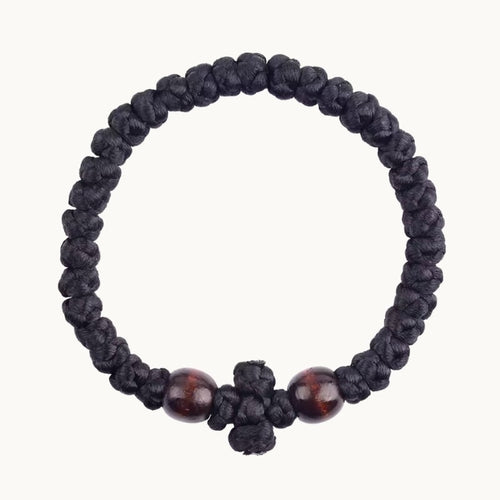
For a child or teenager, a chotki bracelet: an Orthodox prayer rope worn on the wrist.
 Orthodox Prayer Rope Bracelet
18,90€
View product
The Serbian Slava: what to bring?
Serbs mainly celebrate the Slava: the patron saint of the whole family, passed down from father to son since the ancestors' conversion to Christianity. The Slava has been on UNESCO's list of intangible cultural heritage since 2014. The most common Slavas are Saint Nicholas (Nikoljdan), Saint George (Đurđevdan), Saint John (Jovanjdan) and Saint Demetrius (Mitrovdan).
On that day, the family prepares the Slava bread (slavski kolač) and boiled wheat (žito) in memory of the departed, and lights the Slava candle. The priest comes to bless the home, or the bread is blessed in church. Then the family welcomes its guests.
If you are invited to a Slava:
- it is traditional to bring a bottle of wine, sweets or flowers;
- a beeswax candle or an icon of the family's saint are much appreciated gifts;
- on arrival, greet with "Srećna slava!" (Happy Slava!) and cross yourself before the icon;
- if the Slava falls during a fast (like Saint Nicholas, during the Nativity Fast), the meal is lenten: do not bring meat or cheese.
 Orthodox Beeswax Candles from Jerusalem — 3 Bundles of 33 Candles Blessed at the Holy Sepulchre, 24 cm
64,90€
View product
How is a name day celebrated?
The celebration begins in church: the person attends the Divine Liturgy and receives communion, often after confession. At the end, the priest and the parish sing "Many years!" (Mnogaya leta, Eis polla eti). Then comes the festive meal, with family or friends.
If the feast falls on a fast day, the meal stays lenten, and the festivities can be moved to the following Sunday. And if you forget the exact day? Don't worry: you can wish a happy name day throughout the following week.
Wishing a happy name day: greetings and texts
Here is how to wish a happy name day in the main Orthodox languages:
- English: "Happy name day! May your patron saint pray for you."
- Russian: "S dnyom angela!" (Happy Angel's day!)
- Greek: "Chronia polla!" (Many years!)
- Romanian: "La mulți ani!"
- Serbian: "Srećan imendan!", and for the Slava: "Srećna slava!"
- Bulgarian: "Chestit imen den!"
And three sample texts to write in a card:
For a friend: "Dear George, happy name day! May Saint George keep you as brave and faithful as he was. Many years!"
For a godchild: "My dear Nicholas, today is the feast of your patron saint. Saint Nicholas loved children and helped the poor: I pray that he always protects you. With love from your godmother."
For a grandmother: "Dear Granny Anne, happy name day! May Saint Anne, the grandmother of Christ, watch over you as you watch over us. With all our love."
Mistakes to avoid
- Choosing the wrong saint: Saint Catherine of Alexandria is not Saint Catherine of Siena, a Catholic saint. Check the baptismal name.
- Getting the date wrong because of the Julian or Gregorian calendar.
- Giving a statue or a Catholic holy picture: Orthodox Christians pray before icons.
- Bringing meat or spirits to a feast that falls during a fast, without asking.
- Forgetting what matters: a call, a visit or a prayer for the person are worth more than an expensive gift.
FAQ — Frequently asked questions about name-day gifts
What gift should I give for an Orthodox name day?
The most traditional gift is an icon of the person's patron saint. A pendant or medal of the saint, a book of saints' lives, beeswax candles or a prayer rope are also good ideas.
How do I find out someone's patron saint?
It is the saint whose name the person received at baptism. This name may differ from their everyday first name: ask them or their family, checking the exact saint and the date of the feast.
Is the name day more important than the birthday?
In many Orthodox countries, such as Greece, Romania and Bulgaria, it is celebrated at least as much as the birthday. For the Church, it is the day we remember the saint who accompanies the person.
How do you wish an Orthodox Christian a happy name day?
In English, simply "Happy name day!". In Greek, "Chronia polla!"; in Russian, "S dnyom angela!"; in Romanian, "La mulți ani!"; in Serbian, "Srećan imendan!".
What should I bring to a Serbian Slava?
Traditionally, a bottle of wine, sweets or flowers. A beeswax candle or an icon of the family's saint are also much appreciated. If the Slava falls during a fast, avoid meat and dairy.
Can I give an icon of a saint other than the patron saint?
Yes. An icon of Christ, the Mother of God or a saint dear to the family is always welcome. But for a name day, the icon of the patron saint has a special meaning.