


-
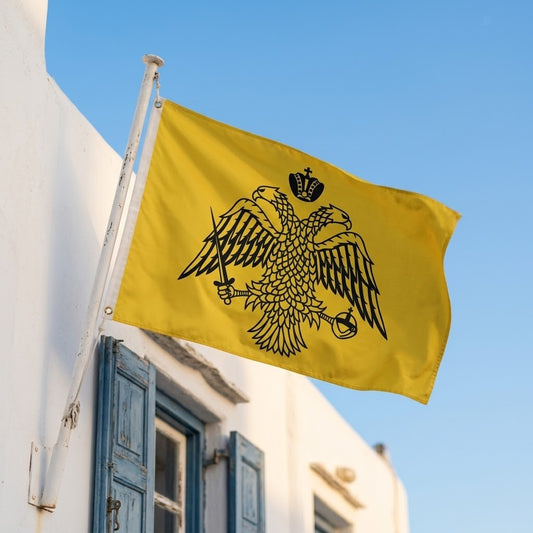
Mount Athos Flag — Greek Orthodox Double-Headed Eagle
Regular price From 22,90€Regular price From 22,90€ Sale priceUnit price per -
Flag of Greece 90x150cm
Regular price 28,90€Regular price 28,90€ Sale priceUnit price per



The Flag of Greece: History and Significance
The Greek flag is one of the most recognisable and historically significant national symbols in the world. Composed of nine alternating blue and white horizontal stripes, with a white cross on a blue field in the upper left canton, the flag of Greece is a direct reflection of Greek national and spiritual identity.
The nine stripes of the Greek flag represent the nine syllables of the Greek national motto — "Eleftheria i Thanatos" — "Liberty or Death" — the rallying cry of the fighters of the Greek War of Independence against Ottoman occupation in the 19th century. This flag is therefore much more than a national emblem: it is a symbol of a struggle for freedom fought in the name of Orthodox faith and Hellenic identity.
The white cross: symbol of Greek Orthodox faith
The white cross in the canton of the Greek flag is its strongest symbol. It represents the Orthodox Christian faith, which has been at the heart of Greek national identity for centuries. The Greek Orthodox Church played a central role in preserving Greek language, culture, and identity during four centuries of Ottoman rule. The cross on the flag of Greece is a direct tribute to this fundamental role. If you are passionate about these Orthodox symbols, also discover our collection of Orthodox flags that celebrate this shared spiritual heritage across Christian nations.
Blue and white: the colours of eternal Greece
The blue and white of the Greek flag are inseparable from Greek identity. Blue evokes the Aegean Sea, the Mediterranean sky, and the immensity of Greek horizons. White symbolises purity, light, and clarity — values central to Greek philosophy and civilisation since antiquity. These two colours have, over the centuries, become the emblematic colours of Greece, recognisable throughout the world.
Why Buy a Flag of Greece?
Whether you have personal ties to Greece or simply wish to express your admiration for its exceptional culture and history, there are many reasons to buy a Greek flag.
For the Greek diaspora
The Greek diaspora is one of the largest and most active in the world. Millions of Greeks live outside their national borders — in Australia, the United States, Germany, France, the United Kingdom, and all over the world. For the diaspora, the Greek flag is much more than a decorative object. It is a symbol of strong cultural identity, a tangible link to the homeland to proudly display at home, in the office, or at community events.
For sporting and cultural events
Greece is the birthplace of the Olympic Games, and its sporting tradition dates back to antiquity. During international competitions — football, basketball, athletics — the Greek flag is proudly waved by passionate supporters from around the world. Greece is also the country of the Patras Carnival, the Independence Day celebrations on 25 March, and countless Orthodox celebrations like Easter — the most important feast in the Greek Orthodox calendar.
For culture and history enthusiasts
Greece is the cradle of philosophy, democracy, Western arts, and sciences. From Athens to Sparta, from Homer to Plato, from the Acropolis to the Aegean islands, Greece has shaped world civilisation in an incomparable way. Displaying the Greek flag is paying tribute to this cultural and intellectual heritage that continues to influence the entire world.
Our Selection of Greek Flags
Our selection of Greek flags is designed to combine quality, authenticity, and durability.
Classic Greek flag
The flag of Greece in its official form — nine horizontal blue and white stripes with the Greek cross in the upper left canton. Available in several sizes, ideal for interior decoration, an office, or use at cultural and sporting events.
Mini Greek flag
Compact and practical, the mini Greek flag is ideal for decorating a desk, a car, or accompanying your travels. It is also a much-appreciated gift idea for the Greek diaspora or for any enthusiast of Mediterranean and Orthodox culture.
How to Choose Your Greek Flag?
Before buying a Greek flag, a few criteria deserve attention:
Size: depending on the intended use — wall decoration, outdoor use, sporting or cultural event — the ideal size varies. Our product descriptions specify the available dimensions to help you make the best choice.
Fabric quality: a good Greek flag must withstand time, washing, and prolonged exposure to the Mediterranean sun. We select durable materials to guarantee vibrant colours and maximum longevity.
Sharpness of stripes and cross: the nine horizontal stripes and the white cross are the central elements of the flag of Greece — make sure they are accurately reproduced, with clean lines and a vibrant blue on immaculate white.
Frequently Asked Questions
What do the nine stripes of the Greek flag represent?
The nine alternating blue and white stripes of the Greek flag represent the nine syllables of the national motto "Eleftheria i Thanatos" — "Liberty or Death" — the rallying cry of the Greek War of Independence in the 19th century against Ottoman occupation.
What does the cross on the Greek flag symbolise?
The white cross on a blue background in the upper left canton of the Greek flag represents the Orthodox Christian faith, which has been at the heart of Greek national identity for centuries. The Greek Orthodox Church played a fundamental role in preserving Greek language and culture during four centuries of Ottoman rule.
Which flag size should I choose for outdoor use?
For outdoor use — façade, garden, flagpole — the large format is recommended for strong visual presence and wind resistance. The standard format suits a balcony or window. The mini flag is ideal for a desk or indoor decorative use.
Can the Greek flag be used at Orthodox celebrations?
Yes. The flag of Greece is widely used at Orthodox celebrations — Greek Orthodox Easter, Theophany (6 January), Independence Day on 25 March — both in Greece and throughout the Greek diaspora. For celebrations with a more specifically religious character, also discover our Orthodox flags.