

Reading time: 10 minutes
In the Eastern Christian tradition, the home is not a neutral space. It is a sanctified place — a space into which the presence of God is invited to dwell, made visible by the icons that watch over family life, by the light of the vigil lamp that never goes out, and by the prayer that rises every morning and every evening toward heaven. At the centre of this sacred life of the household stands the krasny ugol — the prayer corner — which this guide invites you to discover and create in your own home.
What is the Krasny Ugol?
The krasny ugol (красный угол) is the sacred space reserved for prayer in the traditional Orthodox home. In English it is variously called the icon corner, the prayer corner, the beautiful corner, or the holy corner. Its Russian name carries a double meaning: krasny means both red (a colour associated with beauty, the sacred, and royalty in Slavic tradition) and beautiful (in Old Russian, krasny was the common word for beautiful — the same root as "Red Square" in Moscow, Krasnaya Ploshchad, which is actually the "Beautiful Square"). The krasny ugol is therefore simultaneously the red corner and the beautiful corner — the most beautiful place in the home, adorned with the greatest care.
As Grokipedia summarises: the icon corner "functions as a personal iconostasis, mirroring the icon screens found in Orthodox churches and serving as the spiritual focal point of the household." Metropolitan Tikhon describes the Orthodox home as a "little church" — and the prayer corner is where that ecclesial dimension becomes tangible. The practice traces its roots to early Christian house churches described in the New Testament (Acts 2:46), evolving through the centuries into the distinctively Orthodox custom we know today.
Traditionally, when first entering an Orthodox home, the visitor would venerate the icons in the prayer corner — making the sign of the cross before them — before greeting the members of the household. The icons are the first hosts. Often, in addition to the main icon corner, an Orthodox family will hang a small portal icon (usually of the Virgin and Christ Child) by the front door, venerated by family and guests whenever going in or out of the house.
Where to Place the Prayer Corner in Your Home
The Orthodox tradition recommends placing the prayer corner in the main living space of the home, in the corner or on the wall facing east. As the St John the Baptist Cathedral in Washington DC states: it is preferable to place icons on the eastern wall, "because the East as a theological concept has special significance in Orthodoxy."
The east is the direction of the rising sun — and in Orthodox theology, the rising sun symbolises the Risen Christ, "the Sun of Righteousness" (Mal 4:2). It is the direction toward which Orthodox altars have faced since the earliest centuries, the direction in which Orthodox Christians are buried in expectation of the resurrection, and the direction of Christ's Second Coming. To pray facing east is to pray in the direction of the returning Lord.
If an east-facing corner is not available, St Michael Tampa Bay offers a liberating clarification: "The traditional place is the east wall of the main living space. If that is not practical, the quiet corner of a room works just as well. The one rule is that it be seen. The whole point is that prayer becomes part of the rhythm of the home. Hidden icons cannot do that." A shelf, a small table, a windowsill — any of these can become a prayer corner. Many families also keep a small icon in every room: above the kitchen sink, in each bedroom, so that prayer reaches the whole house.

What to Place in the Orthodox Prayer Corner
The composition of the krasny ugol follows a hierarchy and a theological logic. Here are the essential elements, from the most indispensable to the most enriching. As St Michael Tampa Bay advises: "Begin with two icons and a candle. Everything else is added gently, over time."
1. The icon of Christ — the central element
The icon of Christ is the foundational element of any Orthodox prayer corner. It is generally placed at the centre or in the dominant position — traditionally on the right as you face the corner. The most common representations are Christ Pantocrator ("Ruler of All") — the blessing Christ holding the open Gospel — and Christ the Saviour. The icon of Christ is the visible presence of the Lord in the home — not an illustration but a window onto the living person of the Son of God.
2. The icon of the Theotokos
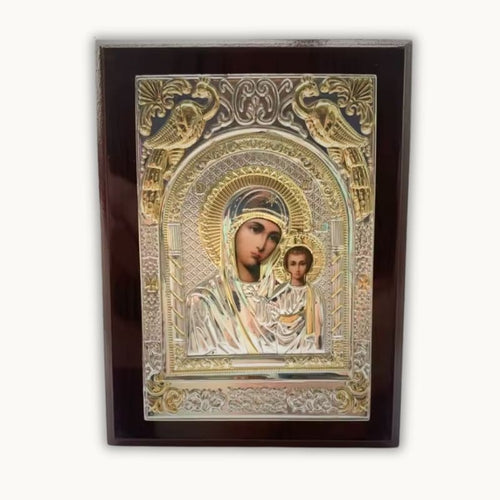
The icon of the Theotokos (the Virgin Mary, Mother of God) is traditionally placed beside the icon of Christ — to his left as you face the corner, where the Theotokos always occupies the first place after Christ. The most venerated types are the Hodigitria ("She Who Shows the Way"), the Theotokos of Vladimir, and the Theotokos of Kazan. As St Michael Tampa Bay puts it: "An icon of the Mother of God stands in every Orthodox home. Two icons make a real icon corner: Christ and His Mother. The Theotokos, on the left as you face the corner. Christ the Pantocrator, on the right."
3. Icons of patron saints
Each family member may have in the prayer corner the icon of their patron saint — the saint whose name they bear and whose feast day they celebrate as their name day. These patron saint icons are often passed down from generation to generation, blessed at baptism, and carried as invisible witnesses of the entire family's life. Their presence in the krasny ugol reminds the family that they are surrounded by a "cloud of witnesses" (Heb 12:1) interceding for them.
4. The vigil lamp
The vigil lamp (kandili in Greek; lampada in Russian) — a small oil lamp placed before the icons — is the element that gives life to the prayer corner. Its flame never goes out, or is at least lit during all prayers and vigils. It symbolises the presence of Christ, "light of the world" (John 8:12), and recalls the wise virgins of the Gospel parable whose lamps were ready at the Bridegroom's arrival. Olive oil and a small floating wick are traditional; a candle serves equally well for those new to the practice.
5. The Orthodox cross
An Orthodox cross — wall-mounted or standing — may be placed in the prayer corner or above the icons. The tradition holds that the cross should bear the figure of Christ — not be empty. Its presence at the summit of the prayer corner means that all prayer is addressed to God through the mystery of the cross and resurrection.
6. The prayer rope
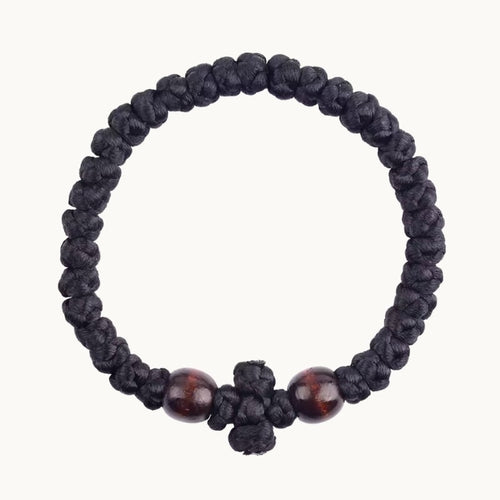
The komboskini or chotki — the knotted Orthodox prayer rope — is often hung near the icons or laid before them, recalling its primary vocation: the Jesus Prayer repeated before the icons is one of the most deeply rooted forms of prayer in the Orthodox tradition. As The Eastern Church website notes, the prayer rope "aids in reciting the Jesus Prayer, fostering hesychastic stillness." Our guide to the Orthodox prayer rope explains the practice step by step.
7. Incense and a home censer
Burning incense before the icons symbolises prayers rising to heaven — "Let my prayer rise like incense before you" (Ps 141:2). In the Orthodox home tradition, the head of household may take a hand censer after the evening prayers and cense the icons and all the members of the household — a beautiful domestic echo of the priestly censing at Vespers. A small home censer with charcoal and resin incense serves this purpose.
8. Seasonal liturgical objects
Several blessed objects received at the great liturgical feasts naturally find their place in the krasny ugol:
- Holy water (aghiasma) — blessed at Theophany (Orthodox Epiphany), kept in a small bottle in the prayer corner and used for household blessings
- Palm Sunday branches (or pussy willows, in Slavic tradition) — hung behind the icons for the whole year as a sign of protection
- The Easter egg — the first blessed red egg at Pascha is traditionally kept behind the icons for a year, as a symbol of the resurrection and household protection
- The Paschal candle — brought home from the Paschal Vigil, kept in the prayer corner and lit at important moments of family life
- Flowers from special services — Good Friday epitaphios flowers, Transfiguration grapes, Dormition herbs — kept briefly in the corner and then distributed to the birds or reverently burned when they fade
- The towel framing icons — in the Russian tradition, larger icons are framed with embroidered towels (rushnyk). This tradition is ancient and has a theological basis: it connects the icon of the Saviour with the Image Not Made By Hands (the icon of Christ's face impressed on the cloth He gave to King Abgar of Edessa)

How to Pray Before the Orthodox Prayer Corner
The prayer corner is made for living — not for decorating. It takes its meaning from daily use, from the prayer that rises within it every morning and every evening. Here is how the Orthodox Church invites us to pray before the krasny ugol:
Morning and evening prayers
The Orthodox tradition provides prayer rules for morning and evening — a set of psalms, troparia, kontakia, and prayers that form the daily canon of the lay faithful. These prayers are said standing before the icons, facing east. One begins with the sign of the cross, a prostration or bow, and the opening prayer: "In the name of the Father, and of the Son, and of the Holy Spirit. Amen." Orthodox prayer books in English — published by the OCA, ROCOR, and the Antiochian Archdiocese — provide these rules in full.
The Jesus Prayer
The Jesus Prayer — "Lord Jesus Christ, Son of God, have mercy on me, a sinner" — is the heart of Orthodox domestic prayer. It may be said before the icons, holding the prayer rope, for a number of repetitions determined by one's spiritual father or chosen freely. The gaze resting on the iconographic face of Christ during prayer is one of the richest forms of Orthodox prayer: the icon does not represent an absent person — it manifests a presence.
Veneration of icons
Prayer before the krasny ugol is traditionally accompanied by the veneration of icons: a bow, then a kiss on the icon, then another bow. This gesture — which surprises non-Orthodox visitors — expresses that the veneration is directed not to the painted image but to the person represented. As the Seventh Ecumenical Council (Nicaea II, 787) declared: "The honour paid to the image passes to its prototype."
The Prayer Corner Across Orthodox Traditions
While the krasny ugol is universal in the Orthodox Church, its form varies by national tradition:
- Russian and Slavic tradition — classic red corner in the northeast corner of the main room; icons on a small shelf or in a kivotion (icon cabinet); permanent vigil lamp; holy water, Palm Sunday branches, and Easter egg kept behind the icons. In English-speaking countries, Russian Orthodox parishes (ROCOR, OCA) maintain this tradition actively. The icon corner may grow over decades as new icons are added for the births, baptisms, and marriages of family members.
- Greek tradition — the prayer corner (ikonostasi in Greek) tends to be simpler; often one icon of Christ and one of the Theotokos with an oil lamp. Greek families frequently add icons of saints bearing the names of family members. The Greek Orthodox Archdiocese of America's parishes often display their icon corners on their websites — a helpful reference for English-speaking converts.
- Romanian tradition — painted-glass icons (icoane pe sticlă) — a Transylvanian folk art tradition — are often found alongside Byzantine-style icons in Romanian prayer corners. Romanian Orthodox communities in the UK (London, Birmingham) and the USA maintain this distinctively beautiful folk tradition.
- Serbian tradition — the prayer corner typically includes the icon of the family patron saint (Slava) — the feast of the saint inherited from the family's baptism — as well as warrior saints (St George, St Demetrios) particularly venerated in Serbian tradition.
- Antiochian / Arabic tradition — icons are often draped with richly embroidered cloths; the prayer corner is a focal point for family gatherings and for the recitation of Arabic liturgical hymns. Antiochian parishes in the US and UK often include bilingual prayer books for the home.
The Prayer Corner and the Liturgical Life of the Church
The krasny ugol is not an autonomous space, separated from the life of the Church. It is its extension into the home — a visible link between family prayer and the Divine Liturgy celebrated in church. The icons of the prayer corner echo the icons of the iconostasis; the vigil lamp of the home echoes the candles of the church; morning and evening prayer echoes the offices of Matins and Vespers. The Orthodox home is a little church, and the krasny ugol is its altar.
The great liturgical feasts renew and enrich the prayer corner through the year: Theophany holy water, Palm Sunday branches, the Paschal candle — each feast leaves a sign in the krasny ugol, making it a living liturgical calendar visible within the space of the home.
FAQ — Frequently Asked Questions about the Orthodox Prayer Corner
What is the krasny ugol?
The krasny ugol (красный угол) is the traditional prayer corner of the Orthodox home — the space reserved for icons, the vigil lamp, and liturgical objects, oriented toward the east, which serves as the place of daily family prayer. Its name means in Russian both "red corner" and "beautiful corner." It is the domestic counterpart of the iconostasis of the church, and what Metropolitan Tikhon calls the mark of the home as a "little church."
Which icon do you put first in the prayer corner?
The icon of Christ is always the first and most central — traditionally on the right as you face the corner. It is generally completed by an icon of the Theotokos on the left, and then by the patron saints of family members. Quality matters more than quantity: two or three canonical icons are worth far more than ten poor reproductions. Begin simply — and let the corner grow.
Does the prayer corner have to face east?
That is the canonical tradition — praying facing east has been the constant practice of the Orthodox Church since its origins. But in the reality of a modern apartment or house, perfect east-facing is not always achievable. The tradition is flexible on this point: the essential thing is that the prayer corner be in a visible, dignified, and dedicated place. As St Michael Tampa Bay says: "The one rule is that it be seen." The intention to orient your heart toward God matters more than the compass reading.
Can you set up an Orthodox prayer corner in a flat or apartment?
Absolutely — and this is precisely the vocation of the krasny ugol: to adapt to every living situation. A simple wall shelf, a free windowsill, or a corner of the living room can hold one or two icons and a lamp. The tradition does not require a dedicated room of several square metres — it requires a respected, clean space consecrated by regular prayer. Even a single icon and a candle on a shelf is a genuine beginning.
What do you do with the lamp when you leave home?
The lamp may be extinguished during extended absences for safety reasons — this is common and entirely acceptable. The permanent flame is a monastic ideal, not an obligation for the laity. An LED vigil light can serve as an alternative, providing continuous light without fire risk. Many English-speaking Orthodox families use these for everyday use and reserve the oil lamp for Sundays and feast days.
What prayers do you say before the Orthodox prayer corner?
The Orthodox morning and evening prayers (available in prayer books from the OCA, ROCOR, and Antiochian Archdiocese) are the foundation. The Jesus Prayer ("Lord Jesus Christ, Son of God, have mercy on me, a sinner") with the prayer rope is the simplest and deepest form. The sign of the cross, a bow, and the kiss of the icon accompany every prayer before the krasny ugol.
Should the objects in the prayer corner be blessed?
Yes — in the Orthodox tradition, icons, the cross, and the lamp are blessed by the priest when first installed, and the entire home may receive the priest's blessing (the house blessing, particularly associated with Theophany). This blessing is not a mere formality: it consecrates the space and makes it genuinely a place sanctified by the grace of God. Ask your parish priest — most will gladly come to bless a new home or a newly established prayer corner.