

Reading Time: 12 Minutes
On the night of June 28–29, 1904, thieves broke into the Convent of the Mother of God in Kazan and made off with one of the holiest icons in all of Russia. Caught a few years later, they claimed to have destroyed it after stripping away its precious gold and jeweled setting. The original was never found. More than a century later, the mystery remains unsolved — and it has never weakened devotion to this icon; if anything, it has made it more alive, carried today by more than sixty copies, several of which are themselves venerated as miraculous.
A Theft That Remains a Mystery: The Disappearance of 1904
The original Icon of Our Lady of Kazan was kept at the Convent of the Mother of God in Kazan, founded specifically to house it after its miraculous recovery in the 16th century. On the night of June 28–29, 1904, a thief named Stoyan broke into the convent and stole the icon, adorned with a rich setting of gold and precious stones accumulated from the gifts of the faithful over more than three centuries.
At his trial, Stoyan claimed to have cut up and burned the icon after removing its precious ornaments — fragments of velvet and the hinges of its case, found in the furnace of his house, appear to confirm this account. But doubt was never fully put to rest: some continue to believe the icon may have survived, hidden in a remote monastery or kept in a private collection. The Russian Orthodox Church long interpreted this disappearance as an omen of the upheavals about to strike Russia, just thirteen years before the Revolution of 1917.
Two separate episodes, often confused with one another, later reignited attention on this case. In 2004, Pope John Paul II handed over to the Moscow Patriarchate an old copy of the icon that had been kept at the Vatican since the early 20th century; it was solemnly reinstalled in Kazan in July 2005, in the presence of Patriarch Alexy II — a significant ecumenical gesture, but one that had nothing to do with the original lost in 1904. Nearly twenty years later, in 2023, Patriarch Kirill raised the possibility that an icon matching the original's characteristics had been identified — a separate announcement, met with the same caution by historians of sacred art. To this day, the mystery of 1904 remains officially unresolved.
Back to 1579: The Legend of Matrona and the Fire of Kazan
To understand why the disappearance of this icon had such resonance, one has to go back to its origin. According to tradition, an icon of the Virgin had been brought to Russia from Constantinople as early as the 13th century, before vanishing after the Tatar conquest of Kazan in 1438 — hidden, it is believed, to save it from destruction.
It remained lost for over a century, until a devastating fire ravaged the city of Kazan in 1579. A ten-year-old girl named Matrona, the daughter of an archer, had a dream in which the Mother of God showed her the exact location where her icon could be found, buried beneath the ruins of a destroyed house. The archbishop, informed by the girl, did not believe her. The dream repeated twice more; Matrona and her mother then went to the spot themselves and dug up, at a depth of about a meter, an icon wrapped in the sleeve of an old garment — intact, its colors as bright as if it had just been painted.
The archbishop, struck with remorse for his disbelief, had the icon carried in procession to the Church of Saint Nicholas. A blind man in the crowd immediately regained his sight — the first of a long series of miracles attributed to the icon. Tsar Ivan the Terrible ordered a convent built on the very site of the discovery; Matrona and her mother were the first to receive monastic tonsure there.
This detail is not incidental: in Orthodox tradition, it is not unusual for a child or a person of no particular standing to be chosen as the instrument of a revelation that even Church authorities themselves initially struggle to accept. The archbishop's initial disbelief, followed by his public repentance, remains an integral part of the account handed down for over four centuries, and is still recalled each year at the icon's two feasts.
A Distinct Icon Type: The Hodegetria of Kazan
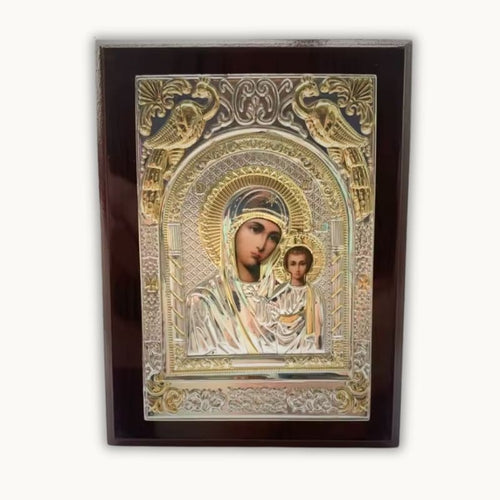
The Icon of Kazan belongs to the broader Hodegetria icon type ("she who shows the way"), but in its own distinct composition: the Virgin is shown in half-length, her face tilted slightly toward the Child, who is placed not at the center but slightly to one side, blessing with his right hand. This close, almost intimate composition stands apart from the more formal, hieratic solemnity of other Byzantine Marian types.
Specialists in Russian iconography, including the great Byzantinist Nikodim Kondakov, noted as early as the start of the 20th century that the Kazan icon constituted a variant original enough to be considered a type in its own right within the broader Hodegetria family — which is why it remains so easily recognizable among the countless depictions of the Mother of God.
Protectress of Russia: 1612 and the Great Hours of Russian History
Devotion to the Icon of Kazan took on a national dimension as early as the beginning of the 17th century, during what Russian history calls the "Time of Troubles." In 1612, a copy of the icon was carried by the Russian people's militia during the recapture of Moscow, which had been occupied by Polish forces for several years. The victory was attributed to the intercession of the Mother of God of Kazan, and a second feast was instituted in thanksgiving — which, centuries later, became Russia's National Unity Day.
This protective role did not end in the 17th century. One tradition holds that a copy of the icon was carried in procession along the fortifications of besieged Leningrad during the Second World War, to support the city's defenders. Whether this is a rigorously documented fact or a piece of popular devotion passed down through generations, it illustrates just how closely the Icon of Kazan remains bound, in the Russian Orthodox imagination, to the defense of the country in its darkest hours. This link between a Marian icon and national destiny is not unique to Russia — it is found elsewhere in the Orthodox world — but in Kazan's case it reaches a particularly remarkable intensity and historical continuity, running unbroken across four centuries of Russian history, from the Time of Troubles to the Second World War.
1812: Kutuzov, Napoleon, and the Kazan Cathedral
The most monumental episode in this history unfolds in 1812. When Napoleon invades Russia, General Mikhail Kutuzov, named commander-in-chief of the Russian armies, goes to pray before the copy of the Kazan icon kept in Saint Petersburg before setting out to confront the Grande Armée. The campaign ends in French defeat; on his return, Russia widely credits this victory to the intercession of the Mother of God of Kazan.
This link between the icon and the 1812 victory is written into stone itself: the magnificent Kazan Cathedral of Saint Petersburg, built between 1801 and 1811 on the model of Saint Peter's Basilica in Rome, had been erected specifically to house this venerated copy. In the aftermath of the victory over Napoleon, the building becomes a monument to Russian military glory: captured French army standards and the keys to seventeen conquered European cities are hung inside it, and Kutuzov himself is buried there after his death in 1813, just steps from the icon before which he had prayed. A second, older Kazan Cathedral also stands in Moscow, on Red Square — demolished under Stalin in 1936, then rebuilt identically after the fall of the Soviet Union, in 1993.
Two Feasts, Sixty Copies: The Spread of the Kazan Icon
The Icon of Kazan is honored on two separate dates of the liturgical calendar:
- July 8/21 — commemorating the icon's miraculous discovery in 1579
- October 22/November 4 — commemorating the liberation of Moscow in 1612, instituted by Tsar Michael Romanov, the first ruler of his dynasty
More than sixty copies of the original icon have been made over the centuries, some themselves considered miraculous and venerated independently at their own shrines — a pattern also seen with other great Marian icons, such as the Panagia Gorgoepikoos of Mount Athos. One such copy, of considerable artistic value, is kept at the Russian Monastery of Saint Panteleimon, discovered by anyone taking an Orthodox pilgrimage to the Holy Mountain.
How to Venerate the Icon of Kazan Today
Before an icon of Kazan, Orthodox believers follow the usual gestures of veneration — the sign of the cross, a reverent kiss on the Theotokos's hand — often accompanied by a personal prayer entrusting to her intercession whatever trials their family or country is facing, in keeping with her historic role as protectress. Such an invocation, frequently used in Russian households, can be phrased as follows:
"Most Holy Mother of God of Kazan, you who have protected our people in the darkest hours, watch over us and those dear to us, and intercede for us before your Son and our God."
This prayer is not a fixed formula: as with any Marian icon, the faithful are free to add their own words, what matters being the trust placed in the Mother of God's intercession rather than the exactness of a particular wording. An icon of Kazan naturally finds a place in the home prayer corner, alongside morning prayers. In Russian parishes, the icon's two feasts are marked by a particularly solemn Divine Liturgy, often followed by a procession.
FAQ — Frequently Asked Questions About the Icon of Kazan
What happened to the original Icon of Our Lady of Kazan?
It was stolen on the night of June 28–29, 1904, from the Convent of Kazan. The thief claimed to have destroyed it after removing its gold and jeweled setting, but the mystery of its disappearance was never definitively resolved.
Who was Matrona in the legend of the Icon of Kazan?
Matrona was a ten-year-old girl to whom the Mother of God appeared in a dream three times in 1579, showing her the exact location where her icon could be found, buried beneath the ruins of a house destroyed by fire.
Why is the Icon of Kazan called the "Protectress of Russia"?
Because a copy of the icon was carried by the Russian militia during the liberation of Moscow in 1612, a victory attributed to its intercession, and because tradition credits it with a protective role at other critical moments in Russian history, including the siege of Leningrad.
When is the Icon of Kazan celebrated?
Twice a year: on July 8/21, for the icon's discovery in 1579, and on October 22/November 4, for the liberation of Moscow in 1612 — this second date now corresponds to Russia's National Unity Day.
How many copies of the Icon of Kazan exist?
More than sixty copies have been made over the centuries, some themselves considered miraculous, including one kept at the Russian Monastery of Saint Panteleimon on Mount Athos.
What distinguishes the Icon of Kazan from other icons of the Mother of God?
Its icon type: a particular variant of the Hodegetria, in which the Virgin is shown in half-length with the Child placed slightly off-center — a close composition considered by specialists original enough to form a type in its own right.
Was the original Icon of Kazan ever found?
Not with certainty. Two separate episodes should not be confused: the 2005 return to Kazan of an old copy given by Pope John Paul II, and the later 2023 announcement by Patriarch Kirill regarding the possible identification of the original itself — an announcement met with caution by historians. The mystery of 1904 remains officially unresolved.
What is the connection between the Icon of Kazan and the 1812 war against Napoleon?
General Kutuzov prayed before a copy of the icon in Saint Petersburg before setting out to fight Napoleon; the Russian victory was attributed to its intercession. The Kazan Cathedral in Saint Petersburg, built to house this icon, later became a monument to that victory, and Kutuzov was buried inside it.