

What exactly is an Orthodox icon? Why do Orthodox Christians venerate them — and how is that veneration different from the worship due to God alone? Why is an icon "written" rather than "painted"? And what do the pervasive gold, the elongated faces, and the light that comes from nowhere actually mean? This guide explores the theology, history, and visual language of the Orthodox icon — the most characteristic sacred object of Eastern Christian tradition.
To understand the icon's central role in the Sunday service itself — from the iconostasis to the feast-day processions — our guide to the Divine Liturgy traces the place of the sacred image in the eucharistic service.
Table of Contents
- What is an icon?
- The theology of the icon: the Incarnation as foundation
- Veneration, not worship: an essential distinction
- Iconoclasm and the Triumph of Orthodoxy
- How is an icon "written"?
- The visual language of the icon
- The main types of icons
- Icons in daily life
- FAQ — Questions about Orthodox icons
What is an icon?
The word "icon" comes from the Greek eikôn (εἰκών), which simply means "image." But in Orthodox tradition, it designates something far deeper than a religious picture. Bishop Kallistos Ware, one of the most widely read Orthodox theologians writing in English, puts it clearly: "An icon is not simply a religious picture designed to arouse appropriate emotions in the beholder; it is one of the ways whereby God is revealed to us. Through icons the Orthodox Christian receives a vision of the spiritual world." An icon is a liturgical and sacramental object — a vehicle of prayer that makes present the person depicted, not an illustration with decorative or documentary value.
This means an authentic Orthodox icon is not a work of art in the way that phrase is usually understood. The iconographer does not sign the work: the protagonist of the icon is always its sacred subject, never the artist. As one parish guide puts it, icons are "theological statements painted in egg tempera and gold leaf" — not pious paintings expressing the artist's personal emotion, but a visual theology expressing the Church's received faith. The very word used matters: icons are "written," not painted, for the same reason the Gospels are written, not composed.
The theology of the icon: the Incarnation as foundation
Orthodox icon theology rests on one foundational dogma: the Incarnation. St. John of Damascus (ca. 676–749), the greatest Byzantine theologian and defender of icons, states it definitively: "When the Invisible, clothing himself with flesh, appeared visible, then you may represent the likeness of what was seen." Before the Incarnation, God was unrepresentable — no image could claim to depict him. But by becoming man in Jesus Christ, God became visible, and therefore depictable.
The icon is therefore not a human invention or a cultural convention: it is a logical and necessary consequence of Christianity's central dogma. To reject the icon is, in a real sense, to reject the Incarnation — to deny that God truly clothed himself in visible flesh. This is why the Church's victory over iconoclasm was proclaimed the "Triumph of Orthodoxy," not simply the "defense of an art form." It was a Christological battle, not an aesthetic one. As St. John of Damascus makes clear, to reject the icon of Christ is to reject his Incarnation; to venerate it is to affirm it.
The word eikôn itself appears throughout the Greek New Testament in precisely this theological context. Paul writes that Christ is "the image [eikon] of the invisible God" (Col. 1:15), and Genesis records that God created mankind "in his own image [eikon]" (Gen. 1:27). The icon doesn't introduce a new concept: it inhabits one already deep in the scriptural tradition.
Veneration, not worship: an essential distinction
The question that comes up most often, and deserves a direct answer: do Orthodox Christians worship icons? The Church's answer is no — and this isn't a rhetorical evasion. It's the hinge on which the entire theology of the icon turns.
Worship (latreia in Greek) belongs to God alone. Veneration (proskynesis) is the honor given to a person — a saint, a parent, someone loved — through the symbol or image that represents them. St. John of Damascus formulates the principle with a clarity the Seventh Ecumenical Council would make its own: "The honor given to the image passes to the prototype." What the faithful honor by bowing before an icon of Christ is not the wood and pigment — it's Christ himself, whom the image points to and makes present.
A practical comparison helps: most of us keep photos of people we love. If someone threw that photo in the trash or defaced it, we'd feel genuinely upset — not because we think the person lives inside the photograph, but because the image represents someone we love, and dishonoring the image feels like dishonoring the person. Icons work on a similar logic, except they go further: the sacred image is understood as a site of real presence, not merely affective memory. The veneration passes through the image to the person depicted, who is alive in the Kingdom of God and genuinely present wherever their image is honored.
If you've grown up in a Protestant tradition, this is probably where your deepest objection sits: doesn't the Second Commandment forbid making images? Orthodox theology has engaged this question directly since the eighth century. The command forbids making images to worship as gods — which is precisely what the Church distinguishes from venerating icons. God himself instructed Moses to make cherubim on the Ark (Exod. 25:18–22) and to embroider them on the Tabernacle curtain; the same God who gave the commandment gave these instructions, because the prohibition was against idolatry, not against sacred imagery as such.
Iconoclasm and the Triumph of Orthodoxy
The history of the icon is inseparable from a crisis that tore the Byzantine Church apart for over a century: iconoclasm — literally "image-breaking." The crisis erupts in 726 when Emperor Leo III orders the destruction of icons throughout the Empire, supported by clergy who feared icon veneration was sliding into idolatry. Thousands of icons, mosaics, and frescoes are destroyed; monks who defend the images are exiled, tortured, sometimes killed.
The Seventh Ecumenical Council, meeting at Nicaea in 787, ends the first phase by officially restoring the veneration of icons and giving the theology of veneration its definitive conciliar formulation. After a relapse under Leo V the Armenian (813–820), the crisis ends permanently. On March 11, 843, the first Sunday of Great Lent, Empress Theodora solemnly proclaims the restoration of icons — the Triumph of Orthodoxy, celebrated every year on the first Sunday of Great Lent in Orthodox churches worldwide with a solemn procession of icons through the nave. This day is a reminder that the defense of the icon was the defense of the Incarnation itself.
How is an icon "written"?
The choice of the word "written" rather than "painted" carries real theological weight. In Greek, the verb graphein covers both writing and drawing, suggesting that creating an icon resembles transmitting a text — a theological message — rather than producing a personal artistic work. The iconographer does not invent: they hand down, following precise models and canons, an image received from the Tradition. The work is never signed.
Technically, the traditional icon is made on a wooden panel, covered with layers of levkas (a mixture of chalk, marble dust, and gelatin) forming a smooth, solid surface. The design is first transferred, then layers of paint are applied progressively, from darkest to lightest tones — the method of "progressive illumination." The paint is traditionally egg tempera: mineral pigments (colored earths, lapis lazuli, malachite, cinnabar) ground by hand and mixed with an emulsion of egg yolk and white wine. This technique, unchanged since late antiquity, gives icons extraordinary durability. The whole process is accompanied by prayer: the iconographer fasts, goes to confession, and prays throughout — recognizing that what is being done exceeds purely human capacity.
The visual language of the icon
The Orthodox icon differs radically from Western religious art through several visual principles, each carrying a precise theological meaning:
- The gold background — called "light" in iconographic vocabulary, it symbolizes the uncreated light of God, the divine glory in which the figures depicted dwell. There is never an external light source in an icon: the light comes from within the figures themselves, from the divine presence that transfigures them.
- The absence of shadow — in the Kingdom of God, there is no darkness. The absence of cast shadows means the figures shown are already "in the light."
- Reverse perspective — in Western art, lines of recession converge to a vanishing point inside the picture. In an icon, they converge toward the viewer, outward. It is not the faithful person who "looks at" the icon: it is the icon that "looks at" the faithful — the person depicted turns toward them.
- Deliberately elongated proportions — the bodies are stretched, the foreheads large, the hands expressive. These are not failed attempts at realism: they are intentional, signifying the transfiguration of flesh by divine grace. Glorified bodies are no longer bound by the laws of nature.
- Inscriptions — the name of the person depicted is always written on the icon. This inscription is theologically essential: it identifies the person specifically and makes the icon a named presence, not an anonymous image. The Second Council of Nicaea stressed this point: veneration remains concrete and directed, not generalized.
The main types of icons
In Byzantine tradition, iconographic types are fixed and passed down across generations — not as arbitrary constraint, but as a common language ensuring the continuity of faith. Among the most widely encountered:
- Christ Pantocrator ("Almighty") — one of the most venerated images: Christ depicted frontally or to the waist, holding the Gospel in his left hand and blessing with his right in the standard Byzantine gesture. Two raised fingers and three folded ones signify the two natures (divine and human) and the three Persons of the Trinity.
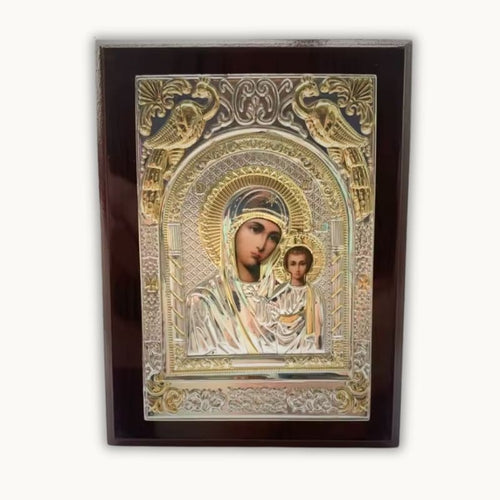
- Theotokos Hodegetria ("She who shows the way") — the Mother of God holds the Christ Child on her left arm and points to him with her right hand as the path to the Father. This type is attributed to St. Luke and is the most widespread Marian icon in the Eastern Church.
- Theotokos Eleousa ("Of tenderness") — the Theotokos's cheek rests against the Child's in an expression of infinite tenderness. The Vladimir Mother of God is the supreme masterwork of this type.
- Feast icons — each major liturgical feast has its own icon, displayed on a stand (the analogion) at the center of the church on the feast day itself.
- Andrei Rublev's Trinity — widely regarded as the absolute masterwork of Orthodox iconography, this icon depicts the three angels of Genesis 18 and synthesizes the entire Orthodox theology of the Trinity in the simplicity of three figures seated around a table.
Icons in daily life
The icon is not confined to churches. In Orthodox tradition, every household has its prayer corner (krasny ugol in Russian, literally "beautiful corner") — a space in the home, usually in the eastern corner of the main room, where one or more icons are placed and before which the family prays. This corner is the heart of the home's spiritual life: morning and evening prayers are said here, a small oil lamp (lampada) is kept burning, and this is where one turns in difficult moments.
Icons accompany the key moments of life: given at baptism, at marriage, when entering a new home. Carried in procession at major feasts. Blessed by a priest in a special service. For the Orthodox Christian, the icon is not simply a sign of faith: it is a presence — the presence of the one depicted, who intercedes and protects. The tradition expresses this simply: the icon is a window to heaven. Or as Grigorij Krug, one of the great twentieth-century iconographers, put it: "The veneration of icons in the Church is like a lamp that has been lit, whose light will never go out."
FAQ — Questions about Orthodox icons
Is venerating icons idolatry?
No, by the precise definition the Church itself gives the term. Idolatry is worshiping — giving absolute religious devotion to — something that is not God. Venerating icons means honoring, through the image, the person it depicts. The Seventh Ecumenical Council (787) defined clearly that the honor given to the image "passes to the prototype" — the person depicted, never the material object itself.
Doesn't the Second Commandment forbid this?
The commandment forbids making images to be worshiped as gods. God himself instructed Moses to make cherubim on the Ark and to embroider them on the Tabernacle curtain — the same God who gave the commandment, because the prohibition was against idolatry specifically, not against sacred imagery as such. The Seventh Ecumenical Council addressed this question definitively in 787.
Why is an icon "written" rather than "painted"?
Because the iconographer doesn't create a personal artistic work but transmits a theological message received from Tradition. They follow strict canons and models, never sign the work, and carry out the process in prayer and fasting. The verb "to write" (graphein in Greek) better reflects this posture of transmission than "to paint."
What is the "Triumph of Orthodoxy"?
The feast celebrated every year on the first Sunday of Great Lent, commemorating the final restoration of icon veneration on March 11, 843, after more than a century of iconoclast persecution. It is observed in all Orthodox churches worldwide with a solemn procession of icons, recalling that the defense of the icon was the defense of the Incarnation.
Does an icon need to be blessed before use?
In Orthodox tradition, yes — an icon is normally blessed by a priest in a special service before being venerated in a home or church. This blessing is not merely ceremonial: it officially recognizes the icon as a liturgical object rather than a decorative item. Many faithful do keep icons at home while awaiting a blessing, however, and divine grace is not strictly limited by this rite.
Is a printed icon less valid than a hand-written one?
Orthodox tradition does not exclude printed icons, provided they follow iconographic canons. What matters is not the technical process but fidelity to the model transmitted by Tradition, and the devotion with which the icon is venerated. Hand-written icons in traditional egg tempera carry a particular artistic and spiritual value and are widely preferred for significant occasions — but this is not a doctrinal requirement.
A Window to Heaven
The Orthodox icon is far more than a religious object or a support for prayer: it is the visible meeting-point between the temporal world and the eternal Kingdom, the painted confirmation of Christianity's central dogma — that God willed to make himself known not only through the word, but through matter, color, and the gaze. To contemplate an icon is less to look at an image than to be looked at by it — and through it, by the living presence of the one it depicts.
For more on the season in which the Triumph of Orthodoxy takes its most solemn place in the liturgical year, see our complete guide to Orthodox Great Lent.