

Reading time: 10 minutes
The Orthodox cross is much more than a simple religious symbol: it embodies centuries of faith, tradition, and spirituality within Eastern Christianity. With its three characteristic bars, it differs from the Latin cross (or Catholic cross) and conveys a unique symbolic richness.
For many believers, it is not merely an ornament or a liturgical object, but a true spiritual and identity marker. In this comprehensive guide, discover the historical origins of the Orthodox cross, its profound meaning, and its role in the lives of believers throughout the ages.
Presentation of the Orthodox Cross
A three-barred cross
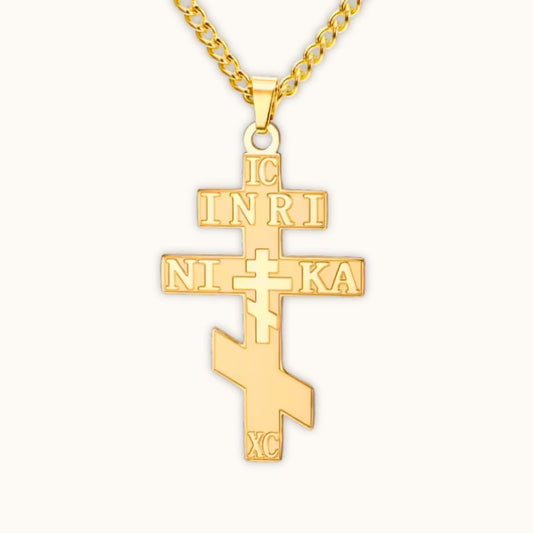
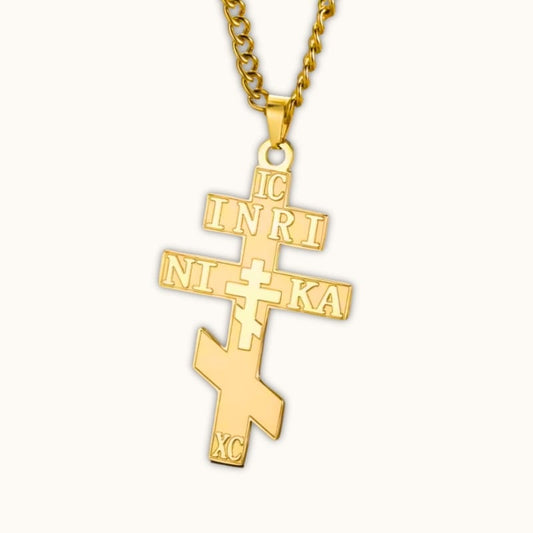
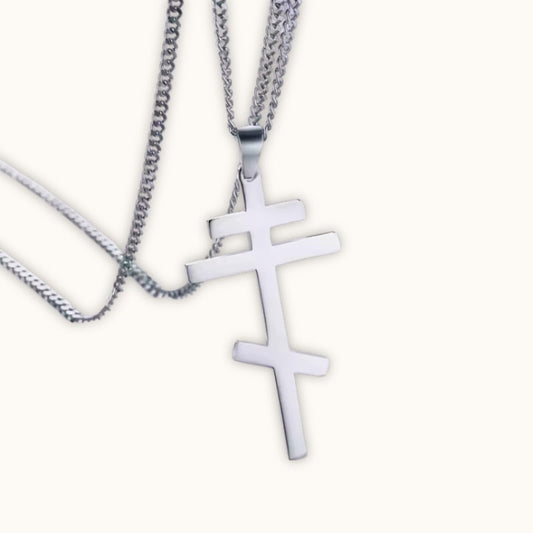
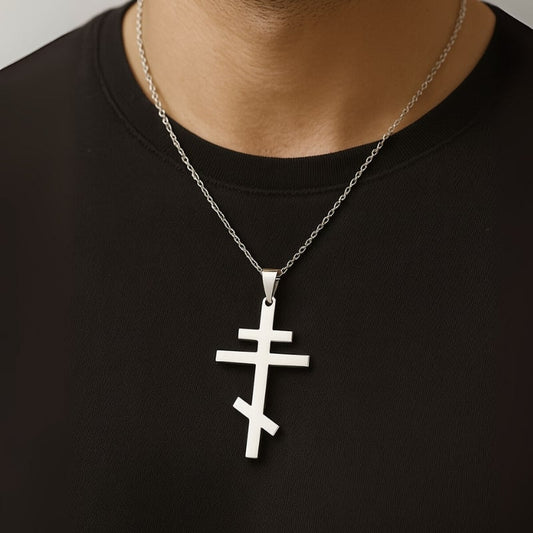
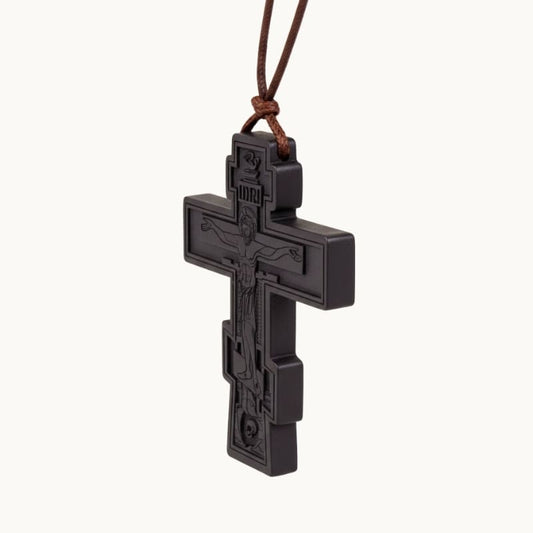
The Orthodox cross, often called the Russian cross or Byzantine cross, is distinguished by its three horizontal bars. The first, at the top, recalls the inscription "INRI" placed above Jesus during the crucifixion. The middle bar symbolizes Christ's outstretched arms in his sacrifice. Finally, the bottom bar, often angled, represents the Savior's footstool — called the suppedaneum in liturgical terminology — imbued with profound theological meaning.
This particular form, very widespread in the churches of Eastern Europe, has become one of the major symbols of the Orthodox faith. It is also known as the eight-pointed cross, since its three bars together create eight endpoints — compared to four for the simple Latin cross.
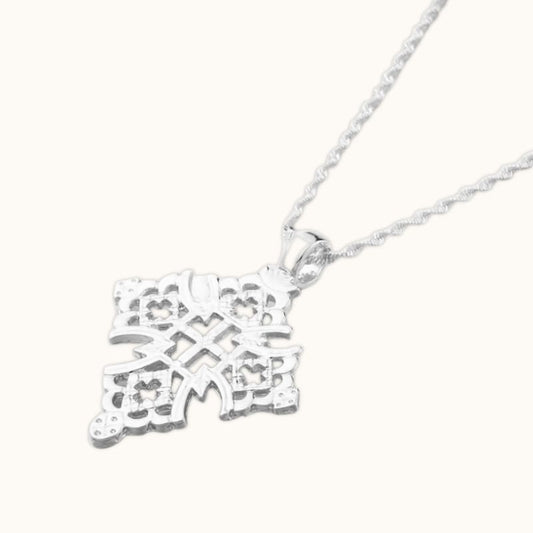
If you would like to discover authentic models, explore our collection of Orthodox crosses.
Differences with the Catholic cross
Unlike the Latin cross, which is simpler and universally known in the West, the Orthodox cross emphasizes an additional spiritual dimension. Its eight points — four ends of the central bar, two of the upper bar, and two of the lower bar — evoke the fullness and infinity of the salvation offered to the whole world, while the sloping lower bar evokes both divine justice and the choice between salvation and damnation.
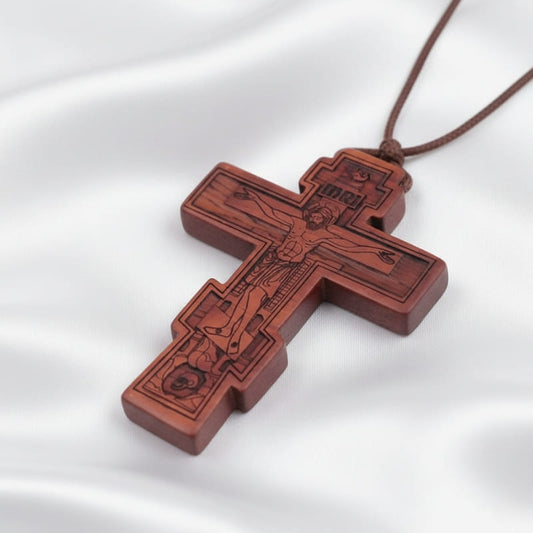
Another important distinction: in the Orthodox tradition, the crucified Christ is often depicted without a crown of thorns and nailed to the cross with four nails (one per hand and one per foot) rather than three as in Western Catholic iconography. The Orthodox tradition emphasizes the glorified, risen Christ rather than suffering alone.

The Historical Origin of the Orthodox Cross
The Byzantine and Russian era
The Orthodox cross has its roots in the Byzantine Empire, the spiritual and cultural heart of Orthodoxy. Its three-barred form stabilized around the 9th century — the period marking the end of Iconoclasm and the Triumph of Orthodoxy of 843, when the Church solemnly reaffirmed the legitimacy of sacred images, including the cross. In Russia, its adoption became firmly established from the 16th century onward, particularly during the reign of Ivan the Terrible, who sought to strengthen the Orthodox identity of his people by positioning Moscow as the "Third Rome" — the rightful heir to Constantinople. From then on, the Orthodox cross became a national as well as a religious symbol, visible on church domes, frescoes, and coats of arms.
Distribution in Europe and in Orthodox churches
With the expansion of Orthodoxy — particularly through the missionary work of Saints Cyril and Methodius among the Slavic peoples in the 11th century — the three-barred cross spread far beyond Byzantium and Russia. It can be found in Serbia, Greece, Romania, Bulgaria, and in many diaspora communities. Each local tradition has sometimes introduced variations (a straight or slanted lower bar), but all retain the same symbolic power: to recall the sacrifice of Christ and the hope of the resurrection.

The Meaning of the Orthodox Cross
The upper bar — the titulus (INRI)
The small horizontal bar at the top of the Orthodox cross recalls the inscription that Pontius Pilate had placed above Jesus during his crucifixion: INRI in Latin (Iesus Nazarenus Rex Iudaeorum), meaning "Jesus of Nazareth, King of the Jews." In the Greek tradition, the abbreviation INBI is sometimes found (from the Greek Iesous o Nazoraios o Basileus ton Ioudaion). This detail underscores that, despite the initial mockery, Christ is truly recognized as king and savior of humanity. This plaque is known as the titulus crucis in Latin liturgical terminology.
The central bar — the sacrifice of Christ
The central bar is the longest: it symbolizes the arms of Christ outstretched on the cross. It is this bar that recalls the ultimate sacrifice, unconditional love, and divine mercy. For Orthodox Christians, it is the visible sign of self-giving and redemption. To wear or contemplate an Orthodox cross is to remember at every moment the Christian hope founded on the sacrifice of the Savior.
The lower slanted bar — judgment and salvation
The bottom bar is the most striking feature of the Orthodox cross. It represents the footrest of the crucified Christ (suppedaneum). Often inclined in the Russian and Slavic tradition, it takes on a powerful symbolic dimension: the part that rises to the right evokes the salvation promised to the repentant "good thief" (Dismas), while the part that descends to the left recalls the condemnation of the unrepentant thief (Gestas). This bar thus acts as a spiritual scale, representing the eternal choice between life and damnation.
It is important to note that in the Greek tradition, this lower bar is often horizontal rather than inclined — the slant is a specificity of the Russian and Slavic tradition. This divergence shows that even within Orthodoxy, cultural sensibilities shape the visual expression of dogma without altering its foundation.
A fascinating detail often overlooked: according to tradition, the upper tip of the inclined bar always points north. An Orthodox cross placed on a church dome can thus serve as a compass.
The cross as Tree of Life and Throne of Christ
Beyond the bar-by-bar analysis, Orthodox tradition assigns the cross as a whole three fundamental meanings that transcend the historical depiction of the Passion:
- The Tree of Life — replacing the tree of sin in the Garden of Eden. Where Adam sinned, Christ redeemed; where death entered, life is restored.
- The Throne of Christ — from which He reigns over the world, victorious over death. The cross is not only the place of suffering but of victory.
- The bridge between heaven and earth — connecting God to humanity. The vertical bar unites below and above; the horizontal bar unites east and west.

The Different Types of Orthodox Crosses
The three-barred cross is not the only form of cross used in the Orthodox world. Each local tradition and each Church has developed its own variants:
The Greek cross (equal-armed cross)
The Greek cross is distinguished by its four arms of equal length, forming a perfectly symmetrical sign. Predating Christianity in its geometric form, it was adopted very early by the first Christian communities. It still serves today as the basis for many Orthodox church floor plans and is omnipresent in Byzantine architecture. As jewelry, it offers a simple and elegant alternative to the Russian cross.
The Serbian cross with four Cyrillic Cs
The Serbian cross is a cross with four equal arms, decorated with four Cyrillic letters "С" (the equivalent of the Latin S) in each of its corners. These four Cs form the acronym Само Слога Србина Спасава — "Only Unity Saves the Serbs" — both a national and a religious motto. It is one of the most immediately recognizable Orthodox crosses for its simultaneously spiritual and identity-bearing dimension.
The patriarchal cross
The patriarchal cross (or Cross of Lorraine) has two horizontal bars — the small one at the top (the titulus) and the large one in the center (the arms) — without the third slanted bar. It is used as an insignia of authority by bishops and patriarchs. Not to be confused with the three-barred cross commonly worn by laypeople.
The pectoral cross of the clergy
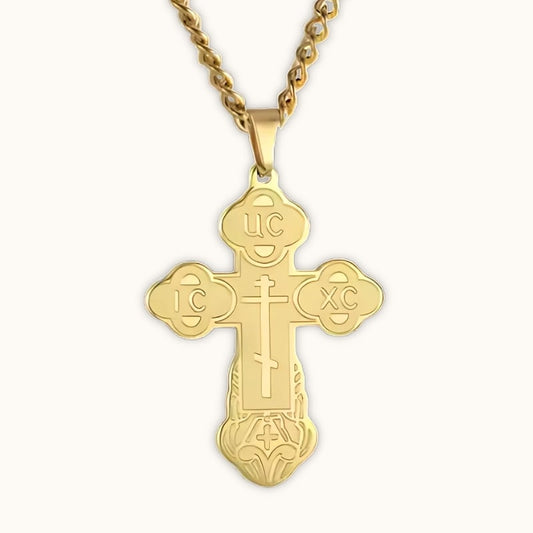
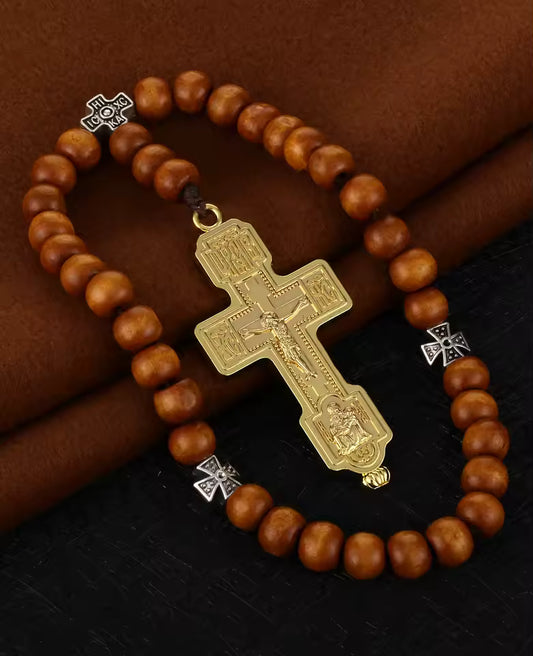
The enkolpion — the pectoral cross worn by bishops and ordained priests on their chest — is often more elaborate, adorned with enamels or stones, and may contain a relic. It is worn under the phelonion (chasuble) during the liturgy and is a sign of holy orders, distinct from the crosses worn by laypeople.
Symbol of the Orthodox Cross and Religious Use
Symbol of faith and protection
For Orthodox Christians, the cross is not merely a historical symbol; it is a true spiritual shield. Many wear it as a pendant or hang it in their homes to remind themselves of Christ's protective presence. It embodies victory over death, but also strength in adversity. In popular tradition, the Orthodox cross protects against evil, danger, and the temptations of daily life.
The sign of the cross in Orthodox tradition
One of the most practically important — and most often overlooked — aspects of the Orthodox cross is the way the Orthodox make the sign of the cross, which differs significantly from Catholic practice:
- Three fingers together — the thumb, index finger, and middle finger — symbolize the Holy Trinity (Father, Son, and Holy Spirit). The ring finger and little finger folded against the palm symbolize the two natures of Christ (divine and human).
- From right to left — the Orthodox trace the sign of the cross from top to bottom, then from right to left, unlike Catholics who go from left to right. This difference is not a minor detail: for the Orthodox Christian, crossing oneself from right to left means identifying with the crucified Christ — taking up his cross — rather than simply contemplating it from the outside.
- With a metania — often accompanied by a deep bow (metania) or a full prostration during major feasts.
The cross in the liturgy and icons
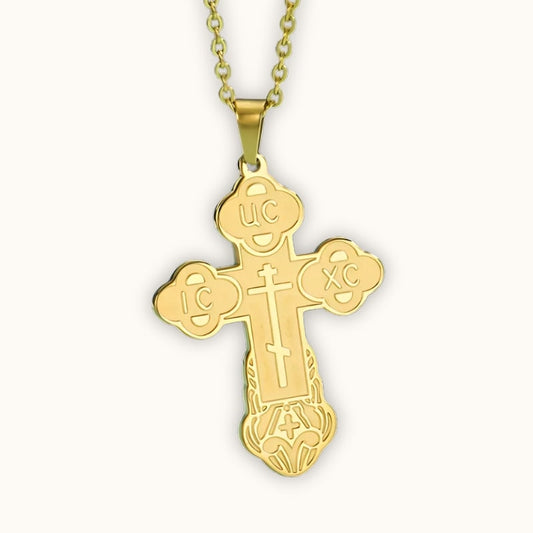
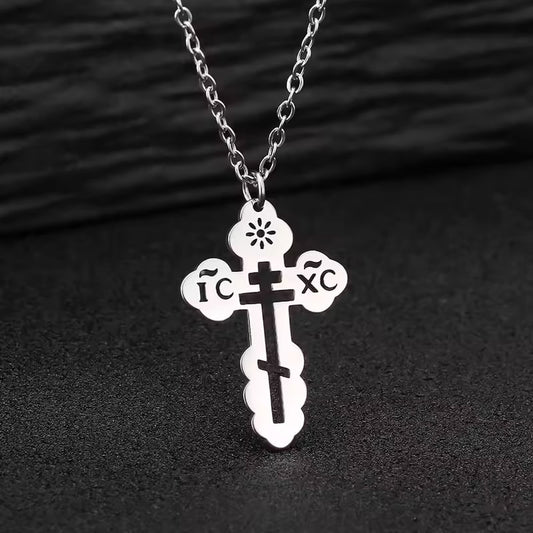
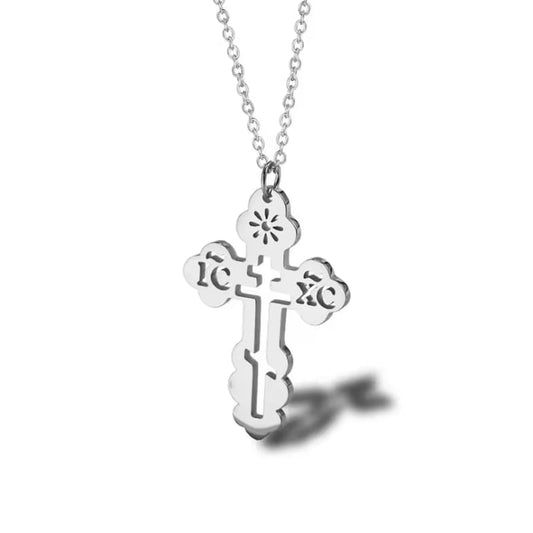
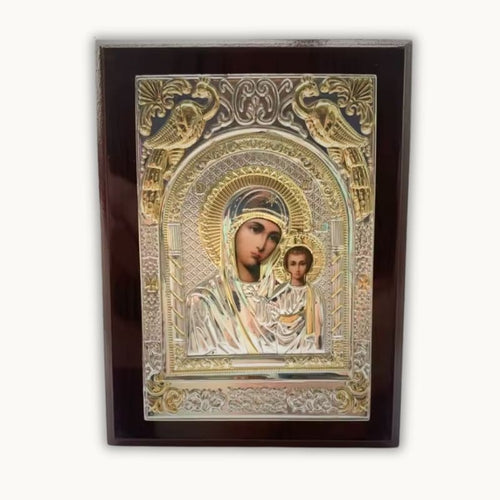
In Orthodox services, the cross holds a central place. It is venerated during processions, placed on the altar, and honored during major liturgical feasts — particularly the Exaltation of the Holy Cross on September 14, one of the Twelve Great Feasts of the Orthodox calendar. In Orthodox icons, it is often depicted with the crucified Christ or surrounded by saints. The sacred inscriptions that surround it in iconography — IC XC (Jesus Christ) and NIKA (conqueror) — recall that the cross is above all a sign of victory.

The Orthodox Cross as Jewelry
An accessory full of meaning
In the Orthodox tradition, the cross is not simply an accessory. It is a constant reminder of Christ's sacrifice and the hope it brings. As a pendant, it becomes a true portable icon, always present against the chest. More than a piece of jewelry, it is a personal protection and a sign of belonging to an age-old faith.
This is why many faithful choose to wear an Orthodox cross pendant, whether in wood, silver, or with a gold finish, as an expression of their spiritual identity.
Giving an Orthodox cross as a gift
For centuries, Orthodox cross pendants have accompanied the major milestones of Christian life: baptisms, communions, and weddings. Giving such a piece of jewelry is much more than an aesthetic gift: it is to transmit a blessing, protection, and a spiritual legacy. In Orthodox baptism, it is traditionally the godfather or godmother who gives the baptismal cross — the one the priest places around the child's neck immediately after the immersion.

Conclusion: The Orthodox Cross, a Timeless Symbol
The Orthodox cross is much more than a simple religious symbol: it embodies the history, symbolism, and faith of Eastern Christians. Its three bars recall the sacrifice of Christ and the promise of salvation, while its use in liturgy and jewelry perpetuates a thousand-year-old tradition.
Even today, it continues to inspire, protect, and unite the faithful. Whether in churches, through icons, or worn as a pendant, the Orthodox cross remains a powerful spiritual symbol. To explore the role of the sacred image in Eastern Christian tradition, our complete guide to the Orthodox icon offers a comprehensive introduction.
To discover different models and choose the one that suits you, explore our selection of Orthodox pendants and crosses.
Frequently Asked Questions about the Orthodox Cross
Why does the Orthodox cross have 3 bars?
The Orthodox cross has three horizontal bars to represent different aspects of the crucifixion. The first represents the inscription "INRI" (the titulus crucis) placed above Jesus, the second symbolizes his outstretched arms, and the third, often inclined, represents the footrest (suppedaneum). This last bar also illustrates judgment: one part turned toward the salvation of the good thief, the other toward the condemnation of the unrepentant one.
What is the difference between an Orthodox and a Catholic cross?
The Catholic cross is generally simpler, consisting of a single horizontal bar. The Orthodox cross has three bars, giving it a more detailed symbolism and a theological dimension specific to the Eastern Orthodox Churches. The Orthodox tradition also depicts Christ without a crown of thorns and with four nails rather than three. Finally, the sign of the cross is made from right to left among the Orthodox, and from left to right among Catholics.
Why do Orthodox Christians make the sign of the cross from right to left?
By making the sign of the cross from right to left, the Orthodox Christian does not contemplate the cross from the outside — they identify with it, taking the position of the crucified Christ. The three fingers held together (thumb, index, middle) symbolize the Trinity; the two fingers folded against the palm symbolize the two natures of Christ.
What is the difference between the Russian cross and the Greek cross?
The Russian cross (three-barred Orthodox cross) has an inclined lower bar symbolizing judgment. The traditional Greek cross has four arms of equal length without the third inclined bar — an older form dating back to the first centuries of Byzantine Christianity. In the modern Greek tradition, the lower bar, when present, often remains horizontal rather than inclined.
What do the four Cs on the Serbian cross mean?
The four Cyrillic letters "С" inscribed in the corners of the Serbian cross form the acronym Само Слога Србина Спасава — "Only Unity Saves the Serbs." It is both a spiritual and a national motto, making this cross a particularly strong identity symbol in the Serbian Orthodox tradition.
Is it permissible to give an Orthodox cross as a gift even if one is not Orthodox?
Yes, giving an Orthodox cross as a gift is perfectly acceptable. It is a gesture of respect and appreciation for the recipient's faith. It is often given at religious events like baptisms or communions, but can also be given as a spiritual gift — a symbol of protection and love.
How do you choose between a wooden, silver, or gold cross?
The choice depends on the use and the occasion. The wooden cross is the most traditional in its simplicity — it recalls the wood of the True Cross. Silver is the traditional metal for baptisms and family occasions. Gold is often reserved for solemn occasions or the pectoral crosses of the clergy. All materials are equally valid liturgically.