

Reading Time: 12 Minutes
There is an image in Orthodox iconography in which everything tightens around two faces. No throne, no solemn gesture of blessing, hardly any setting: one cheek against another, a small arm around a neck, a child's hand reaching for his mother's chin. And yet Mary's gaze does not smile. There is in this icon a tenderness that already knows what is coming — and it is this blend of intimacy and gravity that has made the Glykophilousa one of the best-loved Marian types in the whole Orthodox world.
What You See in the Icon: Two Faces, One Cheek, One Gaze
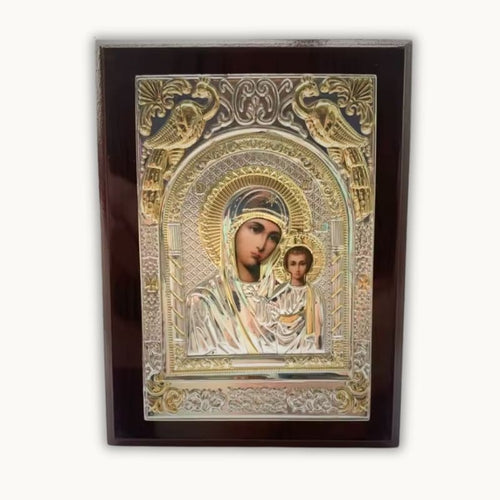
Before a Glykophilousa icon, the first instinct is to look for where the gaze lands. The Virgin is shown in bust or half-length, her head inclined, holding the Christ Child in both arms. The Child's face presses against hers; his small arm sometimes encircles his mother's neck, and in many depictions his hand reaches for the Virgin's chin. Unlike other types, the Child is not frozen in the pose of a teacher: he is a child, mobile, at times playful, nestling in.
The Glykophilousa is therefore an icon type that stages the closeness of two faces, those of the Mother of God and the infant Christ. The gaze follows a remarkably stable rule: in nearly all icons of this type, the Virgin looks at the one contemplating the image, while the Child looks at his Mother — or the two look at each other. This circulation of glances makes the icon less a portrait than a scene one is invited to witness, almost on tiptoe.
One detail will not fool anyone who knows Marian icons: as on most of them, Mary's veil, the maphorion, carries three golden stars — one on the forehead, one on each shoulder — recalling Mary's virginity before, during, and after the birth of Christ. In the midst of so human a scene, these three stars say that the young mother holding her child is also the Theotokos, the Mother of God.
The Meaning of the Name Glykophilousa: The "Sweet Kiss"
The Greek name Glykophilousa (Γλυκοφιλούσα) joins glykys, "sweet," and philousa, the participle of the verb philein, "to love, to kiss." It is translated sometimes as "She Who Kisses Sweetly," sometimes as the Virgin of the "Sweet Kiss"; in Greek art one also finds "Sweet Love," and in Russian these icons were called Sladkoye lobzaniye (Сладкое лобзанье), "the sweet kiss." German sources render it "die Zärtliche," "die süß Küssende" — the Tender One, she who kisses sweetly. In English the type is often called "Loving Kindness."
A frequent misunderstanding should be avoided: this "kiss" has nothing sentimental about it in the modern sense. In Orthodox tradition, the kiss is a gesture of communion and veneration — one kisses the icon, the cross, the Gospel. The Sweet Kiss of Mother and Child says, with the same restraint, that in the Incarnation God truly received and returned the love of a human mother.
Hodegetria, Eleousa, Glykophilousa: How to Tell Them Apart
The Glykophilousa belongs to the great family of icons of the Virgin with the Child, which Orthodox iconography divides into a few principal types. To find one's bearings, it helps to compare them:
- Hodegetria ("She Who Shows the Way") — the Virgin, frontal and rather hieratic, points to the blessing Child; the emphasis falls on the divinity of Christ. The Panagia Gorgoepikoos, for example, belongs to this type
- Eleousa ("the Merciful," "Tenderness") — the Child lays his cheek against his mother's and wraps his arm around her neck; the emphasis falls on the humanity of Christ and Mary's motherly compassion. In Russia this type is called Umileniye ("tender emotion"): the name Eleousa refers to the Mother, the name Umileniye to the Child
- Glykophilousa ("Sweet Kiss") — the most intimate variant of the Eleousa: the faces are at their closest, the Child often touches his mother's chin, and the Virgin keeps a grave or absorbed gaze
The boundary between Eleousa and Glykophilousa is a matter of degree rather than kind: many icons are classed now under one, now under the other depending on the scholar, and some authors regard the Glykophilousa as little more than a partial synonym of the Eleousa. The types also blend: the famous Virgin of Vladimir, of Constantinopolitan origin, is habitually counted among the Eleousa or Glykophilousa icons, yet also shows features of the Hodegetria. This flexibility is not a flaw in the classification — it reflects the way icon painters have always moved forms from one type to another.
The Philotheou Icon: From the Sea to the Holy Mountain
The most famous of the miraculous Glykophilousa icons is kept in the katholikon — the main church — of Philotheou Monastery on Mount Athos. Tradition traces it to the time of Iconoclasm, when Emperor Leo III had sacred images destroyed. It is said to have belonged to a pious Constantinopolitan noblewoman, Victoria, whose husband, the senator Symeon, was an iconoclast. Rather than hand the icon over, Victoria — by tradition on divine instruction — threw it into the sea.
The icon did not sink: floating upright on the waves, it drifted to the coast of Athos and came ashore at the small harbor of Philotheou Monastery. The abbot and monks, warned of its arrival by a revelation of the Mother of God, received it with honor and joy. At the spot on the shore where the icon was set down, a spring of pure water began to flow. A variant of the story says the iconoclasts had tied it to stones before throwing it into the water, without managing to sink it. Like the Iveron icon, the Glykophilousa of Philotheou is one of those images that Athonite tradition presents as saved from Iconoclasm and brought to the Holy Mountain by sea.
Several episodes have remained attached to this icon:
- The thieving monk — a drunken monk is said to have stolen the icon; the farther he walked, the heavier it became, until he collapsed with it, and the next day they were found there
- The protection of the monastery — Philotheou Monastery is said to have been built to guard this wondrous icon
- The pirates of 1801 — when pirates tried to seize the icon, their sailing ship stayed motionless in the harbor despite its taut sails, and the monks were able to keep it
- The procession on Renewal Monday — every year, on the Monday of Renewal Week, which follows Pascha, a procession and blessing with holy water take place at the spot where the spring had gushed forth
For anyone planning an Orthodox pilgrimage to the Holy Mountain, Philotheou Monastery is thus the stop where one can venerate this icon in its original sanctuary.
The Theology of Tenderness: A Mother Who Knows
Why does the Virgin, holding her child close, not smile? Because this icon is not a genre scene: it is a teaching about the Incarnation. Where the Hodegetria foregrounds the divinity of Christ, the Eleousa and the Glykophilousa foreground his humanity: the One worshiped as God needed to be carried, rocked, kissed. Saying this does not diminish Christ; it confesses that his flesh is real, that the Incarnation is no mere appearance.
Mary's face, for its part, carries the knowledge of her Son's destiny. In these icons the mother knows she is the mother of a child who will be handed over; the embrace and the cheek-to-cheek pose symbolically announce the gift of the Cross, the highest expression of Christ's love for humanity. Hence the gravity that runs through the sweetness: the tenderness is already turned toward the Passion.
Orthodox tradition finally draws a spiritual consequence: the Mother of God did not protect her people by force, but by her prayer and intercession. The tenderness of the Glykophilousa is not a weakness — it is the form in which Mary's power shows itself, a power of love that turns to God on behalf of human beings.
The Great Glykophilousa Icons Across the Schools
The type is ancient and immensely widespread: it was very popular in the late Byzantine and post-Byzantine periods, when a great number were painted, and it even circulated in the West though not of Western origin, as the Eleousa in the cathedral of Monreale in Sicily attests. Among the most remarkable examples:
- The Philotheou icon (Mount Athos) — the venerated model just discussed
- The Tzangarolas Glykofilousa (Kefalonia, 1700) — painted by Stephanos Tzangarolas of the Heptanese School in egg tempera on wood (92 × 65 cm), kept at the Monastery and Museum of Saint Andrew; the Virgin Glykofilousa is combined there with images illustrating the stanzas of the Akathist Hymn
- The Great Meteoron icon (Meteora) — a Glykophilousa limited to the closely joined faces of the Virgin and Child, whose style has been compared with icons such as the "Virgin of the Passion" attributed to Andreas Ritzos (late 15th century) and the Kuben icon in the Vologda museum (late 14th century)
- The Virgin of the Don by Theophanes the Greek (Tretyakov Gallery, Moscow) — cited as a representative of the Glykophilousa in late Byzantine art
- The Virgin of Vladimir — classed now among the Eleousa, now among the Glykophilousa, of Constantinopolitan origin (early 12th century) and in Russia one of the most venerated icons of all
This survey shows that the Glykophilousa belongs to no single region and no single era: from Crete to the Ionian Islands, from Athos to Russia, each school has taken up the same intimacy of faces and given it its own manner.
Praying Before the Glykophilousa at Home
In Orthodox tradition one does not contemplate an icon as one would a painting: one venerates it, with the sign of the cross and a reverent kiss, generally on the Theotokos's hand rather than her face. Before the Glykophilousa, whose composition centers on two faces, prayer readily takes a simple, personal form. An invocation of this kind might be phrased as follows:
"Most Holy Mother of God, Sweetly Loving, you who hold against your cheek the One who bears the world, incline your heart toward us, who are weary and troubled. You who know a mother's sorrow, intercede for us before your Son and our God."
This is not a fixed liturgical formula: as with any Marian icon, everyone is free to add their own words. An icon of the Glykophilousa finds its natural place in the home prayer corner, alongside icons of Christ and the saints, and readily accompanies morning prayers.
FAQ — Frequently Asked Questions About the Panagia Glykophilousa
What does the name Glykophilousa mean?
Glykophilousa (Γλυκοφιλούσα) means "She Who Kisses Sweetly," commonly translated as the Virgin of the "Sweet Kiss," "Sweet Love," or "Loving Kindness." The word joins glykys (sweet) and philein (to love, to kiss).
What is the difference between the Glykophilousa and the Eleousa?
The Glykophilousa is a variant of the Eleousa. In the Eleousa the Child lays his cheek against his mother's and embraces her; in the Glykophilousa the intimacy is pushed further, with the faces at their closest and often the Child's hand at the Virgin's chin. The distinction is one of degree more than kind, and many icons are classed under one or the other.
How does the Glykophilousa differ from the Hodegetria?
The Hodegetria, more frontal and solemn, points to the Child and stresses his divinity; the Glykophilousa, centered on the tenderness of the two faces, stresses the humanity of Christ and Mary's motherly compassion.
Why does the Virgin have a grave expression in this icon?
Because, according to the traditional interpretation, the Mother of God senses her Son's destiny. The tenderness of the embrace symbolically announces the gift of the Cross, which gives her gaze a gravity found in almost all icons of this type.
Where is the miraculous Glykophilousa icon located?
The most venerated icon is kept in the katholikon of Philotheou Monastery on Mount Athos, Greece. It is honored there every year on the Monday of Renewal Week with a procession and a blessing with holy water.
What does the legend of the Philotheou icon say?
It is said to have belonged to Victoria, a Constantinopolitan noblewoman at the time of Iconoclasm, who threw it into the sea rather than hand it to her iconoclast husband. The icon floated upright to the harbor of Philotheou Monastery, where a spring gushed forth at the spot where it was set down.
Is the Virgin of Vladimir a Glykophilousa?
She is habitually counted among the Eleousa or Glykophilousa icons, but also shows features of the Hodegetria. She illustrates well how fluid the boundaries between these types are.
How can you recognize a Glykophilousa icon?
By the two faces pressed cheek to cheek, the Child wrapping his arm around his mother's neck or touching her chin, the Virgin's gaze directed at the viewer, and Mary's grave expression despite the sweetness of the embrace.