

Reading time: 12 minutes
In the Orthodox tradition, the Theotokos bears many names — each revealing a different aspect of her maternal love for humanity. Gorgoepikoos is the name of urgent hope: the one you call upon when the situation allows no delay, when the prayer needs to be heard now. It is the title the Mother of God gave herself, in a vision to a monk of Mount Athos in the 17th century. And under this name — "She Who is Quick to Hear" — millions of the faithful, from Athonite monks to Orthodox families in the English-speaking diaspora, turn to her in their most pressing hours. For converts discovering the richness of Orthodox Marian devotion, the Gorgoepikoos is often the icon that makes the theology tangible: the Mother of God is not a distant figure to be admired from afar — she is an active, present, swift intercessor who hears and responds.
What is the Panagia Gorgoepikoos?
The Panagia Gorgoepikoos (Greek: Παναγία Γοργοεπήκοος) is simultaneously a title of the Theotokos, the name of a miraculous icon, and the name of several monasteries and churches dedicated to her throughout the Orthodox world. The term Gorgoepikoos (Γοργοεπήκοος) is a compound of the Greek gorgo (γοργός — quick, prompt) and epikoos (ἐπήκοος — one who hears, one who grants) — literally: «She Who Hears and Grants Quickly.»
She would hear them speedily, for her name is "Gorgoepikoos" (she who hears speedily). In the Orthodox tradition, this title is not a mere poetic metaphor — it is a direct promise of the Theotokos herself, spoken during a miracle at the Monastery of Docheiariou on Mount Athos in 1664 and recorded in the monastery's Synaxarion by Saint Nikodemos the Hagiorite. This promise extends far beyond the walls of the Athonite monastery — it is addressed to all the faithful who turn to her in their needs.
The title "Gorgoepikoos" — etymology and theological meaning
The title Gorgoepikoos expresses a deep theological reality: the intercession of the Theotokos is not passive or distant — it is active, swift, and effective. In Orthodox tradition, Mary is the Mesitria (Mediatrix) and Paraklitissa (Intercessor) par excellence — but the Gorgoepikoos adds a dimension of urgency and immediacy that distinguishes her from all other Marian titles.
The Greek word gorgo (γοργός) indicates speed but also ardour and intensity — a quickness that is not superficial but deeply engaged. The Gorgoepikoos hears prayers «quickly» not because she is in a hurry — but because she is entirely turned toward the needs of her children. Epikoos (ἐπήκοος) is the same word Homer uses for gods who hear the prayers of warriors — in the mouth of the Orthodox Theotokos, it takes on an eschatological dimension: she hears because she intercedes constantly before her Son.
Gorgoepikoos (Quick Helper) is one of the many special epithets given to the Virgin Mary in Greece, describing her power to quickly answer prayers. Where other icons of the Theotokos are associated with specific protections (the sea, travellers, the dying), the Gorgoepikoos is the Mother of God of urgency — for everything that cannot wait.
The icon of Docheiariou — history and description
In the Synaxarion of the Monastery of Docheiariou, Saint Nikodemos records that the holy icon of the Virgin Mary Gorgoepikoos was painted by the founder of the monastery, Neophytos, in the 11th century. It is therefore one of the oldest Athonite icons whose author is known — and one of the rare icons whose tradition directly links the creation to a monastery founder.
The icon is a wall fresco (not a panel icon) — painted on the outer eastern wall of the monastery's refectory, to the right of the entrance. It is a miraculous wall-painting/icon found in the Docheiariou Monastery on Mount Athos, dating to the 11th century. The Holy Virgin Mary Gorgoepikoos is known for responding quickly to prayers. This particular location — on an exterior wall, in a passageway — is at the heart of the miracle that gave it its name.
Docheiariou ranks tenth in the hierarchy of the Athonite monasteries. It houses the icon of the Virgin "Gorgoepikoos" or "She Who is Quick to Hear Prayers". This relatively high rank in the Athonite hierarchy testifies to the antiquity and prestige of this monastery, founded at the end of the 10th or beginning of the 11th century by Euthymios, a disciple of Saint Athanasios the Athonite — the founder of the Great Lavra. The name «Docheiariou» derives from the Greek docheiaris (storekeeper, keeper of provisions) — the office Euthymios held at the Great Lavra before founding his own monastery.
The miracle of 1664 — the monk Neilos and the voice of the icon
The miracle that gave the icon its title and worldwide renown took place in 1664 at the Monastery of Docheiariou. It is recounted in detail in the monastery's Synaxarion, as compiled by Saint Nikodemos the Hagiorite (1749–1809).
In 1664, the trapezares Neilos, who used to pass regularly in front of the icon holding in his hand a lighted torch which he needed for his duties in the refectory, heard a voice telling him: "Do not come past here with a torch, leaving smoke on my icon."
Neilos did not pay much attention to the voice, but it was soon heard again, imposing a punishment on the monk and leaving him blind. The sudden blindness of the monk caused great consternation in the monastery. The brothers began to show great reverence in passing before the icon and hung a perpetual lamp before it, ordering the new trapezares to burn incense before it every day.
The blind Neilos spent all his time in a stall in front of the icon, imploring the Theotokos to forgive him and heal him, and his prayer was granted when, for the third time, a voice was heard from the icon which told Neilos that his supplication had been heard, and that it was to her protection, after God, and her overshadowing guardianship that the monks should thereafter have recourse for all their needs. She would hear them speedily, for her name is "Gorgoepikoos."
This miracle contains several levels of theological significance. First, the fact that the Theotokos names herself — «my name is Gorgoepikoos» — gives the title an absolutely unique authority in the Orthodox tradition. No other title of the Theotokos was received directly from her own mouth in this way. Then, the condition of the granting: the sincere repentance of Neilos. The Gorgoepikoos hears quickly — but she hears those who pray with a contrite heart.
The chapel of the Gorgoepikoos at Docheiariou
After the 1664 miracle, the corridor where the icon stood was closed and a chapel was built dedicated to the Theotokos Gorgoepikoos. The venerable miraculous icon of Virgin Gorgoepikoos, patron of the monastery, is of considerable importance, as well as the namesake chapel dating back to 1723, which are found on either side of the refectory entrance.
The chapel, covered in frescoes from 1744, has an iconostasis crafted in 1760 by the monk Raphael from the Monastery of Simonopetra. Since the fresco is located on the west wall, a separate chapel dedicated to Theotokos Gorgoepikoos was built in 1723 on the opposite side of the corridor so that its sanctuary would face to the east. Before the icon, countless candles burn continuously. Innumerable miracles have been performed by it, and a special priest-monk, the prosmonarios attends to the needs of pilgrims.
The feast of 1 October
The Synaxis of the Most-Holy Theotokos Gorgoepikoos is commemorated on October 1. This feast is celebrated at the Monastery of Docheiariou with a solemn Liturgy and a procession of the icon through the monastery's courtyards — one of the most beautiful liturgical celebrations of the Athonite calendar.
In Orthodox parishes throughout the English-speaking world, 1 October is the occasion for singing the Akathist to the Gorgoepikoos — a hymnographic composition dedicated to this particular title of the Theotokos, available in Orthodox prayer books and through Ancient Faith Radio. The feast falls in early autumn, a natural season for new beginnings — making it an appropriate occasion for bringing any urgent petition before the Mother of God.
Places of veneration of the Gorgoepikoos in the world
The Monastery of Docheiariou — Mount Athos
This is the site of the original miraculous icon. The monastery is situated along the southwestern coast of Mount Athos, between the Monasteries of Xenophontos and Konstamonitou. Access to Mount Athos is restricted to men holding a diamonitirion (Athonite pilgrimage permit). Our guide to Orthodox pilgrimage explains how to organise this journey.
The Mikri Mitropoli in Athens — the Gorgoepikoos church
The Church of Panagia Gorgoepikoos stands as a testament to the resilience of Orthodox Christianity. This small 12th-century Byzantine church, nestled between the Metropolitan Cathedral of Athens and the Monastiraki neighbourhood, is one of the best-preserved Byzantine monuments in the Greek capital. Greeks commonly refer to it as "Μικρή Μητρόπολη" (Little Metropolis). Its exterior walls are decorated with numerous spolia — architectural elements salvaged from ancient monuments — making this church a living palimpsest of Athenian history from Antiquity to Byzantium. It is an essential stop for any Orthodox pilgrim passing through Athens.
St Tikhon's Orthodox Monastery — South Canaan, Pennsylvania
St. Tikhon's Orthodox Monastery in South Canaan, Pennsylvania also maintains a chapel dedicated to the Gorgoepikoos, making it a significant centre of Gorgoepikoos veneration in the English-speaking world. For Orthodox Christians in North America, this provides an accessible local point of pilgrimage dedicated to this title of the Theotokos.
The Gorgoepikoos Monastery in Mandra, Attica
The holy monastery of Panagia Gorgoepikoos is dedicated to the worship of the Virgin Mary, as the icon of the Most Holy Theotokos stored there is a copy of the original icon of the Virgin Mary located in the holy monastery of Docheiariou on Mount Athos. This women's monastery, founded in 1975 in the Mandra region of Attica, receives thousands of pilgrims each year — men and women alike — and is accessible to all.
How to pray before the Gorgoepikoos icon
The Orthodox tradition offers a specific prayer to the Panagia Gorgoepikoos, which can be recited before her icon in the prayer corner:
O Lady Gorgoepikoos, most glorious Lady, hear our prayers and our needs. You who are quick to hear the supplications of your servants, do not delay in coming to our aid in our necessities, you who are our hope and our refuge after God. Amen.
As with all icon veneration in the Orthodox tradition, one lights a candle before the icon, makes three prostrations (or three bows according to the liturgical season), kisses the icon, and stands in silence for a moment before expressing one's prayer. The Akathist to the Gorgoepikoos — available in Orthodox prayer books and online through the OCA and Antiochian Archdiocese websites — can be read or sung in full for the most urgent intentions.
The Gorgoepikoos icon in the Orthodox home
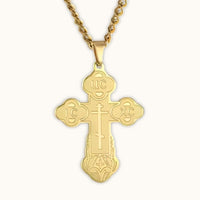
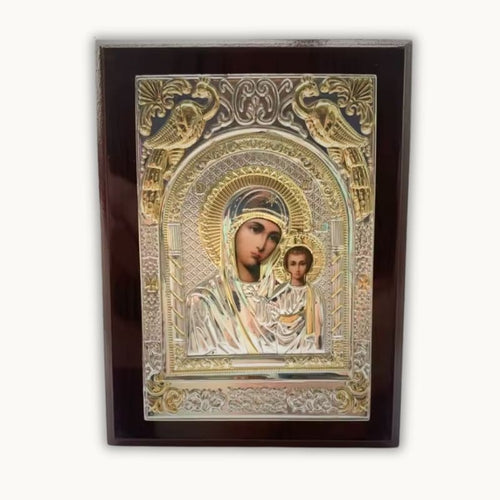
An icon of the Panagia Gorgoepikoos is one of the most sought-after Theotokos icons for the Orthodox home — particularly by families going through difficult or urgent periods. It is naturally associated with a protective pendant for those facing emergency situations.
Copies of the original Docheiariou icon — made according to traditional Byzantine iconographic techniques — are available through Athonite workshops and Orthodox iconography studios worldwide. The tradition recommends placing the Gorgoepikoos icon in the family prayer corner, alongside the icon of Christ and an icon of the family's patron saint.
FAQ — Frequently asked questions about the Panagia Gorgoepikoos
What does Gorgoepikoos mean?
Gorgoepikoos (Γοργοεπήκοος) means in Greek «She Who Hears and Grants Quickly». It is a compound of gorgo (γοργός — quick, prompt) and epikoos (ἐπήκοος — one who hears, one who grants). It is a title the Theotokos gave herself during the miracle at the Monastery of Docheiariou in 1664.
Where is the original Gorgoepikoos icon?
The original icon is a wall fresco kept in the Monastery of Docheiariou on Mount Athos (Greece). It is housed in a dedicated chapel, built in 1723, on the wall of the corridor leading to the monastery's refectory. Access to Mount Athos is restricted to men holding a diamonitirion (Athonite pilgrimage permit).
When is the feast of the Panagia Gorgoepikoos?
The Synaxis of the Panagia Gorgoepikoos is celebrated on 1 October in the Orthodox calendar. It is a special day of celebration at the Monastery of Docheiariou, with a solemn Liturgy and procession of the icon.
For what intentions does one pray to the Gorgoepikoos?
The Gorgoepikoos is invoked for all urgent needs — sudden illness, imminent danger, important decisions, situations of distress where a swift response is needed. In the Athonite tradition, she is also the protector of the Monastery of Docheiariou and of all who entrust themselves to her care. Her promise is universal: she hears quickly all those who invoke her with faith and repentance.
What is the difference between the Gorgoepikoos and the Portaitissa?
The Portaitissa («Keeper of the Gate») of the Monastery of Iviron and the Gorgoepikoos of the Monastery of Docheiariou are the two most venerated miraculous icons of Mount Athos. The Portaitissa is associated with the overall protection and guardianship of Mount Athos; the Gorgoepikoos is associated with swift intercession for the needs of the faithful. Both are medieval wall frescoes with long histories of well-documented miracles.
Can one venerate the Gorgoepikoos without going to Mount Athos?
Yes — authentic copies of the Gorgoepikoos icon are available in many Orthodox parishes worldwide. The Gorgoepikoos Monastery in Mandra (Attica, Greece) keeps a copy of the original icon and is accessible to both women and men. In North America, St Tikhon's Monastery in South Canaan, Pennsylvania also maintains a Gorgoepikoos chapel. Iconographic copies made according to traditional Athonite techniques are available through specialist Orthodox icon stores.
How is the Gorgoepikoos different from other icons of the Theotokos?
Most titles of the Theotokos were given to her by the Church — by theologians, hymnographers, and the faithful over centuries. The title Gorgoepikoos is unique in that the Theotokos gave it to herself, in a direct spoken apparition. It is not a theological description of her — it is her self-introduction: «This is who I am to you, and this is what I promise.» That directness — and the specific urgency of the promise — makes the Gorgoepikoos unlike any other icon in the Orthodox tradition.