

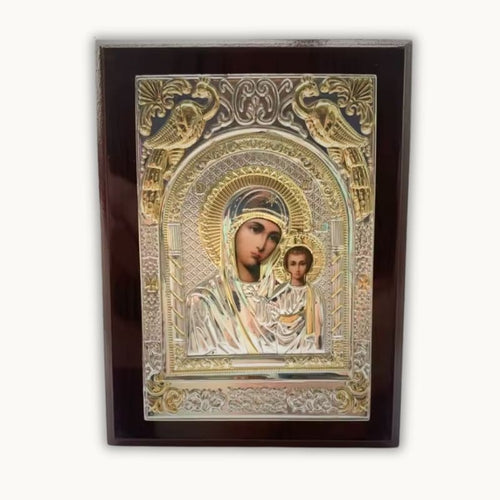

The Akathist Hymn is one of the most beloved and enduring compositions in all of Orthodox Christian worship — a poetic masterpiece dedicated to the Virgin Mary that has been chanted, studied, and translated into dozens of languages over fourteen centuries. Yet for many Orthodox Christians, and certainly for most newcomers, it remains something of a mystery: What exactly is it? When is it sung? What does the name mean? This guide answers those questions and opens up the hymn's extraordinary depth.
The Akathist belongs to the same Marian devotional current as the Feast of Pokrov, which celebrates the protection of the Theotokos over the Church. Our guide to Pokrov traces that broader tradition of Marian intercession of which the Akathist is one of the most exquisite expressions.
Table of Contents
- What does "Akathist" mean?
- Origin: a city saved, a hymn born
- Who wrote it?
- Structure: 24 stanzas, two movements
- The "Rejoice" salutations
- When is it sung?
- Beyond the Theotokos: other Akathists
- The Akathist in iconography
- FAQ — Questions about the Akathist Hymn
What does "Akathist" mean?
The word comes from the Greek akathistos — a- (without) + kathisis (sitting) — meaning literally "the unseated hymn" or "the hymn sung standing." In the Orthodox tradition, the faithful stand for virtually all services as a mark of reverence, but most hymns are technically chanted while seated in the stalls along the church walls. The Akathist is an exception: the entire congregation stands throughout its performance, without sitting at any point. This is not merely a rubrical curiosity — it is, as the ancient Synaxarion explains, a bodily expression of the extraordinary gratitude that originally gave birth to this hymn.
Origin: a city saved, a hymn born
The historical origins of the Akathist Hymn trace back to the night of June 626 AD, when Constantinople — the capital of the Byzantine Empire and the heart of the Orthodox world — was besieged simultaneously by Avar and Persian armies. The Emperor Heraclius was away on a military campaign, leaving the city's defense to Patriarch Sergios of Constantinople. The Patriarch led the population in an all-night vigil, processing with an icon of the Theotokos along the city walls while hymns were sung to the Virgin Mary. By morning, the attacking fleet had been destroyed in a storm, and the enemy armies withdrew. The survivors, standing in gratitude, sang the hymn that would bear this name ever after — the entire congregation on its feet through the night, unwilling to sit even as the hours passed.
The opening kontakion that now introduces the Akathist — "To you, the Champion Leader, we your servants dedicate a feast of victory and of thanksgiving, as ones rescued out of sufferings, O Theotokos; but as you are one with might which is invincible, from all dangers that can be do thou deliver us, that we may cry to you: Rejoice, O Unwedded Bride!" — was added at precisely this moment, as a thank-you from a city that believed it owed its survival to her intercession.
Who wrote it?
The authorship of the Akathist Hymn remains one of the great unresolved questions of Byzantine hymnography. Three names recur most often in scholarly discussion: Romanos the Melodist (6th century), regarded as the greatest Byzantine hymnographer and credited with over a thousand compositions; Patriarch Sergios of Constantinople (7th century), who led the 626 vigil; and St. Photios (9th century). The most likely picture, as most scholars now accept, is that the hymn is a composite: an older core — possibly by Romanos — that was in circulation before 626, to which the opening kontakion ("To the Champion Leader") was then added after the siege, and various hands may have refined or expanded it over the following generations. The beauty of this uncertainty is that it mirrors the hymn's own nature: a communal act of praise shaped over centuries by an entire Church, not just one poet.
Structure: 24 stanzas, two movements
The Akathist Hymn consists of an opening kontakion followed by 24 stanzas called oikoi (singular: oikos, meaning "house" in Greek), arranged in an acrostic pattern following the 24 letters of the Greek alphabet. Each oikos begins with the successive letter of the alphabet in its opening word, an ancient poetic device used to signal both completeness and artful craftsmanship.
The 24 oikoi alternate between two types, creating a rhythmic structure across the whole hymn: the longer stanzas (the odd-numbered ones) contain the famous "Rejoice" salutations (see below) and end with the refrain "Rejoice, O Unwedded Bride"; the shorter stanzas (even-numbered) are narrative or theological in content and end with the simpler exclamation "Alleluia."
The 24 oikoi are further divided into two movements of 12 stanzas each: the historical section (oikoi 1–12) narrates the events of the Annunciation, the Nativity, the visit of the Magi, the Flight into Egypt, and the Presentation in the Temple; the theological section (oikoi 13–24) meditates on the mystery of the Incarnation itself, the Virgin's role as instrument of salvation, and the profound theological paradoxes she embodies — a Virgin who bore God, a creature who carried the Creator.
The "Rejoice" salutations
The most distinctive poetic feature of the Akathist are the lists of "Rejoice" (Chaire in Greek) acclamations that fill the longer stanzas — each one a compressed theological or poetic image of the Theotokos. They come in pairs, each pair forming a kind of parallelism in the biblical tradition of the Psalms, where a single meaning is expressed in two different images. There are twelve pairs per long stanza, sixty pairs in the historical section alone. Some examples from across the hymn:
- "Rejoice, fertile field growing a bounty of mercies"
- "Rejoice, sea who drowned the invisible Pharaoh"
- "Rejoice, pillar of fire who guides those in darkness"
- "Rejoice, restoration of fallen Adam; Rejoice, redemption of the tears of Eve"
These salutations are not mere decoration — each one is a dense theological statement compressed into a single image. The images draw on the Old Testament (the burning bush, the pillar of fire, the fleece of Gideon), on the New Testament, and on the Church's patristic tradition, weaving the whole of salvation history into a sustained meditation on Mary as the pivot point between the human and the divine. Reading them carefully — or hearing them sung — is itself a form of theological formation.
When is it sung?
In most Orthodox parishes, the Akathist Hymn is sung across the first five Fridays of Great Lent, typically at a small Compline or Vespers service in the evening. The first four Fridays divide the hymn into four sections — one quarter per Friday — while the fifth Friday hears the entire hymn sung in full. This fifth Friday is formally called the Saturday of the Akathist (since liturgically the service begins on Friday evening and its feast falls on the following Saturday) and is one of the intermediate Saturdays of Great Lent with its own liturgical character.
The placement of the Akathist within the penitential framework of Great Lent is intentional and beautiful: at the midpoint of the long Lenten ascent, the Church pauses for a moment not of further austerity but of joyful praise, turning toward the one who makes the whole journey of repentance possible. The hymn's repeated refrain — "Rejoice, O Unwedded Bride" — sounds a note of genuine gladness in the midst of the Lenten fast.
Beyond this formal Lenten context, Akathist services to various saints and feasts have become common in many parishes throughout the year, particularly on the eve of a patron saint's feast or during personal times of thanksgiving or petition.
Beyond the Theotokos: other Akathists
The original Akathist Hymn to the Theotokos inspired an entire genre of liturgical poetry. From the medieval Byzantine period onward — particularly from the 14th to the 17th centuries — additional Akathists were composed dedicated to Christ, to the Holy Trinity, to individual saints, and to specific feast days. Today there are hundreds of Akathist hymns in use across the Orthodox world. The most widely sung after the original Marian Akathist include the Akathist to Jesus, the Akathist to St. Nicholas, and various national saints. All share the same structural DNA as the original — 24 stanzas, alternating long and short oikoi, the pattern of "Rejoice" salutations — making the original Akathist a kind of template for Orthodox devotional poetry.
The Akathist in iconography
The Akathist Hymn inspired one of the richest traditions of Byzantine iconographic cycles. Beginning in the Palaiologan period (14th century), icon painters and fresco artists created visual sequences illustrating the hymn's 24 stanzas, integrating them into church decoration as a visual counterpart to the sung text. These cycles are found in churches throughout Greece, Serbia, Bulgaria, Romania, and Russia. The figures of the Theotokos in these depictions often appear in the Hodegetria type — pointing toward the Christ Child — surrounded by Old Testament prophets holding scrolls inscribed with the "Rejoice" phrases. The icon of the Akathist of the Theotokos (a fresco detail from 1644 in the Church of the Deposition of the Robe in the Moscow Kremlin is among the most famous) remains one of the recognizable images of this tradition.
FAQ — Questions about the Akathist Hymn
Is the Akathist the same as a Paraklesis?
No, they are distinct services. The Paraklesis (or Supplicatory Canon) is a shorter service of petition to the Theotokos, typically sung during the Dormition Fast in August. The Akathist is a longer, more festive composition with a specific 24-stanza structure and a character of praise and thanksgiving rather than petition.
Can the Akathist be prayed privately at home?
Yes. The text is widely available in Orthodox prayer books and online. Many Orthodox Christians incorporate it into their personal rule of prayer, particularly during Great Lent. Praying it privately preserves something of its liturgical character, though the full sung experience in a parish setting remains its proper home.
Why is it always sung standing?
Standing is the normal posture of Orthodox prayer, expressing attentiveness and readiness before God. For the Akathist specifically, standing without exception recalls its origins — the all-night vigil of 626 AD when the people of Constantinople stood through the night to intercede for their city's deliverance, and refused to sit even as exhaustion came.
Is the "Akathist" a single hymn or a type of hymn?
Both. The original Akathist Hymn to the Theotokos is a specific, named composition. But "akathist" is also a genre designation for any hymn built on the same structural template. When someone says "we sang the Akathist to St. Nicholas," they mean a hymn in this specific structural form dedicated to that saint.
Does the Akathist Hymn belong to a specific Orthodox tradition or is it universal?
It originated in Byzantine Constantinople and is common to virtually all Orthodox traditions — Greek, Russian, Serbian, Romanian, Antiochian, and others — as well as Byzantine Catholic churches. It has also been translated and adapted by some Western Christian communities who admire its poetic depth. Among the Orthodox, it is one of the most genuinely pan-Orthodox elements of liturgical life.
A Crown Jewel of Orthodox Hymnography
The Akathist Hymn has been called "the crown jewel of Orthodox hymnology" — and not without reason. In twenty-four stanzas it weaves together biblical narrative, theological depth, and poetic beauty into a sustained act of praise that has nourished the Church for fourteen centuries and shows no sign of losing its power. To hear it sung in a darkened church on a Friday evening in Lent, voices rising in the "Rejoice" salutations, is to encounter something that mere literary analysis cannot quite capture — the whole Church standing, together, before the one it loves.
To understand more of the liturgical season in which the Akathist is most often heard, see our complete guide to Orthodox Great Lent.