

Reading time: 10 minutes
For English-speaking Orthodox Christians — across Greek, Antiochian, OCA, and ROCOR parishes — Saint Nektarios of Aegina is one of the great entry points into the living saints of the modern Orthodox Church. His story has all the elements of classic hagiography: a childhood of miraculous piety, a career destroyed by slander, decades of silent suffering, and a death followed immediately by miracles. But unlike the saints of the early centuries, he lived in an era we can document — his photographs exist, his handwriting survives, and people who knew him personally were still alive when he was canonised. He is a saint of our time in the most literal sense.
Who is Saint Nektarios of Aegina?
Saint Nektarios of Aegina (Greek: Ἅγιος Νεκτάριος Αἰγίνης) is a 19th–20th century Greek Orthodox bishop, born on 1 October 1846 in Selymbria (Silivri) in Thrace and reposed on 8 November 1920 in Athens. He was glorified as a saint by the Ecumenical Patriarchate of Constantinople on 20 April 1961. His liturgical feast is celebrated on 9 November.
Saint Nektarios is regarded as the wonderworker (thaumaturgos) par excellence of the contemporary Orthodox Church — a saint of our time whose miracles are attested in extraordinary numbers, particularly for cancer patients and those in spiritual distress. His civil name was Anastasios Kephalas. He is also the Archbishop of the Pentapolis and the composer of the Marian hymn Agni Parthene ("Pure Virgin") — one of the most beloved Orthodox hymns in the world. As Patristic Faith notes: "Saint Nektarios is one of the most popular saints in the Greek Orthodox world."
The life of Saint Nektarios — from Thrace to Aegina
Childhood and youth (1846–1876)
Anastasios Kephalas was born into a modest, deeply pious family on 1 October 1846 in Selymbria in Thrace, on the shores of the Sea of Marmara. From childhood he showed an intense piety and an unusual thirst for God. As a very young man he went to Constantinople to study and work — as a shop assistant, to pay for his education. He wrote letters to Jesus Christ asking for help to buy clothes to go to school — letters his employer discovered, which reveal the depth of his childhood faith.
The monk and the priest (1876–1889)
He became a teacher on the island of Chios, then a monk under the name Lazaros at the Nea Moni Monastery on Chios on 7 November 1876. Ordained deacon a year later, he obtained his theology degree in Athens. Ordained priest, he received the monastic name Nektarios. He went to Cairo, where he was appointed priest at the Church of Saint Nicholas. His reputation as preacher and confessor grew rapidly in Egypt.
Metropolitan of the Pentapolis (1889–1891)
In 1889 he was appointed Bishop-Metropolitan of the Pentapolis (in modern Libya). It is during this period that he composed the Agni Parthene and developed his deep devotion to the Theotokos. His ministry in Egypt was marked by remarkable pastoral effectiveness — but also by the growing jealousy of certain members of the local clergy.
The slander and exile from Alexandria
The most painful trial of Saint Nektarios's life — and the most revealing of his holiness — is his unjust expulsion from Alexandria. Jealous members of the Alexandrian clergy spread false accusations against him to the Patriarch of Alexandria, Sophronios IV. Without genuine investigation, he was deposed and had to leave Egypt. He returned to Greece in 1891.
The precise nature of the slanders is not fully established historically — but their effect was devastating: Nektarios found himself without a diocese, without income, without defenders, in a foreign country. He never responded to the accusations, never sought to defend himself publicly, never harboured resentment against his persecutors. This silent acceptance of injustice is regarded by the Orthodox tradition as one of the clearest signs of his holiness.
More than a century later, in 1998, the Holy Synod of the Orthodox Patriarchate of Alexandria, under Patriarch Petros VII, officially acknowledged the injustice done to Saint Nektarios. It is one of the rare occasions in Orthodox Church history where an ecclesiastical institution has formally recognised a grave error toward a saint — and represents a remarkable act of institutional repentance.
The monastery on Aegina and the final years
From 1894 to 1908, Nektarios was appointed director of the Rizarios Ecclesiastical School in Athens — a modest position for a bishop-metropolitan, but one he accepted in humility and carried out with excellence, forming generations of Greek clergy.
Nektarios harboured deep in his heart a burning love for the quiet and peace of monastic life. Between 1904 and 1907 he founded a women's monastery on the island of Aegina — the Monastery of the Holy Trinity. He spent his final years on Aegina — working in the garden dressed in a threadbare cassock, celebrating the services, spiritually directing his nuns, receiving hundreds of sick people from all over Greece who came seeking his blessing and prayers.
The death and incorruption
After a final pilgrimage to an icon of the Mother of God, he announced to his disciples his imminent departure to heaven and was transferred to a hospital in Athens, where after fifty days of suffering — which he bore with a patience that edified all who came near him — he peacefully gave his soul to God on 8 November 1920.
An extraordinary sign immediately marked his death: when the nurse removed the shirt of the deceased to dress him for burial, he placed it on the bed of a neighbouring paralysed patient — who immediately rose, healed. This was the first post-mortem miracle of Saint Nektarios.
The body of the saint remained miraculously incorrupt for more than twenty years, emitting a celestial, delicate fragrance. In 1953, when it was finally dissolved according to the laws of nature, his relics were translated — and the same fragrance was found powerfully emanating from them.
The miracles of Saint Nektarios
Saint Nektarios is one of the most miracle-active saints in the contemporary Orthodox Church. His miracles concern primarily:
- Cancer patients — Saint Nektarios is invoked as a privileged intercessor for cancer, and numerous medically inexplicable healings are attributed to him; he is the Orthodox saint most associated with cancer healing in English-speaking communities
- Paralysis and chronic illness — beginning with the paralytic healed at his death
- Mental illness and demonic oppression — Saint Nektarios is renowned for his power against demonic influences
- Job seekers and the poor — his patronage of the poor and unemployed is deeply rooted in his own experience of poverty and humiliation
His tomb at the Monastery of the Holy Trinity on Aegina is one of the most visited Orthodox pilgrimage sites in Greece. The OCA notes that the monastery on Aegina "has become a major pilgrimage centre, especially for those suffering from cancer."
The canonisation of 1961
His holy relics were elevated on 3 September 1953, and on 20 April 1961, by act of the Ecumenical Patriarchate, he was proclaimed a saint of the Orthodox Church. His feast was set on 9 November — the day after his repose (8 November), since 8 November is already the feast of the Synaxis of Archangel Michael.
The speed of his canonisation — less than 41 years after his death — testifies to the strength and unanimity of popular veneration. In 1998, the Patriarchate of Alexandria formally acknowledged the injustice done to him — completing the full rehabilitation of a man the institution had once gravely wronged. For English-speaking converts, this detail resonates powerfully: a church institution acknowledging its error toward one of its own bishops is an act of transparency rare in any Christian tradition.
Saint Nektarios and the Agni Parthene hymn
Saint Nektarios is the composer of the hymn Agni Parthene (Ἁγνὴ Παρθένε — "Pure Virgin"), one of the most beloved Orthodox hymns in the world. Composed during his time in Egypt, probably around 1890, this hymn in classical Greek celebrates the Theotokos with incomparable poetic and musical beauty.
Saint Nektarios, marked by trials and persecution, found in the Virgin Mary a spiritual refuge and an inexhaustible source of comfort. The Agni Parthene is sung in Orthodox monasteries throughout the world, in many languages. In the English-speaking world, it has been recorded by Ancient Faith Radio, by numerous monastic communities, and has been performed at major Orthodox and ecumenical gatherings. It is frequently the first Orthodox hymn encountered by converts — and it often plays a decisive role in their journey toward the Orthodox faith.
The icon of Saint Nektarios
Saint Nektarios is depicted in Orthodox iconography in episcopal vestments — sakkos (ornate tunic), omophorion (liturgical stole), with an episcopal crown — holding the Gospel in one hand and blessing with the other. His face is gentle, slightly bearded, with a gaze of deep compassion. Photographs of Saint Nektarios taken during his lifetime survive — making him one of the very few Orthodox saints whose actual physical appearance is known to us.
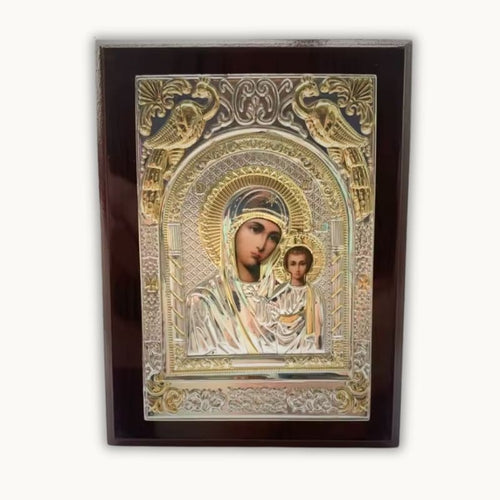
An icon of Saint Nektarios is one of the most requested among icons of modern saints — by the sick seeking his powerful intercession, by faithful bearing the name Nektarios, and by all who seek a saint close to our time. It can be placed in the prayer corner of the home. His feast on 9 November is the great name day for all who bear this name, as our guide to Orthodox name days explains.
FAQ — Frequently asked questions about Saint Nektarios of Aegina
Who is Saint Nektarios of Aegina?
Saint Nektarios of Aegina (1846–1920) is a Greek Orthodox bishop, Archbishop of the Pentapolis, wonderworker and composer of the Agni Parthene hymn. Born in Thrace to a poor family, unjustly expelled from Alexandria through slander, he ended his life on the island of Aegina where he founded a women's monastery. He reposed on 8 November 1920 after 50 days of suffering. Canonised in 1961, he is one of the most venerated saints of the contemporary Orthodox Church.
When is the feast of Saint Nektarios?
The feast of Saint Nektarios of Aegina is celebrated on 9 November — the day after his repose (8 November 1920), since 8 November is already the feast of Archangel Michael.
Why was Saint Nektarios expelled from Alexandria?
Saint Nektarios was expelled from Alexandria through slanders spread by jealous members of the Alexandrian clergy to Patriarch Sophronios IV. In 1998, the Patriarchate of Alexandria officially acknowledged this injustice. Saint Nektarios never sought to defend himself publicly and harboured no resentment — which the Orthodox tradition regards as a major sign of his holiness.
What miracles does Saint Nektarios work?
Saint Nektarios is particularly invoked for healing of cancer, paralysis and chronic illness, mental illness, and protection against demonic influences. He is also the patron of the poor and unemployed. Miracles are attributed to him daily by witnesses worldwide. The OCA specifically notes his monastery as a pilgrimage centre for those suffering from cancer.
Where is the tomb of Saint Nektarios?
The tomb of Saint Nektarios is at the Monastery of the Holy Trinity on the island of Aegina (Greece), the monastery he himself founded. It is one of the most visited Orthodox pilgrimage sites in Greece, receiving tens of thousands of pilgrims each year, especially around 9 November.
What is the Agni Parthene hymn?
The Agni Parthene ("Pure Virgin") is a Marian hymn composed by Saint Nektarios during his time in Egypt, around 1890. Written in classical Greek, it celebrates the Theotokos with incomparable poetic beauty and is sung in Orthodox monasteries worldwide. In the English-speaking world it is available through Ancient Faith Radio and many monastic recordings, and is frequently the first Orthodox hymn encountered by people on the path toward Orthodoxy.