

Reading time: 10 minutes
In the Orthodox liturgical calendar, saints are generally celebrated on the day of their death — their "birth into heaven." But there are three exceptions: Christ, the Theotokos — and Saint John the Baptist. These three persons are so closely bound to the mystery of salvation that the Orthodox Church celebrates their conception, their nativity, and their death. For John the Baptist, three further feasts for the finding of his head are added — making him the most-celebrated saint in the Orthodox calendar after Christ and the Virgin.
Who is Saint John the Baptist in the Orthodox tradition?
Saint John the Baptist (Greek: Ἅγιος Ἰωάννης ὁ Πρόδρομος) is the last prophet of the Old Testament and the first witness of Christ in the New. Son of the priest Zacharias and Elizabeth — a kinswoman of the Virgin Mary — he is miraculously conceived of elderly, barren parents, announced by the Archangel Gabriel six months before the Annunciation to Mary.
Christ himself gave him the highest possible testimony: "Truly I say to you: among those born of women there has arisen no one greater than John the Baptist" (Mt 11:11). Yet Christ immediately adds: "But the one who is least in the kingdom of heaven is greater than he." This paradox is at the heart of John's role: the greatest of the Old Covenant, the first of the New — the bridge between the two Testaments, living on both sides of the doorway of salvation.
For English-speaking Orthodox Christians — across Greek, Antiochian, OCA, and ROCOR parishes in the USA, UK, Canada, and Australia — Saint John the Baptist is one of the most personally familiar saints. His story is told in all four Gospels. His name remains one of the most common names in the English-speaking world (John, Jonathan, Joan, Jean, Jane, Janet, Jack — all ultimately derived from the Hebrew Yohanan). And his feast of 24 June coincides with the ancient English Midsummer, giving his veneration a cultural resonance unique to English-speaking countries.
The Orthodox titles of Saint John the Baptist
- Prodromos (πρόδρομος — Forerunner) — his principal Orthodox title. It comes from the Greek prodromos: "one who runs ahead." John is the Forerunner of Christ — he precedes him in preaching, in baptism, and in death.
- Prophet — the last and greatest of the Old Testament prophets, fulfilling the prophecy of Malachi: "Behold, I send my messenger before your face, who will prepare your way before you" (Mal 3:1; Mt 11:10).
- Baptist — the one who baptised Christ in the Jordan, accomplishing the revelation of the Trinity: the voice of the Father, the Son in the water, the Holy Spirit in the form of a dove.
- Angel of the Desert — sometimes depicted in Orthodox iconography with angel's wings, emphasising his angelic life in the solitude of the wilderness.
The life of Saint John the Baptist
The annunciation and miraculous birth
The Archangel Gabriel announces to Zacharias, a priest of the Jerusalem Temple, that he will have a son despite his advanced age and Elizabeth's barrenness. Zacharias doubts — and is struck dumb until the birth of the child. When Mary visits Elizabeth, John "leaped in her womb for joy" (Lk 1:44) — the first recognition of the Messiah, while both children are still in their mothers' wombs.
Life in the wilderness
From his youth, John withdrew into the Judean wilderness — "his clothing was made of camel's hair with a leather belt around his waist, and his food was locusts and wild honey" (Mt 3:4). He spent decades there in total ascesis, prayer, and fasting. The Orthodox tradition sees him as the spiritual founder of Christian monasticism — before the Desert Fathers, before St Anthony, he was the first monk.
The baptism of Christ
John's preaching at the Jordan drew crowds from all Judea. When Jesus came to be baptised, John refused at first: "I need to be baptised by you, and do you come to me?" (Mt 3:14). The baptism of Christ revealed the Trinity — it is the foundation of the Orthodox feast of Theophany (6 January). John is the human instrument of that revelation.
The imprisonment
John publicly rebuked King Herod Antipas for his adulterous marriage to Herodias, the wife of his brother. Herodias pressed Herod to imprison John in the fortress of Machaerus, beyond the Jordan. From prison, John sent disciples to ask Jesus: "Are you the one who is to come, or shall we look for another?" (Mt 11:3) — a question that is not one of doubt, but catechesis for his disciples.
The Beheading — martyrdom and meaning
At Herod's birthday banquet, Salome — daughter of Herodias — danced before the guests. Herod, drunk, promised her whatever she asked. On her mother's advice, Salome demanded: "Give me here, on a plate, the head of John the Baptist." (Mt 14:8). Despite his regret, Herod kept his oath. John was beheaded in his cell.
The feast of the Beheading of John the Baptist (29 August) is a day of strict fasting in the Orthodox calendar — one of the few fasting days connected to a saint rather than to repentance. No meat, fish, oil, or wine is consumed. This fast expresses the Church's mourning for the death of the Forerunner, and a symbolic refusal to participate in the debauchery of Herod's banquet.
The Orthodox tradition sees in John's death a foreshadowing of Christ's Passion: just as John preceded Christ in preaching and baptism, he precedes him in death — descending into the realm of the dead to announce to the righteous the coming of the Messiah. John the Forerunner goes before Christ even through death's door.
The six Orthodox feasts of Saint John the Baptist
- 23 September — Conception of Saint John the Forerunner (announcement to Zacharias)
- 7 January — Synaxis of the Holy Forerunner and Baptist John (principal feast, the day after Theophany)
- 24 February — First and second finding of the head of Saint John
- 25 May — Third finding of the head of Saint John
- 24 June — Nativity of the Holy Forerunner and Baptist John (Midsummer / St John's Day)
- 29 August — Beheading of the Holy Forerunner and Baptist John (strict fast day)
The feast of 24 June deserves particular attention in the English-speaking context. It is one of the rarest feast-types in the Orthodox calendar — a saint's feast celebrated on the day of birth rather than death, because John was sanctified from his mother's womb. In the British Isles, this date has been known since Anglo-Saxon times as Midsummer or St John's Eve — one of the four great quarter-days of the English calendar (alongside Christmas, Lady Day, and Michaelmas). The bonfires of St John's Eve, still lit in many English, Welsh, and Irish communities today, are ancient pre-Christian Midsummer fires that were Christianised through the feast of John the Baptist — exactly as the Orthodox liturgical tradition absorbed and sanctified the natural human celebration of the summer solstice.
The three findings of the head of Saint John the Baptist
The head of Saint John the Baptist is one of the most venerated relics in all of Christianity — and its history is marked by miraculous rediscoveries that gave rise to three separate feasts.
First and second finding (24 February)
After the beheading, Herodias had hidden the head to prevent it from being reunited with the body. In the 4th century, during the reign of Constantine, the head was found twice in the region of Jerusalem — hence the joint commemoration of the first two findings on 24 February.
Third finding (25 May)
The third finding occurred in Constantinople in the 9th century, during the reign of Empress Theodora. The head was found in the city of Comana in Cappadocia during renovations and brought to Constantinople.
Relics of Saint John the Baptist are scattered across the Orthodox world. His right hand — the hand that baptised Christ — was transferred from Malta to Gatchina (Russia) in 1799, under Tsar Paul I, and is commemorated on 12 October in the Russian Orthodox calendar. His left hand is venerated at the Topkapi Palace Museum in Istanbul, and various other relics are held at the Monastery of Saint John the Baptist in Sourozh (UK) and other locations across the Orthodox diaspora.
John the Baptist and the origins of Orthodox monasticism
The Orthodox tradition regards Saint John the Baptist as the spiritual forerunner of Christian monasticism. Long before St Anthony of Egypt, John inaugurated the monastic way of life: solitude in the wilderness, extreme ascesis, unceasing prayer, total detachment from the world. Our guide to Orthodox monasticism shows how the entire Eastern monastic tradition looks back to John's example in the desert as its founding pattern.
Orthodox monasteries frequently bear the name of Saint John the Baptist — including communities on Mount Athos, in Jerusalem, and the Monastery of Saint John the Baptist in Essex, England — one of the most important Orthodox monasteries in the English-speaking world, founded by Archimandrite Sophrony Sakharov, a disciple of St Silouan the Athonite.
The icon of Saint John the Baptist
- The Forerunner in prophet's garb — clothed in a camel-hair mantle, holding a scroll with his words and a bowl containing his own head — a symbol of his beheading. This is the most common form in personal devotional icons.
- The Angel of the Desert (Ἄγγελος Ἐρήμου) — with angel's wings, emphasising his angelic life of ascesis. This depiction is widespread in late Byzantine and Russian iconography.
- The Deisis — John the Baptist intercedes to the right of Christ (left as viewed), symmetrical to the Theotokos. The Deisis is the iconographic composition of intercession par excellence, found above the iconostasis in virtually every Orthodox church.
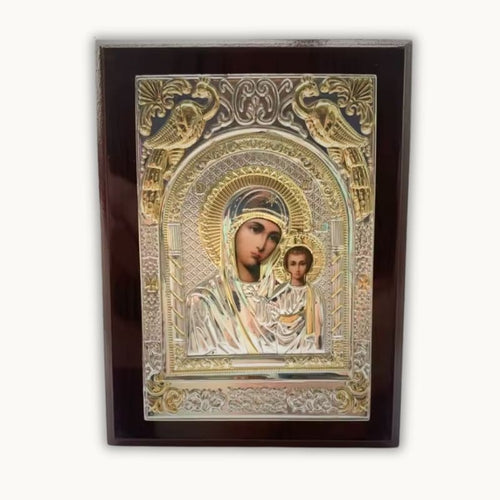
The Orthodox icon of Saint John the Baptist in Byzantine style available in our store depicts the Forerunner in the classical iconographic tradition — ideal for the prayer corner or as a name day gift for those bearing the name John, Jonathan, Joan, Ivan, or Yannis.
FAQ — Frequently asked questions about Orthodox Saint John the Baptist
What is the Prodromos in Orthodoxy?
Prodromos (πρόδρομος — Forerunner) is the principal Orthodox title of Saint John the Baptist. It means "one who runs ahead" — John precedes Christ in preaching, baptism, and death. He is the living bridge between the Old and New Covenants.
How many feasts does Saint John the Baptist have in the Orthodox calendar?
Saint John the Baptist has six feasts: 23 September (conception), 7 January (principal Synaxis), 24 February (1st and 2nd finding of the head), 25 May (3rd finding of the head), 24 June (nativity/Midsummer) and 29 August (beheading). Along with Christ and the Theotokos, he is one of only three persons celebrated for conception, nativity, and death.
Why is 29 August a strict fast day?
The feast of the Beheading of Saint John the Baptist (29 August) is a strict fast day in the Orthodox calendar. This fast expresses the Church's mourning for the death of the Forerunner and a symbolic refusal to participate in the debauchery of Herod's banquet. No meat, fish, oil, or wine is consumed.
What is the connection between St John the Baptist and Midsummer?
The feast of the Nativity of Saint John the Baptist (24 June) falls at the summer solstice — six months before Christmas (the Nativity of Christ). In Britain and Ireland, this date has been celebrated as Midsummer or St John's Eve since Anglo-Saxon times. The bonfires of Midsummer Eve are ancient solstice fires that were Christianised through John's feast. For Orthodox Christians in the English-speaking world, this feast carries a unique double resonance: deeply liturgical and deeply embedded in local cultural tradition.
What is the Deisis?
The Deisis (Δέησις — supplication) is the central iconographic composition of the Byzantine tradition: Christ Pantokrator in the centre, the Theotokos to his right (left as viewed) and Saint John the Baptist to his left. Both intercede before Christ for humanity. The Deisis is found above the iconostasis in virtually every Orthodox church and represents the intercession of the saints for the world.
Is there an Orthodox monastery of Saint John the Baptist in the English-speaking world?
Yes — the Monastery of Saint John the Baptist in Tolleshunt Knights, Essex (England) is one of the most significant Orthodox monasteries in the English-speaking world. Founded by Archimandrite Sophrony Sakharov (1896–1993) — a disciple of Saint Silouan the Athonite — it remains an active monastic community and spiritual centre for Orthodox Christians across Britain and beyond.