

Reading Time: 11 Minutes
A young man walks into a monastery church on Mount Athos one day. He approaches a small icon to venerate it, as countless pilgrims before him had done. What happens next will shape, though he cannot know it yet, the devotion of thousands of Orthodox families who will face the same fear decades later: the fear of illness. This is where the story of the Panagia Pantanassa has to begin — an icon whose reputation was never built by decree, but testimony after testimony.
A Miracle That Changed Everything: One Young Man's Conversion
The story takes place at Vatopedi Monastery, one of twenty monasteries on the monastic peninsula of Mount Athos. A young man from Cyprus, visiting the monastery, approaches a small portable icon of the Virgin to venerate it as custom required. Abbot Joseph of Vatopedi, witnessing the scene, sees the face of the Theotokos suddenly flash with light, while an unseen force throws the young man to the ground.
Once he comes to his senses, he confesses in tears that he had been living far from God and had been involved in occult practices. Shaken by what he had just experienced, he changes his life completely and becomes a practicing Christian. This founding account, handed down by the fathers of the monastery, marks the beginning of the particular veneration given to this icon ever since — not simply as an object of piety, but as a tangible sign of the Mother of God's intervention in the lives of those who turn to her.
Anyone familiar with Athonite tradition will recognize the shape of this story: episodes like it are not unusual on the Holy Mountain, where nearly every monastery keeps similar accounts tied to its most venerated icons. What makes the Pantanassa's story distinctive is less the event itself than what followed it over the following decades. Only with time, as further testimonies accumulated, did the Panagia Pantanassa reveal the trait that defines it most clearly today: its particular grace for those suffering from cancer.
For pilgrims hearing this story for the first time, it can sound at first like one of many similar accounts told at nearly every shrine on Athos. What sets it apart is the sheer consistency with which further testimonies have gathered around this particular icon ever since — not a single, isolated event, but an ongoing pattern that has repeated and deepened across decades.
The Panagia Pantanassa, "Queen of All" of Vatopedi
The Greek name Pantanassa (Παντάνασσα) combines pan (παν), "all," and anassa (άνασσα), "sovereign" or "queen." The title translates literally as "Queen of All" or "All-Sovereign" — royal language also found in other Byzantine Marian titles such as Basilissa ("Empress") or Despoina ("Sovereign Lady"). This vocabulary is never purely honorific in Orthodox tradition: it expresses the conviction that Mary, as Mother of the One who is King of the universe, herself exercises a form of spiritual sovereignty — not through domination, but through intercession and compassion toward those who suffer.
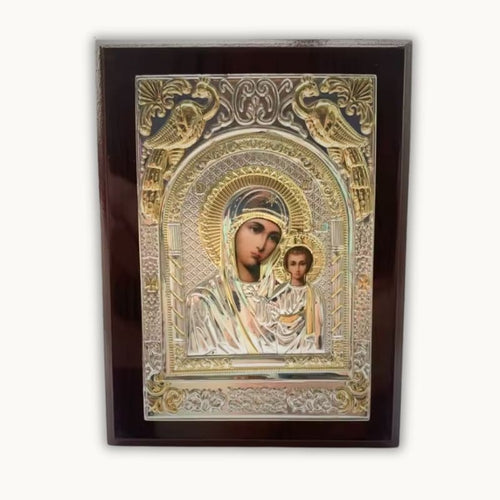
The icon itself, painted in the 17th century in the classic Byzantine style, depicts the Theotokos enthroned, holding the Christ Child. It was originally kept at the Nea Skete, a small community under Saint Paul's Monastery, before being transferred to Vatopedi in 1987 by Abbot Joseph, spiritual disciple of Elder Joseph the Hesychast, one of the leading figures of the 20th-century Athonite monastic revival. Since then it has been kept in a shrine to the left of the northeastern pillar of the katholikon, the monastery's main church.
This particular reputation places the Pantanassa alongside other Marian icons of Athos known for their concrete intervention in the lives of the faithful, such as the Panagia Gorgoepikoos, known for the swiftness of her intercession. Over the centuries, nearly every Athonite monastery has developed its own particular relationship with a specific icon of the Theotokos — something anyone who takes an Orthodox pilgrimage to the Holy Mountain tends to discover firsthand, monastery by monastery.
Why This Icon Is Associated With Healing From Cancer
Shortly after the incident with the young man, the monks of Vatopedi began to notice a separate phenomenon: a growing number of people with cancer reported an improvement in their condition, or a deep sense of peace, after praying before the icon or having the Paraklesis, the supplicatory service to the Mother of God, said on their behalf. This reputation built gradually, carried by the direct testimony of the families involved rather than by any official declaration.
It is worth saying this carefully: Orthodox tradition has never presented this icon as a substitute for medical treatment, but as a place of prayer and intercession, where the sick and their loved ones can lay down a suffering that often exceeds their own strength. Many monasteries and parishes throughout the Orthodox world now hold regular supplicatory services before a copy of the icon, specifically for the sick and their families.
What stands out in the testimonies gathered by the monks of Vatopedi is their variety: some speak of a profound sense of peace on beginning treatment, others of an unexpected recovery, still others simply of finding the strength to get through a trial that had seemed insurmountable. Orthodox tradition never tries to classify these experiences or guarantee their repetition — it receives them as signs of the Mother of God's presence among those who suffer, without turning them into proof or demonstration.
From Athos to Moscow: A Grace That Travels
The Panagia Pantanassa's reputation quickly spread beyond Greece. At the request of the Patriarch of Moscow, two exact copies of the Vatopedi icon were sent to Russia: one is now kept at the Church of All Saints in Krasnoye Selo, Moscow, the other at the Monastery of the Transfiguration of the Savior in Novospasskoye. These Russian copies have, in turn, produced numerous testimonies of graces received, particularly among children treated at pediatric oncology centers.
Beyond Russia, copies of the icon are found today in Orthodox parishes around the world, from the United States to Australia, each one becoming, in its own right, a place of prayer for the sick of its local community. This rapid spread illustrates a characteristic feature of wonderworking icons in Orthodox tradition: their grace is never considered bound to a single physical original, but carried forward through every faithfully made and faithfully venerated copy.
This expansion is also connected to the icon's own feast, celebrated every year on September 24 at the dependency Vatopedi Monastery holds at Porto Lagos, in Greek Thrace. According to local tradition, during the period of Ottoman rule, a local bey is said to have asked a hermit living near Porto Lagos to heal his sick daughter; once the healing was granted, the bey wished to show his gratitude by giving the hermit land, giving rise to the dependency that still belongs to Vatopedi today. On this day, large numbers of the faithful travel there for a solemn Liturgy followed by a procession.
The Paraklesis: How the Panagia Pantanassa Is Prayed Today
The preferred prayer before this icon remains the Paraklesis, sung or read in full in many parishes on days set aside for prayer for the sick. It is a short liturgical canon of nine odes addressed to the Theotokos as intercessor before God for every need — not a text written specifically for the Pantanassa, but the Marian prayer par excellence with which this icon has naturally come to be associated. Beyond this complete service, the faithful often recite a shorter, personal invocation:
"Good and venerable Mother of God, Pantanassa, Queen of All,
I am not worthy to be sheltered under your protection,
but according to your mercy, gracious Mother, Mother of the Word,
may my soul be healed and my weakened body strengthened,
for you possess invincible power.
Do not disdain my prayer. Amen."
As with any icon, veneration follows a few simple gestures, passed down from one generation to the next:
- The sign of the cross — on approaching the icon
- A reverent kiss — usually on the Theotokos's hand rather than her face
- Reciting the Paraklesis — in full or in part, for oneself or for a sick loved one
- Submitting a prayer note — in many monasteries and parishes, the faithful can have a sick person's name written down to be remembered during the service
- Quiet, wordless prayer — a moment of personal reflection before the image, with no set formula required
Many Orthodox households place an icon of the Panagia Pantanassa in their home prayer corner, particularly when a family member is going through a health difficulty, often alongside a regular morning prayer. Some of the faithful also pair this devotion with the Akathist Hymn to the Mother of God, another major genre of Marian prayer in Byzantine tradition.
FAQ — Frequently Asked Questions About the Panagia Pantanassa
What does the name Panagia Pantanassa mean?
Pantanassa literally means "Queen of All," from pan (all) and anassa (sovereign/queen). The title expresses Mary's particular place as Mother of the King of the universe, exercising her sovereignty through intercession rather than domination.
Where is the original icon of the Panagia Pantanassa located?
The original icon, dating to the 17th century, is kept in the katholikon of Vatopedi Monastery on Mount Athos, Greece. It was transferred there in 1987 from the Nea Skete.
What do people pray for before the Panagia Pantanassa?
This icon is particularly invoked by those with cancer and their families, as well as by anyone going through a serious health crisis. The preferred prayer is the Paraklesis, the supplicatory service to the Mother of God.
When is the feast of the Panagia Pantanassa celebrated?
Her feast is celebrated on September 24, at the Porto Lagos dependency in Greek Thrace, belonging to Vatopedi Monastery, where the icon is especially honored each year.
Are there copies of the icon outside Mount Athos?
Yes — at the request of the Patriarch of Moscow, two copies were sent to Russia, one to the Church of All Saints in Krasnoye Selo, Moscow, the other to the Monastery of the Transfiguration of the Savior in Novospasskoye, both also known for graces received.
Does the icon guarantee a medical cure?
No — Orthodox tradition presents the Panagia Pantanassa as a place of prayer and intercession, not as a substitute for medical treatment. The faithful bring their suffering and their hope before it, without the Church offering any promise of guaranteed healing.
How is it different from the Panagia Gorgoepikoos?
These are two distinct Marian icons, venerated at different monasteries on Mount Athos. The Panagia Gorgoepikoos is known for the swiftness of her intercession in general, while the Panagia Pantanassa is specifically associated with the grace of healing from cancer.