

Reading time: 12 minutes
There are hymns that form the beating heart of a liturgical tradition — texts so deeply woven into prayer that most faithful sing them without being aware of their extraordinary history. The Axion Estin is one of them. Sung at every Orthodox Divine Liturgy for more than a thousand years, in hundreds of languages, by millions of Christians around the world, this hymn to the Theotokos has an origin that transcends human composition: according to unanimous Orthodox tradition, its opening words were brought from Heaven by the Archangel Gabriel himself, inscribed on stone with his finger, and given to the whole Church as the angels' song addressed to the Mother of God. For English-speaking converts, the Axion Estin — also known as «It is truly meet» — is often the first Orthodox hymn encountered at the Divine Liturgy, and the one that most powerfully introduces them to the Orthodox theology of the Theotokos.
What is the Axion Estin?
The Axion Estin (Greek: Ἄξιον ἐστίν — literally «It is worthy» or «It is truly meet») is a theotokion — that is, a liturgical hymn composed in honour of the Theotokos — chanted in the divine services of the Eastern Orthodox and Eastern Catholic Churches. It is one of the most frequently sung hymns in all of Christian tradition: it is chanted at every Orthodox Divine Liturgy, at every Orthros (Matins), and at the conclusion of most liturgical services.
The Axion Estin consists of two parts of different nature and origin: an angelic introduction («It is truly meet to bless thee, O Theotokos, ever-blessed and most pure, and the Mother of our God») revealed by the Archangel Gabriel in 982 on Mount Athos, and an ancient irmos («More honourable than the Cherubim, and more glorious beyond compare than the Seraphim») composed in the 8th century by Saint Cosmas the Hymnographer. Together they form the most theologically dense Marian hymn of the Orthodox liturgy.
Meaning of the title Axion Estin
The title Axion Estin (Ἄξιον ἐστίν) consists of the opening words of the Greek text: Ἄξιόν ἐστιν ὡς ἀληθῶς μακαρίζειν σε τὴν Θεοτόκον — «It is truly meet to bless thee, the Theotokos.» The word axios (ἄξιος) means «worthy, deserving, fitting» — it is the same word used in Revelation to acclaim the Lamb: «Worthy is the Lamb» (Rev 5:12). Applied to the Theotokos, the hymn proclaims that it is right, legitimate, and theologically necessary to glorify her — not as an optional act of piety, but as a truth of the faith.
In English, the hymn is known by several equivalent titles: «It is truly meet», «It is worthy», or «Axion Estin» (the Greek title used untranslated, especially in OCA and Antiochian parishes). In Church Slavonic, the hymn is known as Dostoïno yest' (Достóйно éсть).
The structure of the hymn — two parts, double origin
First part — the angelic introduction (982)
«It is truly meet to bless thee, O Theotokos, ever-blessed and most pure, and the Mother of our God.» These are the words the Archangel Gabriel sang in 982 before the icon of the Theotokos in a hermitage cell near Karyes on Mount Athos, then inscribed with his finger on a stone slab. This is the «new» part of the hymn — though more than a thousand years old — which precedes the irmos of Saint Cosmas.
Second part — the irmos of Saint Cosmas the Hymnographer (8th century)
«More honourable than the Cherubim, and more glorious beyond compare than the Seraphim, without corruption thou gavest birth to God the Word. True Theotokos, we magnify thee.» This irmos was composed by Saint Cosmas the Hymnographer (c. 675–760), one of the great hymnographers of the Byzantine tradition, for the ninth ode of the Canon of Holy Saturday. It was already being sung in the services before the angelic apparition — this is precisely the text the disciple was chanting when Gabriel arrived, and to which the Archangel prefixed the introduction «It is truly meet».
The text of the Axion Estin in English
The standard English text, as used in OCA, Antiochian and ROCOR parishes:
It is truly meet to bless thee, O Theotokos,
ever-blessed and most pure,
and the Mother of our God.
More honourable than the Cherubim,
and more glorious beyond compare than the Seraphim,
without corruption thou gavest birth to God the Word.
True Theotokos, we magnify thee.Axion Estin — standard English liturgical text, as used in OCA, Antiochian and ROCOR parishes
In the original Greek: Ἄξιόν ἐστιν ὡς ἀληθῶς, μακαρίζειν σε τὴν Θεοτόκον, τὴν ἀειμακάριστον καὶ παναμώμητον καὶ μητέρα τοῦ Θεοῦ ἡμῶν. Τὴν τιμιωτέραν τῶν Χερουβεὶμ καὶ ἐνδοξοτέραν ἀσυγκρίτως τῶν Σεραφείμ, τὴν ἀδιαφθόρως Θεὸν Λόγον τεκοῦσαν, τὴν ὄντως Θεοτόκον, σὲ μεγαλύνομεν.
The story of the revelation — the Archangel Gabriel on Mount Athos in 982
The tradition of the revelation of the Axion Estin is one of the most extraordinary in all the monastic history of Mount Athos. It is preserved in ancient synaxaria and reported by the entire Orthodox hagiographic tradition.
Not far from Karyes, the capital of Mount Athos, in the direction of the Pantokrator Monastery, there lived a virtuous hieromonk and his young disciple. One Saturday evening, the elder left the cell to attend the All-Night Vigil at the Church of the Protaton in Karyes. He told his disciple to chant the service alone. That evening, an unknown monk who called himself Gabriel came to the cell, and they began the Vigil together.
During Orthros, when they reached the ninth ode of the canon — the Magnificat — the disciple began to chant the irmos of Saint Cosmas the Hymnographer: «More honourable than the Cherubim...» The stranger chanted the same hymn, but prefaced it with the words: «It is truly meet to bless thee, O Theotokos, ever-blessed and most pure, and the Mother of our God.» During the singing of this hymn, the icon of the Mother of God on the wall of the hermitage was illumined with a heavenly light, and the disciple was moved to tears.
Astonished to hear this chant for the first time, the disciple asked his guest to write it down. Finding no paper, the monk inscribed the hymn deeply and effortlessly on a stone slab with his finger — as if the stone were made of wax. He added: «From this day forward, let all the Orthodox sing thus the hymn to the Mother of God.» And he vanished.
Hearing on his return the account of this apparition and seeing the inscribed stone, the elder understood that the unknown monk was none other than the Archangel Gabriel. He reported the miracle to the Protos of the Holy Mountain and the Elders. They sent the stone slab to the Patriarch and the Emperor in Constantinople, so that the hymn would be spread throughout the Orthodox world. The icon before which the miracle had occurred was transferred to the Church of the Protaton in Karyes, where it has remained ever since behind the altar, as sovereign, abbess and protector of the Holy Mountain.
The hermitage cell where the miracle took place has since been called Adein — from the Greek verb ádein (άδειν), meaning «to sing, to chant» — because that is where the hymn to the Theotokos was first sung in its complete form.
The Axion Estin icon of the Protaton in Karyes
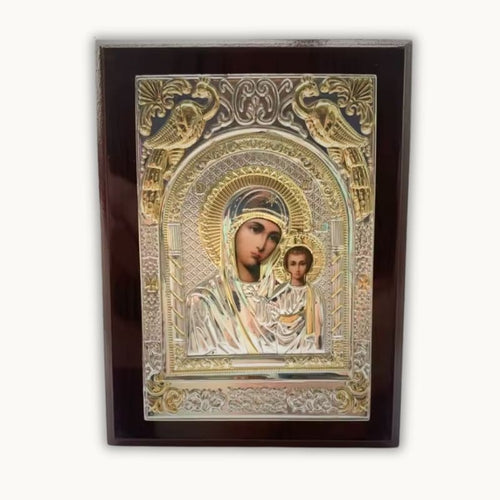
The Axion Estin icon — also called the Panagia Axion Estin or «It is Truly Meet» icon — is the icon of the Mother of God before which the angelic revelation of 982 took place. It depicts the Theotokos in the «Eleousa» (Tender Mercy) type, holding the Christ Child against her cheek. Together with the Portaitissa of Iviron Monastery, it is the most celebrated miraculous icon of Mount Athos — the «Garden of the Mother of God».
The icon is placed in the synthronon (elevated seat behind the altar) of the catholicon of the Protaton in Karyes — the oldest church on Mount Athos — and has left it only three times to be venerated by the people: in 1963, 1985, and 1987. On each occasion it received the honours due to a head of state. Every Easter Monday, it is carried in solemn procession through Karyes and its surroundings to sanctify the land and protect the inhabitants.
The hermitage cell of Adein, where the miracle took place, is accessible to male pilgrims with a valid diamonitirion. Our guide to Orthodox pilgrimage explains how to obtain one.
The feast of 11 June
The Orthodox Church celebrates the Synaxis of the Mother of God in memory of the revelation of the hymn Axion Estin on 11 June in the Gregorian Calendar. This feast is celebrated with particular solemnity on Mount Athos — especially at the cell of Adein, where Athonite monks gather each year for a festal Divine Liturgy. In the English-speaking world, it is observed in OCA, Antiochian and ROCOR parishes with a solemn Liturgy and the singing of the full Axion Estin in Greek and English.
The liturgical use of the Axion Estin
- At the Divine Liturgy — chanted during the Anaphora, immediately after the communion of the faithful. This is its most solemn and universally known liturgical use
- At Orthros (Matins) — as the irmos of the ninth ode of the canon, with the Magnificat
- At Compline and other services — the second part («More honourable than the Cherubim») is frequently chanted before the dismissal of most services, often followed by a metania or prostration
- In personal prayer — the Axion Estin is part of the morning and evening prayers in most Orthodox prayer books
During the great feasts, the Axion Estin is replaced by a festal irmos specific to the occasion — giving it a paradoxical presence: omnipresent in the ordinary liturgy, replaced in the most festive moments by an even more solemn text. This substitution is one of the most beautiful features of the Orthodox liturgical year: the «ordinary» magnificence of the Axion Estin gives way to something even greater.
The theology of the hymn — why the Theotokos is «more honourable than the Cherubim»
The central phrase of the Axion Estin — «More honourable than the Cherubim, and more glorious beyond compare than the Seraphim» — is the most theologically bold statement of all Orthodox Mariology. It places the Theotokos above the highest order of angels. How is this claim to be understood?
The Orthodox answer is christological: Mary is greater than the angels not by nature, but by the grace of divine motherhood. The Cherubim and Seraphim are the beings closest to God in the celestial hierarchy — but none of them carried God in their womb, nursed God, was the Mother of God. The divine motherhood of Mary gives her a dignity that no creature — angelic or human — can equal. The following line provides the theological foundation: «without corruption thou gavest birth to God the Word» — it is the virginal motherhood of the Theotokos that is the reason for her incomparable dignity. This is why the Axion Estin is not merely a Marian devotion — it is a Christological confession: to proclaim the Theotokos «more honourable than the Cherubim» is to confess the Incarnation itself.
An icon of the Theotokos in the family prayer corner is the natural setting in which to sing or recite the Axion Estin during personal prayer.
FAQ — Frequently asked questions about the Axion Estin
What does Axion Estin mean?
Axion Estin (Ἄξιον ἐστίν) means in Greek «It is worthy» or «It is truly meet» — the opening words of the full hymn: «It is truly meet to bless thee, O Theotokos.» In English-speaking Orthodox parishes, the hymn is commonly known as «It is truly meet». In Church Slavonic it is Dostoïno yest'.
Who composed the Axion Estin?
The Axion Estin has a double origin. The second part («More honourable than the Cherubim») was composed in the 8th century by Saint Cosmas the Hymnographer (c. 675–760). The first part («It is truly meet to bless thee») was, according to unanimous Orthodox tradition, revealed in 982 AD by the Archangel Gabriel to a monk on Mount Athos near Karyes, miraculously inscribed on a stone slab with the angel's finger.
When is the feast of the Axion Estin?
The Synaxis of the Mother of God in memory of the revelation of the hymn Axion Estin is celebrated on 11 June in the Orthodox Gregorian Calendar. It is celebrated with particular solemnity on Mount Athos and in Greek Orthodox communities worldwide.
Where is the Axion Estin icon?
The Axion Estin icon (also called the «It is Truly Meet» icon or Panagia Axion Estin) is kept in the synthronon of the Protaton Church in Karyes, the administrative capital of Mount Athos. It has left the Protaton only three times (1963, 1985, 1987). Every Easter Monday it is carried in solemn procession through Karyes.
When is the Axion Estin sung during the Divine Liturgy?
In the Orthodox Divine Liturgy, the Axion Estin («It is truly meet») is chanted during the Anaphora — after the consecration, immediately after the communion of the faithful. During great feasts, it is replaced by a festal irmos specific to the occasion.
What is the difference between the Axion Estin and the Agni Parthene?
These are two different types of Orthodox Marian hymn. The Axion Estin («It is truly meet») is an official liturgical hymn — sung at every Divine Liturgy since 982, of angelic origin, integral to the Typikon. The Agni Parthene («O Virgin Pure») is a paraliturgical hymn — composed in the 19th century by Saint Nektarios of Aegina for private devotion. Both are among the most beloved Marian hymns of the Orthodox tradition — and for converts, the two are often discovered together.
Can the Axion Estin be sung at home?
Yes — the Axion Estin is part of the morning and evening prayers in most Orthodox prayer books, including the Jordanville Prayer Book and the OCA/Antiochian prayer books in English. It is traditional to sing or recite it before the icon of the Theotokos in the family prayer corner. For converts, it is often one of the first hymns learned by heart — brief enough to memorise quickly, profound enough to repay a lifetime of reflection.