


Reading time: 12 minutes
There are musical works that cross all boundaries — linguistic, cultural, confessional — and touch the soul before the mind even understands the words. Agni Parthene is one of them. Millions of people around the world have heard this Orthodox hymn for the first time without understanding a word of Greek — and were immediately moved. For English-speaking converts to Orthodoxy, Agni Parthene is often the first Orthodox hymn they ever hear — played on Ancient Faith Radio, discovered on YouTube, or sung at the end of their first Divine Liturgy as antidoron is distributed. It is, in the truest sense, the sound of the Orthodox Church reaching out to those who are coming home.
What is Agni Parthene?
Agni Parthene (Greek: Αγνή Παρθένε) literally means "Pure Virgin" or "O Virgin Pure" in classical Greek. It is a non-liturgical Marian hymn composed in Greek by Saint Nektarios of Aegina (1846–1920) in the late 19th century, first published in his Theotokarion (Θεοτοκάριον, ἤτοι προσευχητάριον μικρόν) in Athens in 1905.
(cite index="24-1">In Orthodox churches, it is considered a paraliturgical hymn and therefore only to be used outside of liturgical services. However, it is often performed by some choirs as a recessional after the conclusion of the Divine Liturgy during the veneration of the cross and receiving of antidoron. Its use in parishes has become so widespread that many Orthodox Christians regard it as a permanent fixture of the Orthodox musical landscape — even though its author intended it as a hymn of personal devotion rather than public liturgy.
The hymn is structured in 24 stanzas — all followed by the refrain Χαῖρε νύμφη ἀνύμφευτε ("Rejoice, O Bride Unwedded") — (cite index="26-1">written much like a canon in that it has nine odes.) This structure is the formal framework par excellence of Byzantine hymnography — the same used in the canons of the great liturgical feasts. This means Agni Parthene, though paraliturgical, is composed in the most exacting tradition of Byzantine hymnographic form.
Saint Nektarios and the composition of the hymn
To understand Agni Parthene, one must understand the spiritual relationship of its author with the Theotokos. Saint Nektarios of Aegina (1846–1920) endured one of the most painful trials in modern Church history: unjustly expelled from Alexandria through slander, reduced to a humble position in Greece, ignored by those with power. It was precisely in this period of suffering and humiliation that his devotion to the Theotokos deepened until she became the centre of his spiritual life.
(cite index="14-1">Saint Nektarios liked to compose hymns in honor of the Mother of God to deepen his personal prayer and relationship with her. (cite index="13-1">This hymn is part of the little Theotokarion (Athens, 1905), a book of hymns for the Mother of God written by Saint Nektarios. The Theotokarion is not a mere collection of texts — it is the testimony of an entire life devoted to the Mother of God, composed by a man who had found in her his only refuge in the darkest hours of his existence. (cite index="14-1">The original script can still be viewed on his prayer table in his bedroom at this monastery.
The apparition of the Theotokos — the tradition of the Aegina monastery
The most moving tradition connected to the composition of Agni Parthene is that handed down at the Monastery of the Holy Trinity on Aegina, founded by Saint Nektarios himself.
(cite index="14-1">The tradition passed down at the monastery of St. Nektarios, in Aegina, Greece, is that the Lady herself appeared before him and requested that he record on paper a particular hymn the angelic choirs were about to sing. This hymn was the "Agni Parthene". The original script can still be viewed on his prayer table in his bedroom at this monastery.
This tradition is not an anecdotal detail — it stands within the great Byzantine tradition of hymns received in heavenly visions. The Akathistos Hymn — the greatest Marian hymn of all Orthodox liturgy — is itself attributed to divine revelation. That Saint Nektarios received Agni Parthene from the Theotokos herself, in the form of an angelic chant she asked him to write down, gives the hymn a supernatural dimension the Orthodox tradition takes seriously.
The melody, too, has a heavenly origin in the Athonite tradition: (cite index="14-1">the original melody to this hymn was composed by an Athonite hymnographer who is said to also have had a vision of the Virgin Mary prior to composing the work. The hymn is therefore a doubly heaven-given gift — the text through Saint Nektarios, the melody through a monk of Mount Athos.
The structure of the hymn — 24 stanzas and the refrain
Agni Parthene consists of 24 invocatory stanzas to the Theotokos, (cite index="17-1">all followed by the refrain Χαῖρε νύμφη ἀνύμφευτε ("Rejoice, O Bride Unwedded"). This refrain is one of the oldest and most theologically rich titles of the Theotokos in the Orthodox tradition — it is the closing exclamation of the Akathistos Hymn at every oikos, and summarises the paradoxical grandeur of Mary: bride (through her mystical union with the Holy Spirit) and unwedded (through her perpetual virginity). It is the condensation into three words of the entire mystery of the Virgin Birth.
The invocations move through the entire Orthodox theology of the Theotokos, drawing on images from the Old Testament, the Psalms, and the Prophets:
- "More radiant than the rays of sun, and higher than the heavens" — Mary elevated above all creation
- "Fleece which is all dewy" — the Fleece of Gideon (Judg 6:36–40), the ancient type of the virginal conception of Christ
- "More honourable than the Cherubim, and incomparably more glorious than the Seraphim" — a line drawn directly from the Divine Liturgy's Great Doxology, instantly recognisable to any Orthodox Christian
- "Rejoice, O song of the Cherubim. Rejoice, O hymn of the Angels" — Mary as the centre of heavenly song
The text of Agni Parthene — English translation and commentary
Here are the first stanzas of the hymn in the English translation most widely used in Orthodox parishes across the English-speaking world, as sung by the Valaam Monastery Choir and on Ancient Faith Radio:
O Virgin pure, immaculate,
O Lady Theotokos.
Rejoice, O Bride Unwedded!
O Virgin Mother, Queen of all,
And fleece which is all dewy.
Rejoice, O Bride Unwedded!
More radiant than the rays of sun,
And higher than the heavens.
Rejoice, O Bride Unwedded!
Joy of the choirs of virgins,
Surpassing angel legions.
Rejoice, O Bride Unwedded!
Much brighter than the firmament,
And purer than the sun's light.
Rejoice, O Bride Unwedded!
More holy than the multitude
Of all the heav'nly armies.
Rejoice, O Bride Unwedded!Agni Parthene — English translation, as sung in Orthodox parishes
The complete text of all 24 stanzas is available in the Theotokarion of Saint Nektarios, in English translation from Holy Trinity Publications (Jordanville) and on oca.org. Audio recordings with English subtitles are available on Ancient Faith Radio and YouTube.
The melody — Simonopetra, Valaam and the great recordings
The worldwide popularity of Agni Parthene is inseparable from its musical history — a history that traces the path of monastic prayer from Mount Athos to churches on every continent.
The Simonopetra recording
(cite index="14-1">The recording of this melody by the Monks of Simonopetra has contributed significantly to the popularization of the hymn. The Monastery of Simonopetra is one of the twenty monasteries of Mount Athos, renowned for the exceptional quality of its Byzantine musical tradition. Their recording — a simple, deeply contemplative melody sung in classical Greek with extraordinary vocal purity — introduced Agni Parthene to the world beginning in the 1980s.
The Valaam version
(cite index="21-1">One such variation is the Valaam Monastery chant of the Russian translation. The Slavonic version of the Valaam Monastery (Lake Ladoga, Russia) — with its deeper timbre, rich Slavic harmonies, and the sound of bells in the opening — has become, for many listeners, the most emotionally overwhelming of all interpretations. (cite index="22-1">Although sung and performed in many languages, the Slavonic rendition by the Valaam monastery choir (complete with bells) in particular has fascinated and entranced many - both Orthodox and non-Orthodox alike - much more so than the other versions.
Divna Ljubojević and modern interpreters
(cite index="17-1">Many singers have taken up the hymn, notably Divna Ljubojević. The Serbian singer Divna Ljubojević, director of the Melodi ensemble, has recorded multiple versions of Agni Parthene that have reached a worldwide audience far beyond the boundaries of Orthodoxy. Her recordings have been broadcast on classical radio stations across Europe. (cite index="22-1">One hearing is often enough to set this tune in the mind of its listener, especially with its oft-repeated refrain. In the English-speaking world, Ancient Faith Radio has done more than any other platform to spread the hymn — broadcasting it regularly and making it available in multiple recordings through their online archive.
Liturgical and paraliturgical use
Agni Parthene is a paraliturgical hymn — it does not belong to the official texts defined by the Typikon of the Orthodox Church. Its composer intended it for private devotion and personal prayer rather than public liturgy.
However, its use in parishes has grown considerably. It is typically sung:
- After the Divine Liturgy — during the distribution of antidoron (the blessed bread distributed at the end of the liturgy) and the veneration of the cross
- At the beginning of Vespers — as an opening hymn in some parishes
- At feasts of the Theotokos — particularly appropriate for the Dormition (15 August), the Nativity of the Theotokos (8 September), and the Presentation of the Theotokos (21 November)
- In personal prayer — before the icon of the Theotokos in the prayer corner
Agni Parthene in the world — versions and languages
One of the most striking signs of the universal diffusion of Agni Parthene is the number of languages into which it has been translated and recorded. (cite index="21-1">Due to its popularity, the hymn has been translated into many languages and the original melody has been adapted to suit the particular style of church chanting.
Known versions include: Classical Greek (Simonopetra original), Church Slavonic (Valaam version), Romanian (Fecioară curată), Serbian (Divna Ljubojević), Arabic (Patriarchates of Antioch and Jerusalem), English (O Virgin Pure, widely available through Holy Trinity Publications and Ancient Faith Radio), French, German, Japanese (the Japanese Orthodox Church, one of the richest non-Greek Orthodox musical traditions).
For English-speaking converts, the journey of Agni Parthene is particularly poignant: (cite index="22-1">This hymn is perhaps the most accessible point of entry into Byzantine chant. Its simple structure, its oft-repeated refrain, and its incomparably beautiful melody make it the hymn that most often opens the door to the entire world of Orthodox liturgical music.
The Theotokos in the hymn and her icon
Agni Parthene is a continuous meditation on the titles and attributes of the Theotokos as the Orthodox tradition has defined them over twenty centuries of prayer, theology, and hymnography. Each stanza is a window onto a different aspect of Mary's greatness — her purity, her divine motherhood, her place in the celestial hierarchy, her spiritual beauty.
The title of the hymn itself — Agni Parthene, "Pure Virgin" — is the fundamental Orthodox title of the Theotokos. It expresses both her perpetual virginity (Parthenos — virgin) and her absolute spiritual purity (Agnè — pure, undefiled). It is the title under which the Theotokos is invoked at the beginning of almost every Orthodox prayer addressed to her.
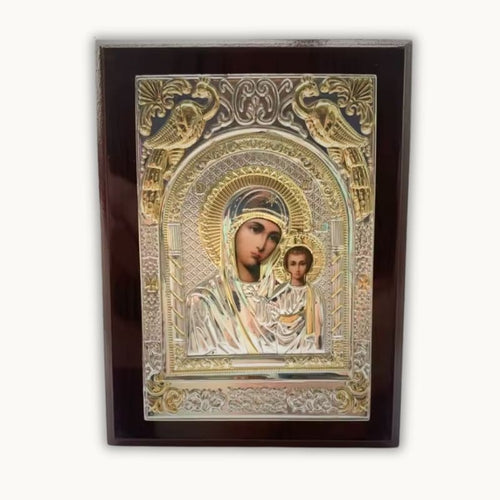
An icon of the Theotokos is the natural frame within which to sing or listen to Agni Parthene. The Orthodox tradition recommends placing an icon of the Theotokos in the prayer corner and lighting a candle before her whenever one prays — whether reciting the hymn or listening to a recording.
FAQ — Frequently asked questions about Agni Parthene
What is Agni Parthene?
Agni Parthene (Αγνή Παρθένε — "O Virgin Pure") is a non-liturgical Marian hymn composed in classical Greek by Saint Nektarios of Aegina in the late 19th century and published in his Theotokarion of 1905. Structured in 24 stanzas with the refrain "Rejoice, O Bride Unwedded", it is today sung worldwide in many languages and is considered the most universally beloved Orthodox hymn.
Who composed Agni Parthene?
Agni Parthene was composed by Saint Nektarios of Aegina (1846–1920), Archbishop of the Pentapolis, wonderworker and founder of the Monastery of the Holy Trinity on Aegina. His profound devotion to the Theotokos — deepened especially during the years of trial of his exile from Alexandria — is the spiritual source of the hymn.
What does the refrain "Rejoice, O Bride Unwedded" mean?
The refrain Χαῖρε νύμφη ἀνύμφευτε ("Rejoice, O Bride Unwedded") is one of the oldest and richest titles of the Theotokos in the Orthodox liturgical tradition. It is the closing exclamation of the Akathistos Hymn at every oikos. It expresses the fundamental paradox of Mary: bride (through her mystical union with the Holy Spirit) and unwedded (through her perpetual virginity). Every Orthodox Christian recognises this title — it is one of the first phrases learned by converts and catechumens.
What is the best version of Agni Parthene?
Each version has its own beauty. The Greek version of Simonopetra Monastery (Mount Athos) is the most faithful to the original melody and the most austere. The Slavonic version of Valaam Monastery (Russia) — with its deep harmonies and bells — is most often described as the most emotionally overwhelming. Divna Ljubojević's Serbian version is the most widely known to the general Western public. For English speakers, Ancient Faith Radio offers multiple recordings in English, including versions suitable for parish choirs.
Is Agni Parthene a liturgical prayer?
No — Agni Parthene is a paraliturgical hymn: it does not form part of the official texts prescribed by the Typikon of the Orthodox Church. However, its use in parishes has become so widespread that it is sung in many churches after the Divine Liturgy (during the antidoron) or at the beginning of Vespers. It remains primarily a hymn of personal devotion.
What does Agni Parthene mean in English?
Agni Parthene translates from classical Greek as "O Virgin Pure" or "Pure Virgin" — the title under which it is sung in English-speaking Orthodox parishes. Agni (ἁγνή) means pure, chaste, undefiled; Parthene (παρθένε) means virgin, and is the vocative form — the form used when addressing someone directly. The title is both a description of the Theotokos and an invocation: "O Pure Virgin, I come before you..."
Where can I find the full text of Agni Parthene in English?
The complete English text is available through: Holy Trinity Publications (Jordanville — the English Theotokarion); Ancient Faith Radio (ancientfaith.com), which offers both the text and audio recordings; OrthodoxWiki (orthodoxwiki.org/Agni_Parthene); and in the prayer books of most Antiochian and OCA parishes. Many Orthodox parishes in the English-speaking world now have printed copies of the English text for the congregation.