

Reading time: 12 minutes
Hypapante is one of the most poetically beautiful feasts of the Orthodox liturgical calendar. It celebrates a meeting — not just any meeting, but the meeting between God and his people, between the New Covenant and the Old, between the Light of the world and the men who waited for it in darkness. It is the meeting of the child Jesus and the old man Simeon — a man who had waited his whole life to see the Messiah, and who in dying could say: «Now let your servant depart in peace.» In the English-speaking world, this feast is also known as Candlemas — a name that comes from the blessing of candles, itself inspired by Simeon's proclamation of Jesus as «a light for revelation to the Gentiles». For English-speaking Orthodox Christians, Hypapante offers a unique opportunity: it is a feast celebrated on the same day (February 2) in the Orthodox, Catholic, and Anglican traditions, making it a natural point of encounter and dialogue across confessions.
What is Hypapante?
Hypapante (Greek: Ὑπαπαντή, sometimes spelled Hypapanti) is one of the Twelve Great Feasts (Dodekaorton) of the Orthodox liturgical calendar. It is celebrated on February 2 in Orthodox churches following the Gregorian Calendar, and on February 15 in those following the Julian Calendar (Russian, Serbian, Georgian Orthodox Churches).
Its full official name in the Orthodox tradition is «The Holy Meeting of Our Lord, God and Saviour Jesus Christ». This feast commemorates the Presentation of Jesus at the Temple of Jerusalem forty days after the Nativity, and the meeting of the Christ Child with the elder Simeon and the prophetess Anna. It is unique among the Twelve Great Feasts in that it is simultaneously a Feast of the Lord (centred on Christ) and a Feast of the Theotokos (centred on the Mother of God who presents her Son at the Temple). As OrthodoxWiki notes, «the Meeting of the Lord is unique in that it combines elements of both a Great Feast of the Lord and a Great Feast of the Theotokos.»
In the Western Christian world, this same feast is known as Candlemas — a name derived from the blessing of candles, inspired by Simeon's proclamation of Jesus as «a light for revelation to the Gentiles» (Luke 2:32). The custom of blessing candles on February 2 is shared between the Catholic and Orthodox traditions.
Meaning of the word Hypapante
The Greek word Hypapante (Ὑπαπαντή) derives from the verb hypantaô (ὑπαντάω) — «to go to meet someone, to go out to greet». It designates literally «the meeting» or «the act of going to meet». In antiquity, going out to meet a great personage was a gesture of honour and recognition — a delegation would leave the city to greet an approaching king or dignitary. Applied to this feast, the Byzantine tradition expresses that Simeon and Anna, representing all of Israel, went out to meet Christ — paid him the honours due to him as King and Messiah.
In Church Slavonic, the feast is called Sreteniye Gospodne (Сретение Господне — «Meeting of the Lord»); in Romanian, Întâmpinarea Domnului (same meaning). The English name «Meeting of the Lord» is a direct translation of the Greek Hypapante and is the most common name used in OCA, Antiochian, and ROCOR parishes.
The Gospel event — Luke 2:22-40
Hypapante is grounded in the account of the Gospel of Luke (2:22–40). Forty days after the Nativity — forty days after Christmas, hence February 2 — Mary and Joseph bring the child Jesus to the Temple of Jerusalem to fulfil two prescriptions of the Law of Moses:
- The purification of the mother — forty days after the birth of a son, the mother was to perform a ritual of purification and offer at the Temple a year-old lamb for a burnt offering, or, for poor families, two turtledoves or two young pigeons. Mary and Joseph offer two turtledoves — a sign of their poverty and of the humility of the Incarnation
- The consecration of the firstborn — «Every male that opens the womb shall be called holy to the Lord» (Luke 2:23; Ex 13:2). The firstborn was «redeemed» by the parents through an offering at the Temple — a gesture recalling that God had spared the firstborn of the Hebrews at the tenth plague of Egypt
It is in this context of strict observance of the Law of Moses that the great meeting occurs: Christ, come to fulfil the Law he himself gave to Moses, submits to it and transcends it at once.
Saint Simeon the God-receiver
The central figure of Hypapante is the elder Simeon, called in the Orthodox tradition Theodochos (Θεοδόχος — «The God-receiver» or «He who receives God»). The Gospel describes him as «a man just and devout, looking for the consolation of Israel, and the Holy Spirit was upon him» (Luke 2:25). The Holy Spirit had revealed to him that he would not see death before he had seen the Christ of the Lord.
On the day of Hypapante, «led by the Spirit, he came into the Temple» — and when Mary and Joseph entered with the child Jesus, he took him in his arms and blessed God. Some ancient authors identify Simeon as one of the seventy scholars charged with translating the Septuagint, who received the promise of not dying before seeing the Messiah because he had doubted Isaiah's prophecy of the virginal birth. The Orthodox Church celebrates Saint Simeon on February 3 — the day after Hypapante — together with the prophetess Anna.
The prophetess Anna — witness of the deliverance
The prophetess Anna, daughter of Phanuel, of the tribe of Asher, is the second figure of the feast. An 84-year-old widow, she never left the Temple and served God night and day with fasting and prayer. When she saw the child Jesus, «she gave thanks to God and spoke of him to all who were waiting for the redemption of Jerusalem» (Luke 2:38). Anna represents in the Orthodox tradition the faithful Israel that waited for the Messiah in prayer and fasting.
The Song of Simeon — Nunc Dimittis
One of the most enduring liturgical contributions of Hypapante is the Song of Simeon (Luke 2:29–32), known in the Latin tradition as the Nunc Dimittis (opening words: «Now let depart»):
«Lord, now let your servant depart in peace,
according to your word;
for my eyes have seen your salvation
which you have prepared in the presence of all peoples,
a light for revelation to the Gentiles,
and for glory to your people Israel.»
(Luke 2:29–32)
In the Orthodox liturgy, the Song of Simeon (Nyn apolueis — Νῦν ἀπολύεις) is chanted at the end of every Vespers service — every evening, in every Orthodox church in the world. It is one of the most universally sung prayers of the Eastern Christian tradition, and one of the first liturgical texts memorised by Orthodox converts. Its presence every evening in the liturgy gives the Feast of Hypapante a daily resonance throughout the entire year.
The theology of Hypapante — Feast of the Lord and of the Theotokos
Hypapante is unique among the Twelve Great Feasts: it is the only one that is simultaneously a Feast of the Lord and a Feast of the Theotokos. This dual nature is expressed in the kontakion (short hymn) of the feast:
«Adorn your bridal chamber, O Zion,
and receive Christ the King.
Embrace Mary, the gate of heaven:
for she is the living chariot of the Cherubim.
She bears the King of glory,
the shining cloud bearing in the flesh the Son begotten before the morning star.
Simeon, receiving Him in his arms,
proclaims to all peoples that He is the Master of life and death
and the Saviour of our souls.»
Theologically, Hypapante is a feast of light — as Simeon's words indicate: «a light for revelation to the Gentiles». Christ is the true Light that has entered the world, and the blessing of candles at Hypapante is its sacramental sign. It is also a feast of the meeting between the Old and New Testaments: Simeon and Anna represent believing Israel receiving the long-awaited God into its arms.
History of the feast — from origins to the Byzantine tradition
Hypapante is one of the oldest Christian liturgical feasts. It is attested in Jerusalem as early as the 4th century — the pilgrim Egeria, in her travel diary (around 380–384 AD), describes a solemn procession celebrated forty days after Epiphany (January 6 was then the date of the Nativity in Jerusalem), thus on February 14. When the Nativity was fixed at December 25, the feast moved to February 2.
Under Emperor Justinian I (527–565), following a devastating epidemic in Constantinople in 542, Hypapante was introduced throughout the Byzantine Empire with increased solemnity. Justinian ordered torch processions in all the cities of the Empire on February 2 — reinforcing the symbolism of light and the connection with the Song of Simeon. From this date, the feast has been universally celebrated throughout the Orthodox Church.
The liturgical celebration of Hypapante
Hypapante has a fore-feast of one day (February 1) and an after-feast of seven days until February 9 — although this after-feast may be shortened or omitted altogether if February 2 falls near the beginning of the preparation for Great Lent.
On the eve of the feast, the icon of Hypapante is placed in the centre of the church. On the day of the feast itself, a solemn Divine Liturgy is celebrated. In many Orthodox parishes, candles are blessed on February 2 — a practice shared with the Catholic tradition. These blessed candles are kept by the faithful and lit at important moments of life: at the birth of a child, in serious illness, or at the hour of death.
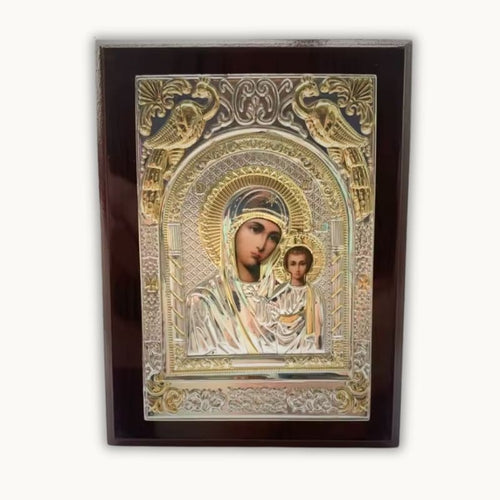
The icon of Hypapante can be placed in the family prayer corner throughout the after-feast period. Icons of Hypapante are available from Orthodox icon stores.
The icon of Hypapante
The iconography of the feast was definitively fixed in the 9th–10th centuries and has remained almost unchanged since. The icon depicts:
- At the centre — the elder Simeon holding the Christ Child on his arms, veiled by his phelonion. The Christ Child, never depicted in swaddling clothes, sometimes blesses with his right hand — emphasising that he is simultaneously the King being received and the Priest who blesses
- At the left — the Theotokos, her hands extended toward Simeon in a gesture of offering
- At the right — Saint Joseph, holding the two turtledoves of the offering
- Behind Simeon — the prophetess Anna, holding a scroll, her gaze turned toward heaven in a sign of prophetic inspiration
- In the background — the architecture of the Temple of Jerusalem, with a ciborium altar evoking the Eucharistic liturgy
The earliest known representations of the Presentation appear in a mosaic at Santa Maria Maggiore in Rome (5th century). The definitive Byzantine iconographic composition, with Simeon at the centre holding Christ, was established in the 9th century.
FAQ — Frequently asked questions about the Orthodox Hypapante
What is the feast of Hypapante?
Hypapante (Ὑπαπαντή — «Meeting») is one of the Twelve Great Feasts of the Orthodox Church, celebrated on February 2. It commemorates the Presentation of Jesus at the Temple of Jerusalem forty days after Christmas and the meeting of Christ with the elder Simeon and the prophetess Anna. It is the only Great Feast that is simultaneously a Feast of the Lord and a Feast of the Theotokos.
What does Hypapante mean?
Hypapante (Ὑπαπαντή) is a Greek word meaning «meeting» or «the act of going to meet someone». In English-speaking Orthodox parishes it is most commonly known as the «Meeting of the Lord». In Church Slavonic it is Sreteniye Gospodne; in Romanian Întâmpinarea Domnului — both meaning «Meeting of the Lord».
Is Hypapante the same as Candlemas?
Yes — Orthodox Hypapante and Catholic/Anglican Candlemas commemorate the same Gospel event (Luke 2:22-40) on the same day (February 2). Both traditions bless candles, in reference to Simeon's proclamation of Jesus as «a light for revelation to the Gentiles». The main differences are liturgical and theological: in Orthodoxy the emphasis is on the meeting (Hypapante); in Western Christianity more on the presentation and the purification.
When is Hypapante celebrated according to the Julian Calendar?
Orthodox Churches following the Julian Calendar (Russian, Serbian, Georgian) celebrate Hypapante on February 2 Julian, which corresponds to February 15 in the civil Gregorian calendar.
What is the Song of Simeon (Nunc Dimittis)?
The Song of Simeon (Luke 2:29–32), known in Latin as the Nunc Dimittis («Now let depart»), is the prayer Simeon prayed while holding the child Jesus: «Lord, now let your servant depart in peace... for my eyes have seen your salvation.» In the Orthodox liturgy, this canticle is chanted at the end of every Vespers service — every evening in every Orthodox church worldwide.
Why is Hypapante the only Great Feast that is both a Feast of the Lord and of the Theotokos?
Hypapante is simultaneously a Feast of the Lord and of the Theotokos because the Gospel event inseparably involves both. The Orthodox tradition refuses to separate what is inseparable in the reality of the Incarnation: Christ cannot be presented at the Temple without the Theotokos who carries him, and the Theotokos cannot carry him without him. The feast's hymns therefore alternate between glorifying Christ and his Mother.
Can I have candles blessed for Hypapante at an Orthodox church?
Yes — the blessing of candles on February 2 is a practice present in the Orthodox tradition, especially in Greek, Slavic, and Romanian parishes. Many OCA, Antiochian, and ROCOR parishes bless candles at the Divine Liturgy of Hypapante. These blessed candles are kept by the faithful and lit at important moments: birth, serious illness, death. They symbolise the light of Christ that Simeon proclaimed and that each Christian receives at Baptism.