

There is a feast in the Orthodox liturgical year that puzzles at first encounter: a great feast observed with the same strict fast as Good Friday. A feast of joy, the liturgical books say — and yet one weeps at it, prostrates before it, fasts through it. A feast that celebrates an instrument of torture and death as though it were the most precious treasure in the world. That feast is the Exaltation of the Precious and Life-Giving Cross of the Lord — in Greek Hypsosis tou Timiou kai Zôopoiou Stavrou — and it is, in the whole of the Orthodox year, the most arresting sign of what the Christian faith proclaims: that death is defeated, that shame is transfigured, and that the Cross is not the end but the beginning.
Celebrated every year on September 14 in the Orthodox churches of the Gregorian calendar and on September 27 in those of the Julian calendar, the Exaltation of the Holy Cross is one of the Twelve Great Feasts of the Dodekaorton. It is the last great autumn feast before the feasts of the Nativity cycle. It closes a remarkable sequence: forty days after the Transfiguration (August 6), eight days after the Nativity of the Mother of God (September 8), the Cross on which the Son of God was crucified rises above the world as a sign of eternal hope.
The paradox of the Cross: glory in humiliation
To understand why the Orthodox Church dedicates a great feast to the Cross, one must first grasp what the Cross means in Christian theology — and in the Orthodox tradition in particular. The Cross is not simply the sign of Christ's death: it is the place where the most radical reversal in human history was accomplished. What was meant to be the final word of shame and defeat became, through the Resurrection, the first word of glory and victory.
Saint Paul had put it with a boldness that scandalized his contemporaries: "For the word of the cross is folly to those who are perishing, but to us who are being saved it is the power of God." (1 Cor 1:18) The Orthodox tradition has kept this fertile scandal intact: the Cross is at once the sign of the greatest humiliation and the trophy of the greatest triumph. This is why it is celebrated with a joy tinged with compunction — one cannot contemplate the Cross without seeing simultaneously the infinite love of the Son of God and the weight of human sin that made that death necessary.
In daily Orthodox liturgy, the Cross is omnipresent: every Wednesday and Friday of the year, the services commemorate the Passion. Three special feasts are dedicated to it in the Orthodox calendar: the Veneration of the Cross on the third Sunday of Great Lent, the Procession of the Cross on August 1, and the Exaltation of the Holy Cross on September 14. Of these three, the Exaltation is by far the most solemn — the only one counted among the Twelve Great Feasts of the Dodekaorton.
Three historical events, one feast
The distinctiveness of the Exaltation of the Holy Cross lies partly in the fact that it commemorates not one but three historically separate events that unfolded over several centuries, all linked to the Cross of Christ and its destiny in history.
The finding of the True Cross by Saint Helena (320)
The first event is the discovery of the True Cross in Jerusalem, attributed to Saint Helena, mother of Emperor Constantine the Great, around the year 320. Following the legalization of Christianity by the Edict of Milan (313), Constantine ordered excavations at the site of Golgotha, which had been covered since the time of Hadrian (135) by a temple dedicated to Venus. The excavations uncovered the tomb of Christ and, according to tradition, three crosses. To identify the True Cross, the Patriarch Macarius of Jerusalem — or Saint Helena herself, according to some sources — had it brought to a gravely ill woman: at the touch of the True Cross, she immediately recovered her health. The wood of the Cross was then solemnly raised (exalted) by the bishop before the jubilant people — and it is this founding gesture that gave the feast its name.
The dedication of the basilicas of Jerusalem (335)
The second event is the dedication of the basilicas built by Constantine at the holy sites of Jerusalem — the Martyrion (over Golgotha) and the Anastasis (over the Holy Sepulchre) — on September 13, 335. The following day, September 14, the Patriarch of Jerusalem solemnly presented the True Cross to the faithful who had gathered in enormous numbers to venerate it. This September 14, 335 is considered the founding moment of the liturgical feast — the occasion on which the gesture of the Exaltation was performed for the first time officially and solemnly before an immense assembly.
The return of the Cross from Persian captivity (630)
The third event is one of the most dramatic in the history of Eastern Christianity. In 614, during their invasion of the Holy Land, the Sassanid Persians seized Jerusalem and carried away the True Cross as a spoil of war. For fourteen years, the most precious treasure of Christendom was held in Persia. In 628, after a series of military victories, the Byzantine Emperor Heraclius negotiated the return of the relic. He brought it back to Jerusalem himself in 630, in great pomp. According to tradition, as he wished to enter the city in imperial robes carrying the Cross on his shoulders, he was mysteriously halted at the city gate — unable to move forward. The Patriarch Zacharias revealed to him that the one who had carried the Cross to Golgotha had done so in humility and poverty. Heraclius set down his crown, stripped off his imperial ornaments and entered Jerusalem barefoot. From this event onward, the feast of the Exaltation took on exceptional and universal importance throughout the Christian East.
A second Good Friday: the feast of fasting
The Exaltation of the Holy Cross possesses a characteristic unique in the entire Orthodox liturgical calendar that makes it instantly recognizable: it is the only great feast that prescribes a strict fast — even if it falls on a Sunday. Throughout the liturgical year, Sunday is a day on which fasting is lifted — except on September 14. This absolute exception says something essential about the nature of this feast.
The fast of September 14 is as strict as that of Good Friday: complete abstinence from meat, fish, oil and wine. In some monastic traditions, complete abstinence from all food until after the Divine Liturgy is observed. The reason is theological: to contemplate the Cross is to contemplate the freely accepted suffering of the Son of God. One cannot sing the glory of the Cross on a full stomach with a light heart. The fast is the Church's bodily response to the crucified love revealed on this day.
This singularity — a great feast of joy with a Good Friday fast — constitutes what Orthodox liturgists call "the exception that proves the rule." It also expresses a deep truth: Christian joy is not a superficial joy that ignores suffering. It is a joy that has passed through death, that has been nourished by the Cross, and that emerges from it transfigured. The Cross is both a mystery of pain and a mystery of glory — and the fast of the feast says that the two cannot be separated.
The rite of the Exaltation: the Cross raised toward the four horizons
The most characteristic and visually striking rite of this feast is the gesture of the Exaltation itself — the ceremony during which the Cross is solemnly raised and presented to the four cardinal points by the bishop or celebrating priest. It is a rite of great symbolic beauty, unique in the entire Christian liturgical calendar.
During Great Vespers on the evening of September 13, the Cross is carried in solemn procession from the altar to the center of the church, placed on a flower-adorned throne and censed. The following morning, at Orthros (Matins), the central rite of the feast takes place: the bishop or priest, surrounded by deacons carrying lit candles, takes the Cross adorned with basil and flowers, raises it above his head and turns it successively toward the east, south, west and north, then east again. At each orientation, the choir intones the Kyrie eleison ("Lord, have mercy") one hundred times, while the priest bows deeply — almost to the ground — before rising again with the Cross. These five elevations symbolize that the Cross of Christ is offered for the salvation of all humanity, in every direction of the universe.
After the rite of the Exaltation, the Cross is placed in the center of the church to be venerated by the faithful, who approach one by one to kiss it and receive the blessing. It remains there until September 21 — the Apodosis (leave-taking) of the feast. The basil that often adorns the Cross on this day in Greek traditions symbolizes the kingship of Christ (basileus means "king" in Greek) and his victory over death.
September 14 in both calendars
The Exaltation of the Holy Cross is a fixed feast. The thirteen-day difference between the Gregorian and Julian calendars leads to two distinct dates depending on the church.
| Year | Date (Gregorian calendar) | Date (Julian calendar) | Day of the week (Gregorian) |
|---|---|---|---|
| 2023 | September 14, 2023 | September 27, 2023 | Thursday |
| 2024 | September 14, 2024 | September 27, 2024 | Saturday |
| 2025 | September 14, 2025 | September 27, 2025 | Sunday |
| 2026 ← current year | September 14, 2026 | September 27, 2026 | Monday |
The churches of the revised Julian calendar — the Ecumenical Patriarchate, Greek Orthodox Church, Romanian Orthodox Church, Patriarchate of Antioch — observe the feast on September 14. The churches of the Julian calendar — the Russian Orthodox Church, Serbian Orthodox Church, Georgian Orthodox Church, Church of Jerusalem — celebrate it on September 27 in the Gregorian reckoning. In 2026, the feast falls on Monday, September 14, 2026 for the former and on Sunday, September 27, 2026 for the latter. In that year, with September 27 falling on a Sunday, the strict fast remains obligatory — a vivid reminder of the uniqueness of the Exaltation in the Orthodox calendar.
The liturgy of the Exaltation: between mourning and glory
The Divine Liturgy of September 14 proclaims as its Epistle a passage from 1 Corinthians 1:18–24 — Saint Paul's meditation on the foolishness and wisdom of the Cross — and as its Gospel the passage of John 19:6–11; 13–20; 25–28; 30–35, an extract from the Passion narrative. It is one of the very rare occasions on which the Passion Gospel is read at a great feast — underlining that the Exaltation is, in the spirit of the Church, inseparable from Good Friday.
The Troparion of the Exaltation — among the most frequently sung in all of Orthodox liturgy — captures the whole mystery in two sentences:
"O Lord, save your people and bless your inheritance; grant victory over enemies to those who belong to you, and by your Cross protect your people."
— Troparion of the Exaltation of the Holy Cross, Tone 1, Orthodox liturgical tradition
The Kontakion of the feast, traditionally attributed to Saint Romanos the Melodist (5th–6th century), adds a cosmic dimension:
"You who were voluntarily raised upon the Cross, O Christ our God, bestow your mercies upon the new nation that bears your name; gladden with your power those who love you faithfully, and grant them victory over their enemies — may they have you as their ally, the trophy of peace, the invincible sign of victory."
— Kontakion of the Exaltation of the Holy Cross, Tone 4, Orthodox liturgical tradition
The liturgical color proper to the Exaltation in most Orthodox traditions is deep purple or royal crimson — colors that are simultaneously royal and penitential, expressing both the kingship of the crucified Christ and the compunction of the feast. In some Greek traditions, blood red is used as the primary color, in direct reference to the blood shed on the Cross.
The iconography of the Exaltation of the Holy Cross
The icon of the Exaltation of the Holy Cross is immediately recognizable and stands as one of the most meaning-laden representations in all of Byzantine iconographic art. It depicts the scene of the Exaltation itself — not a Gospel event, but a liturgical rite — which makes it an icon of a uniquely distinctive kind.
At the center of the composition, the patriarch or bishop stands upright on a platform or ambo, holding the Cross with both hands raised above his head. To either side, deacons hold lit candles. In the lower portion of the icon, a dense crowd of the faithful — clergy and laity, men and women — gazes up at the elevated Cross, arms outstretched toward it, faces lifted in a mixture of adoration and profound emotion. Sometimes Saint Helena and Emperor Constantine are depicted on either side of the Cross, recalling the first historical event the feast commemorates.
The Cross itself, the geometric and spiritual center of the icon, is often adorned with flowers or basil — and crowned with a golden light radiating toward every edge of the image. This light says that the Cross is not merely an instrument of death: through the Resurrection of Christ it has become a source of uncreated light for the entire universe. The vertical structure of the composition — the Cross rising upward, the people bowing downward — expresses in the visual language of the icon what the feast proclaims in its hymns: the encounter between divine condescension and the human aspiration toward Heaven.
The Cross in Orthodox spiritual life
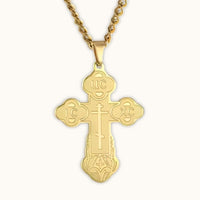
Beyond the feast of September 14, the Cross occupies a place in Orthodox spiritual life that has no real parallel in other Christian traditions. It is present in every gesture of the Orthodox Christian's daily life: the sign of the cross made over oneself, the cross worn on the chest since baptism (enkolpion), the cross above every door and every bed in devout households, the cross at the center of every iconostasis.
Orthodox theology of the Cross is inseparable from Orthodox theology of the Resurrection: one is never celebrated without the other. The Sunday Troparia, sung every week in the services, remind the faithful ceaselessly that it is through the Cross that joy has come into all the world. The shortest and densest liturgical formula of Orthodoxy expresses this in a few words: "Before your Cross we bow down, O Master, and your holy Resurrection we glorify." Prostration and song, mourning and glory — two inseparable gestures, like the Cross and the Resurrection.
The Exaltation of the Holy Cross in English-speaking Orthodox communities
In the United States, Canada, the United Kingdom and Australia, Orthodox parishes of various jurisdictions celebrate the Exaltation of the Holy Cross on September 14 with full liturgical solemnity. The day is not a public holiday anywhere in the English-speaking world, which means Great Vespers are typically offered on the evening of September 13, and the Divine Liturgy early on the morning of September 14, to allow working parishioners to take part. The strict fast of September 14 — observed even on a Saturday, when it falls on one — is one of the most distinctive aspects of the feast for Orthodox Christians in predominantly non-fasting cultures, and often draws comment from friends, colleagues and family members who notice the abstinence. For many converts to Orthodoxy in English-speaking countries, the fivefold elevation of the Cross with the hundredfold Kyrie eleison is one of the most unexpectedly moving liturgical experiences they encounter — a slow, repeated act of humility and worship that sets this feast apart from every other in the calendar year.
FAQ — Frequently asked questions about the Exaltation of the Holy Cross
Why is there a strict fast at a great feast?
It is the question many faithful ask. The answer is both theological and spiritual. The Exaltation of the Holy Cross is a great feast of joy — but a joy that passes through the Cross, that is, through the freely accepted death and humiliation of the Son of God. One cannot contemplate the Cross without experiencing deep compunction — a movement of the heart toward God interwoven with repentance and gratitude. The fast is the bodily expression of that compunction: it says that what was accomplished on the Cross is being taken seriously, that one does not skip past the pain to arrive directly at the glory.
What is the True Cross and where is it today?
The True Cross is the wood on which Jesus Christ was crucified, discovered in Jerusalem according to tradition by Saint Helena around 320. After being venerated in Jerusalem and then distributed in fragments throughout the Christian Empire, the greater part of the relic was taken by the Persians in 614 and returned in 628. Today fragments of the True Cross are preserved in numerous Orthodox monasteries and cathedrals — notably on Mount Athos, at the Patriarchate of Jerusalem, at the Monastery of the Holy Cross in Jerusalem, and in many parishes throughout the world. The authenticity of these relics is affirmed by tradition but is not the subject of a dogmatic definition.
What is the difference between the Orthodox and Catholic Exaltation of the Cross?
Both traditions celebrate the same feast on the same date, September 14. The principal difference is the penitential character of the Orthodox feast: in the East, the Exaltation is a day of strict fasting, even when it falls on a Sunday, and the Passion Gospel is read at the Liturgy. In Western Catholicism, the feast has a more triumphant and festive character — it is called the feast of the Holy Cross or the Triumph of the Cross — with no particular fast. This difference is frequently cited as a striking example of the divergence between Eastern and Western liturgical sensibilities.
What is the sign of the cross in the Orthodox tradition?
In the Orthodox tradition, the sign of the cross is traced from the head to the chest, then from the right shoulder to the left — the opposite of the Latin tradition. It is made with the first three fingers joined (symbolizing the Trinity) and the last two folded into the palm (symbolizing the two natures of Christ). This gesture is performed many times in every service, at every mention of the name of Jesus, the Trinity, or the Mother of God. It is regarded in the Orthodox tradition as a genuine prayer in action — a bodily profession of faith that the Christian inscribes upon himself.
When exactly is the Exaltation of the Holy Cross in 2026?
In 2026, the Exaltation of the Holy Cross is celebrated on Monday, September 14, 2026 by the Orthodox churches of the Gregorian calendar (Greek, Romanian, Antiochian, etc.) and on Sunday, September 27, 2026 by the churches of the Julian calendar (Russian, Serbian, Georgian). The strict fast of September 14 applies in both cases, regardless of the day of the week.
How does one prepare for the feast of the Exaltation?
Preparation includes attending Great Vespers on the evening of September 13, during which the Cross is carried solemnly to the center of the church, and the Divine Liturgy on the morning of September 14, during which the rite of the Exaltation takes place. Confession and Holy Communion are recommended. Observing the strict fast is an essential part of the preparation. Meditating on the Passion Gospel of John (Jn 19) and reading Saint Paul's meditation on the wisdom of the Cross in First Corinthians (1 Cor 1) deepens one's understanding of the mystery being celebrated.
The Cross: trophy of life
The Exaltation of the Holy Cross is, among all the great Orthodox feasts, the one that expresses most powerfully the central paradox of Christianity: that God defeated death by dying, that glory passes through shame, that life springs from the tomb. In raising the Cross toward the four horizons, the Church tells the world that salvation does not come from power, wealth or human wisdom — it comes from a man nailed to wood, who loved to the very end and whom death could not hold.
In 2026, this feast will be celebrated on Monday, September 14 in the Orthodox churches of the Gregorian calendar — in fasting and prayer, in compunction and glory. It is an annual meeting with the Cross — that despised wood which has become the tree of life — and with the certainty that, whatever happens, the last word belongs to love.
"Before your Cross we bow down, O Master, and your holy Resurrection we sing and glorify."
— Hymn of the Veneration of the Cross, Orthodox liturgical tradition