

Reading time: 10 minutes
In the Orthodox world, there are saints whose name alone is enough to evoke a city, a nation, an entire history. Saint Demetrios is one of them. His name is the name of Thessaloniki — the second city of Greece, whose guardian he has been for seventeen centuries. Every year on 26 October, the Greek Prime Minister travels to Thessaloniki to honour him at the solemn liturgy in the basilica that bears his name. In Greek, Serbian, Romanian, Bulgarian, and Russian Orthodox parishes across the English-speaking world — in New York, London, Melbourne, Chicago, and Toronto — this day is celebrated as one of the great feasts of the autumn Orthodox calendar.
Who is Saint Demetrios of Thessaloniki?
Saint Demetrios of Thessaloniki (Greek: Ἅγιος Δημήτριος τῆς Θεσσαλονίκης) is a Great-Martyr of the Orthodox Church, who suffered martyrdom in Thessaloniki at the beginning of the 4th century, around the year 306. He is also called the Myrrh-gusher (Myrovlytis — μυροβλύτης), because of the fragrant healing oil that has flowed miraculously from his relics since the 6th century.
In the hierarchy of Orthodox warrior saints, Demetrios holds the first place alongside Saint George. Together they form the diptych of the two great martyr-warriors of the Byzantine tradition: George the Trophy-bearer (Tropaïophoros) and Demetrios the Myrrh-gusher. Both are depicted on horseback on their most celebrated icons — George on a white horse slaying the dragon; Demetrios on a red horse brandishing a lance. OrthodoxWiki describes him as "one of the most popular saints in the Orthodox world."
His English-speaking patronages are notably broad: according to Wikipedia, he is patron of Thessaloniki, Constantinople, Calgary (Canada), Sremska Mitrovica, and Kosovska Mitrovica — as well as patron of soldiers, of agriculture and shepherds (in the Greek countryside), and of construction workers (in Bulgaria). His feast on 26 October is also celebrated as a second feast on the Sunday of the Myrrh-bearing Women (3rd Sunday of Pascha) in the Orthodox Church of America.
The life of Saint Demetrios — officer, preacher, martyr
Born between 270 and 284 in Thessaloniki, Demetrios came from a noble, secretly Christian Roman family. As St Andrew Greek Orthodox Church of Boca Raton describes: his father "secretly kept two holy icons, adorned with gold and precious stones, one of our Incarnate Savior Jesus Christ and the other of the Most Holy Theotokos. A lamp always burned before them, and he censed them with incense; and together with his wife, who also believed in Christ, he prayed to the True God." After his father's death, Demetrios was baptised in this secret chapel and took up the faith his father had hidden.
Demetrios entered the Roman army and rose quickly through the ranks, becoming Proconsul of the province of Macedonia and commander of the Thessaloniki garrison, with the rank of Chiliarch (commander of a thousand men) at the age of 22. Emperor Maximian sent him to destroy Christianity in the region. The OCA hagiography records what Demetrios did instead: "Rather than persecuting and executing Christians, he began to teach the Christian Faith openly to the inhabitants of the city and to overthrow pagan customs and the worship of idols." The compiler of his Life, St Simeon Metaphrastes (feast November 9), called him "a second Apostle Paul" for Thessaloniki — following in the footsteps of the Apostle who had founded the first Christian community there (1 Thess. and 2 Thess.).
When Emperor Maximian (or, in other traditions, Galerius) learned that his newly-appointed proconsul was a Christian who was converting his subjects, his rage was boundless. Returning from a campaign near the Black Sea, the Emperor resolved to make an example of Demetrios.
The martyrdom of Saint Demetrios
When summoned by the Emperor, Demetrios did not flee. He first instructed his faithful servant Lupus to distribute his wealth to the poor, saying — in the words recorded by the OCA: "Distribute my earthly riches among them, for we shall seek heavenly riches for ourselves." He then appeared boldly before the Emperor, confessing himself a Christian and denouncing the falsehood of Roman paganism. Maximian ordered him thrown into prison.
In prison, Demetrios prayed and sang psalms. An angel appeared to him wearing a crown from Paradise: "Peace be to you, O martyr of Christ. Take courage and be strong!" Demetrios replied: "I rejoice in the Lord and delight in God my Saviour!" This vision filled him with a burning desire to shed his blood for Christ.
At dawn on 26 October 306, soldiers entered the underground prison and ran Demetrios through with their lances — a death evoking the lance thrust into Christ's side on the Cross. His faithful servant Lupus collected the blood-soaked garment and took the imperial ring from his finger, using them to work miracles. Christians buried the body secretly and with honour. Miracles began almost immediately at his tomb.
Saint Nestor — the fellow martyr
One of the most dramatic episodes in the life of Saint Demetrios is his bond with the young Nestor — a Christian of Thessaloniki who visited him regularly in prison.
Maximian was staging gladiatorial games in the arena of Thessaloniki. His champion was a fearsome warrior named Lyaeos (described by the OCA as "a German") — a mighty gladiator with innumerable victories, whom the Emperor used to humiliate Christians by forcing them to fight him on a platform built over the upturned spears of soldiers below.
The young Nestor came to Saint Demetrios in his prison cell and asked for his blessing to fight Lyaeos. Demetrios blessed him and said: "You will defeat Lyaeos, and you will suffer for Christ." Nestor entered the arena, made the sign of the cross, and threw the mighty Lyaeos to the ground — to the astonishment of the crowd and the fury of the Emperor. Maximian immediately executed Nestor. The troparion of the feast captures this miracle: "The whole world has found you as a mighty champion in dangers, O victor, who rout the nations. Therefore as you destroyed the pride of Lyaios in the stadium by giving Nestor courage, holy Great-Martyr Demetrios, implore Christ God to grant us His great mercy." The Orthodox Church celebrates Saint Nestor the following day, 27 October.
The Myrrh-gusher — the wonder-working relics
The most distinctive title of Saint Demetrios in the Orthodox tradition is that of Myrrh-gusher (Myrovlytis) — "the one from whose body myrrh gushes forth". The myrrh is a fragrant holy oil that, according to tradition, has flowed miraculously from the saint's relics since the 6th century. As the Monastiriaka website notes: "From the tomb of the Saint, it was created a well that gushed forth myrrh, a fact that gave the Saint the nickname 'myrrh-gusher' (Myrovlitis)."
Pilgrims from across the Orthodox world — Greeks, Slavs, Romanians, Serbs, Bulgarians, Russians — have testified over the centuries to the sweet fragrance and miraculous oil streaming from the relics of Saint Demetrios. This oil was gathered in silver vials and taken as medicine and protection to Orthodox homes across the Christian world. The patron saint of the Rurikid ruling dynasty of Russia from the late 11th century, his veneration helped spread this tradition across Slavic lands.
The Basilica of Saint Demetrios in Thessaloniki
Shortly after the martyrdom of Demetrios, a small chapel was built on the site of his imprisonment and death. In the 5th century, Leontios, Prefect of Illyria — miraculously healed through the saint's intercession — built a great basilica in its place: the Basilica of Saint Demetrios, which still stands today.
This basilica, one of the greatest early Christian churches in the world, has been a UNESCO World Heritage Site since 1988 (as part of the Palaeochristian and Byzantine Monuments of Thessaloniki). It houses the relics of Saint Demetrios in a silver reliquary in the crypt. The crypt itself is built on the site of the Roman baths where the saint was imprisoned and martyred. The church dates from the mid-5th century — meaning it was built within living memory of those who knew the first eyewitnesses of the martyrdom.
The original basilica, destroyed by fire in 1917, was adorned with precious mosaics from the first millennium. Some of the oldest surviving mosaics depicted Demetrios in deacon's vestments rather than military armour — a detail that reflects the oldest written tradition, which knew him as a deacon-preacher rather than a soldier.
The feast of 26 October — the Demetria
The feast of Saint Demetrios is celebrated on 26 October in Orthodox churches following both the Gregorian (New) Calendar (Greek, Romanian, Bulgarian) and the Julian (Old) Calendar (Russian, Serbian, Georgian — where it falls on 8 November by the civil date). It is one of the great feasts of the Orthodox autumn liturgical calendar.
In Thessaloniki, 26 October is a municipal holiday. The Demetria — the Greek name of the festivities — unite the entire city in a unique blend of solemn liturgy, processions, concerts, and civil celebrations. The Greek Prime Minister travels to Thessaloniki every 26 October by tradition, to attend the solemn liturgy in the Basilica of Saint Demetrios.
The 26 October coincides with the anniversary of the liberation of Thessaloniki from Ottoman rule on 26 October 1912 — which deepens the day's double significance as both a religious and national memorial in Greek consciousness.
In the traditional Greek agricultural calendar, 26 October also marks a symbolic seasonal transition: the end of the great harvest labours and the beginning of winter. Prayers are offered to Saint Demetrios for the protection of families through the cold months, for the health of livestock, and for the fertility of the coming harvest. The saint stands at the threshold between summer and winter — between the open field and the hearth.
The Gospel reading appointed for the feast of Saint Demetrios and all male Great-Martyrs is John 15:17–16:2 — Christ strengthening His disciples before the Passion and promising them the world's hatred as proof of their election: "If the world hates you, know that it hated Me before it hated you."
National Orthodox traditions for the feast of Saint Demetrios
Greek tradition
In Greece, the feast of Saint Demetrios is one of the great name-day celebrations of the year. All Demetrios, Dimitrios, Dimitra and related names receive visits, gifts, and the traditional greeting Χρόνια Πολλά ("Many Years"). In Greek Orthodox communities in the UK, USA, Canada, and Australia, the 26 October feast is celebrated with a solemn Divine Liturgy followed by a communal meal.
Serbian tradition
Saint Demetrios (Sveti Dimitrije) is one of the most venerated saints in Serbia — patron of numerous families whose Slava is celebrated on 26 October. In the Serbian tradition, the feast of Saint Demetrios marks the passage from warm to cold weather. The Serbian Orthodox Church also commemorates the saint as Mitar on 8 November (Julian Calendar equivalent), known as Mitrovdan. In Serbian-American and Serbian-British communities, the Slava on this day is one of the central annual family events.
Romanian tradition
Saint Demetrios (Sfântul Dimitrie) is the patron saint of Bucharest — he appears in the city's coat of arms. Tens of thousands of faithful bearing the name Dumitru, Dimitrie, or Dima celebrate their name day on 26 October.
Russian and East Slavic tradition
Saint Demetrios was the patron of the Rurikid ruling dynasty of Russia from the late 11th century — every prince named Dmitri took him as personal patron. The Dimitrievskaya Subbota — the Saturday of Saint Demetrios — is dedicated to the commemoration of the war dead, a tradition established by Prince Dmitri Donskoi after the Battle of Kulikovo (1380). This Saturday of solemn requiems for soldiers is still observed in the Russian Orthodox Church.
The icon of Saint Demetrios
In the Byzantine iconographic tradition, Saint Demetrios is depicted in two main ways:
- As a standing warrior — in Roman armour (breastplate, red cloak), holding a lance and shield, with a golden halo. This standing depiction is most common in domestic devotional icons and is the form most often found in English-speaking Orthodox parishes.
- On horseback — on a red or chestnut horse, in armour, brandishing a lance. This equestrian form pairs him visually with Saint George, though their targets differ: George slays a dragon; Demetrios overcomes his enemies with the power of the Cross.
The colour red is associated with Saint Demetrios — red of the martyr's blood, red of his horse, red of his military cloak. His companion Nestor is sometimes depicted beside him. In the earliest Byzantine mosaics of Thessaloniki, Demetrios appears in deacon's vestments rather than armour — the oldest iconographic tradition reflecting the earliest historical record.
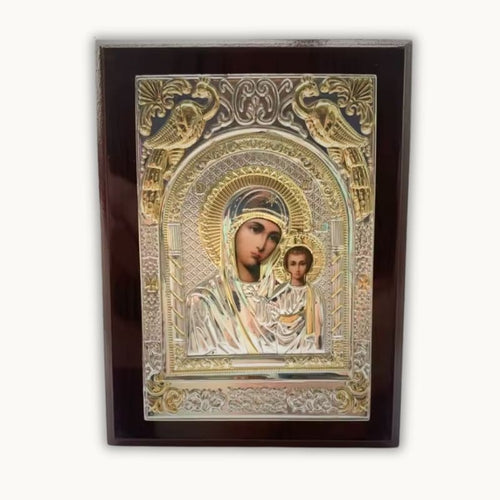
An icon of Saint Demetrios is one of the most meaningful name day gifts on 26 October — for all who bear a name derived from Demetrios. It can be placed in the prayer corner of the home or worn as a pendant. Our guide to the Orthodox icon explains how to venerate and choose a saint's icon.
FAQ — Frequently asked questions about Saint Demetrios
Who is Saint Demetrios of Thessaloniki?
Saint Demetrios of Thessaloniki is a Great-Martyr and Myrrh-gusher of the Orthodox Church, martyred in Thessaloniki around the year 306. A Roman officer from a noble Christian family, he refused to persecute Christians and openly preached the Gospel, before being imprisoned and run through with lances on the orders of Emperor Maximian. He is one of the most venerated warrior saints of the Orthodox world, patron of Thessaloniki, Constantinople, Venice, and Calgary.
When is the feast of Saint Demetrios?
The feast of Saint Demetrios is celebrated on 26 October in Orthodox churches following the New Calendar (Greek, Romanian, Bulgarian). In churches following the Old Calendar (Russian, Serbian, Georgian), this falls on 8 November by the civil date — known in Serbia as Mitrovdan. Millions of faithful bearing the names Demetrios, Dimitri, Dimitar, or Dumitru celebrate this as their name day.
Why is Saint Demetrios called the "Myrrh-gusher"?
The title Myrrh-gusher (Greek: Myrovlytis) designates saints from whose relics a fragrant holy oil miraculously flows. Since the 6th century, the relics of Saint Demetrios in the Basilica of Thessaloniki have been reported to stream this miraculous oil, the source of healings and miracles attested by witnesses from all Orthodox nations across the centuries.
Where are the relics of Saint Demetrios kept?
The relics of Saint Demetrios are kept in the Basilica of Saint Demetrios in Thessaloniki (Greece), a UNESCO World Heritage Site since 1988. The basilica is built over the Roman baths where the saint was imprisoned and martyred. Relics are also present in several monasteries of Mount Athos and other Orthodox churches worldwide.
What gift should I give for the feast of Saint Demetrios?
The traditional gift for the feast of Saint Demetrios is an icon of Saint Demetrios — as a standing warrior or on horseback — for anyone bearing a name derived from Demetrios. An Orthodox pendant with the saint's image or an Orthodox cross are also beloved name day gifts.
What is the connection between Saint Demetrios and Saint Nestor?
Saint Nestor is the young fellow martyr of Saint Demetrios. Demetrios blessed him in his prison cell before he faced the gladiator Lyaeos in the arena — and Nestor defeated the fearsome warrior miraculously, before being executed in turn by the Emperor. The Orthodox Church celebrates Saint Nestor the day after Saint Demetrios, on 27 October.
Is Saint Demetrios venerated outside the Orthodox Church?
Yes — Saint Demetrios is venerated in Eastern Orthodoxy, Oriental Orthodoxy, the Roman Catholic Church (feast on 9 April and 8 October), the Lutheran Church, and the Anglican Communion. He is therefore a truly ecumenical saint of the undivided Church. In the Catholic tradition he is more commonly associated with Sirmium (modern Sremska Mitrovica, Serbia) as the site of his martyrdom, following the research of the Bollandist scholar Hippolyte Delehaye.