

Reading time: 6 minutes
In Eastern Orthodox Christianity, the Virgin Mary is far more than a supporting figure. She stands at the very heart of theology, liturgy, and sacred art. Known by her Greek title Theotokos — "Mother of God" — the Orthodox Virgin Mary holds a place of honor found nowhere else in the Christian world. To truly understand her role, we need to go back to the earliest councils of the Church, to the foundations of Eastern Christianity, and into a living tradition that has never stopped celebrating her.

1. Who Is the Virgin Mary in Orthodox Christianity?
Theotokos: A Foundational Title
Everything begins with the title Theotokos. It was officially proclaimed at the Council of Ephesus in 431 AD, in response to the Nestorian heresy, which denied Mary this divine designation. For the Orthodox Church, calling Mary the Mother of God is first and foremost a statement about Christ — fully God and fully man — a foundational christological truth.
Mary is not venerated for her own sake apart from Christ. Her greatness is entirely bound to her role as the bearer of the incarnate Word. She is the door through which God entered human history.
A Woman of Flesh and History
According to the Gospels and the apocryphal writings recognized by Tradition — particularly the Protoevangelium of James — Mary was born to elderly parents, Anne and Joachim, who had dedicated her to the Temple from childhood. This miraculous birth, granted to a barren couple, already foreshadows the extraordinary destiny of the one who would conceive the Son of God.
Mary grew up in the Temple of Jerusalem in prayer and holiness. She was later entrusted to Joseph, a righteous man, before receiving the announcement of the Archangel Gabriel — the Annunciation — which marks the beginning of the Christian era.
2. The Place of Mother Mary in Orthodox Christianity
The Supreme Intercessor
In Orthodox faith, Mother Mary Orthodox tradition considers her above all the great intercessor. She prays for humanity before her Son, and her intercession is regarded as uniquely powerful. She is often called Panagia — "All-Holy" — a title that expresses the total purity of her being.
This intercession permeates every aspect of Orthodox life: the daily liturgies, morning and evening prayers, litanies and supplications. Believers ask for her protection — known as the Pokrov — which is itself commemorated as a major liturgical feast across the Orthodox world.
The Marian Icon: A Permanent Presence
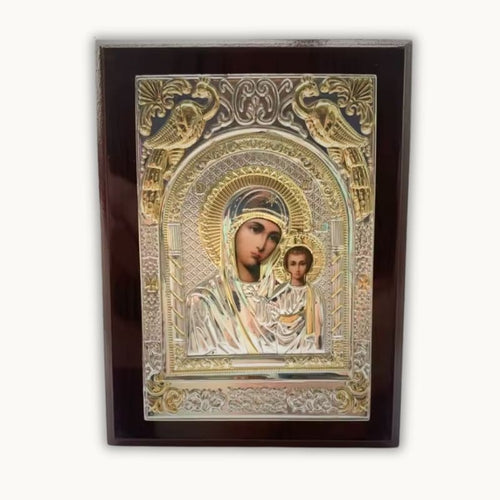
It is impossible to speak of the Eastern Orthodox Virgin Mary without mentioning Orthodox icons. In every Orthodox church, the Hodegetria ("She Who Shows the Way") and the Eleusa ("Virgin of Tenderness") hold prominent positions on the iconostasis. In every believing household, a sacred corner is dedicated to her image.
An icon is not merely artistic representation. It is a window opened onto the divine world — a real presence of the sacred in everyday life. Marian icons are among the most venerated in the Orthodox world, from the Russian Orthodox Virgin Mary of Vladimir (Vladimirskaya) to the Virgin Mary Greek Orthodox icon of Kazan, and the countless miraculous icons of Serbian, Romanian, and Bulgarian traditions.

3. Orthodox Virgin Mary vs. Catholic: What Are the Differences?
The question is a natural one. Both traditions share a deep veneration of Mary, yet their theological approaches differ on several important points.
What Brings Orthodox and Catholics Together
Both Churches recognize Mary as Theotokos, as the Perpetual Virgin, and grant her a supremely honorable place in liturgy. Both traditions celebrate major Marian feasts and have produced an extraordinary wealth of sacred art in her honor.
Key Differences Between Orthodox and Catholic Mariology
| Point | Orthodox Christianity | Roman Catholicism |
|---|---|---|
| Immaculate Conception | Not recognized | Defined as dogma in 1854 |
| Dormition / Assumption | Dormition (peaceful falling asleep) | Bodily Assumption (dogma since 1950) |
| Papal infallibility on Mary | Rejected | Accepted |
| Universal Mediatrix | Intercessor, not mediatrix in the strict sense | Ongoing theological debate |
The Orthodox Church rejects the dogma of the Immaculate Conception not out of disrespect for Mary, but because it understands original sin differently. For the Orthodox, Mary is holy through her free response to God, her total cooperation with divine grace — not through a prior exemption.
As for the Dormition, the Orthodox do not speak of a "bodily Assumption" in the Catholic sense, but of a peaceful falling asleep (Dormition) followed by resurrection and glorification — a significant theological nuance, even if the ultimate outcome is the same: Mary is with God, body and soul.
4. The Great Feasts of the Virgin Mary in the Orthodox Calendar
The Orthodox liturgical year is punctuated by numerous Marian feasts. Some belong to the Twelve Great Feasts of the Lord; others are specifically dedicated to the Mother of God.
The Nativity of the Virgin Mary — September 8
Mary's birth is celebrated as a cosmic event: the dawn of Redemption begins here. This feast is one of the twelve great feasts of the Orthodox calendar, marking the very beginning of the story of salvation.
The Presentation of Mary at the Temple — November 21
The entry of young Mary into the Temple of Jerusalem at the age of three is commemorated with great solemnity. It symbolizes the total gift of self to God from the earliest years of life.
The Annunciation — March 25
Mary's "yes" to the Archangel Gabriel is considered one of the most decisive moments in the history of salvation. It is the moment of the Incarnation — God taking on human flesh. This feast is so important that its date remains fixed even during Great Lent.
The Dormition of the Orthodox Virgin Mary — August 15
This is the most solemn Marian feast of the entire Orthodox liturgical year. The Dormition of the Virgin commemorates the peaceful death — the "falling asleep" — of Mary, surrounded by the apostles miraculously gathered, followed by her resurrection and entry into heavenly glory.
It is preceded by a two-week fast (August 1–14), which speaks volumes about the importance of this feast. In Orthodox countries — Greece, Serbia, Russia, Romania, Ukraine — it is celebrated as both a national and religious holiday. The Ukrainian Virgin Mary and Russian Orthodox Mary traditions both hold this feast in the highest regard.

The Protection of the Virgin (Pokrov) — October 1
A distinctly Slavic feast, it commemorates a tenth-century vision in which Mary extended her protective veil over besieged Constantinople. It symbolizes the ongoing protection of the Mother of God over her people — a feast particularly beloved in Russian Orthodox and Ukrainian traditions.
5. Mary in Orthodox Daily Prayer
The presence of Mary in Orthodox prayer is constant and unbroken. The most frequently recited prayer after the Our Father is arguably the Theotokion — a hymn to the Mother of God woven into nearly every liturgical office.
One of the most celebrated is the Axion Estin ("It Is Truly Meet"), sung in all Greek Orthodox churches and far beyond:
"It is truly meet to bless you, O Theotokos, ever blessed and most pure, and the Mother of our God. More honorable than the Cherubim, and more glorious beyond compare than the Seraphim..."
This prayer encapsulates in a few words the Orthodox vision of Mary: above all the angels, yet close to every human being.
6. Conclusion
The Orthodox Virgin Mary is far more than a figure of popular piety. She is the Theotokos, the All-Holy, the great intercessor, the Mother of the Church. Her place in Orthodox tradition is irreplaceable — present in every liturgy, every icon, every prayer, every feast. To understand the Eastern Orthodox Virgin Mary is to understand the very soul of Eastern Christianity: an embodied, sensory faith that believes Heaven bent toward Earth through a woman from Nazareth.
The Orthodox cross, another central symbol of the faith, is often depicted alongside Marian icons on the iconostasis — the two symbols together forming the heart of Eastern Christian identity.

7. Frequently Asked Questions About the Orthodox Virgin Mary
Do Orthodox Christians pray to the Virgin Mary?
Yes, but this is described as veneration and intercession, never adoration. Adoration (latria) is reserved for God alone. Mary is approached as a powerful intercessor who prays to her Son on behalf of believers.
What is the difference between the Orthodox Dormition and the Catholic Assumption?
The Orthodox Dormition emphasizes Mary's peaceful death — her "falling asleep" — followed by her resurrection. The Catholic Assumption, defined as dogma in 1950, affirms that Mary was taken up bodily into Heaven. Both traditions agree on her final glorification, but differ on the theological framing.
Why do Orthodox Christians call Mary "Theotokos"?
This title, proclaimed at the Council of Ephesus in 431, means "Mother of God." It affirms that Christ is one divine person — and therefore that his mother is truly the Mother of God, not merely the mother of his human nature.
What is the most important Marian feast in Orthodox Christianity?
The Dormition of the Virgin, celebrated on August 15, is the great Marian feast of the Orthodox year. Preceded by a two-week fast, it is experienced with an intensity comparable to Pascha in many Orthodox communities across Greece, Russia, Serbia, and Ukraine.