

Reading time: 10 minutes
The Orthodox wedding ceremony is one of the seven sacraments of the Eastern Christian Church — a holy mystery that unites two people not merely before witnesses, but within the Body of Christ itself. Its structure in two distinct parts, the symbolism of the crowning, the shared common cup, and the joyful procession around the Gospel book make it one of the richest and most beautiful Christian ceremonies in the world. This complete guide walks through every step of the ceremony, its theological meaning, and the traditions that vary across the different Orthodox churches — with a particular focus on what English-speaking guests, couples, and wedding planners need to know.
To understand the sacramental life in which the Orthodox wedding is rooted, our guide to preparing for Orthodox communion traces the eucharistic life in which Orthodox spouses are called to live their marital vocation.
Table of Contents
- The Orthodox wedding: a theology of marriage
- Preparing for an Orthodox wedding
- Part One: the Service of Betrothal
- Part Two: the Service of Crowning
- The crowns: joy and martyrdom
- The Dance of Isaiah
- Traditions across Orthodox churches
- Mixed marriages and remarriage
- Orthodox vs Catholic wedding: the key differences
- FAQ
The Orthodox Wedding: a Theology of Marriage
In the Orthodox tradition, marriage is not simply a blessing of a civil union or a social commitment made in God's presence. It is a sacrament — a mystery through which divine grace transforms a human union into something that entirely surpasses it. The Orthodox Church teaches that the married couple constitutes a little church (in Greek: ecclesia) — a community of salvation on a domestic scale, in which the spouses sanctify one another and become for each other a path toward God.
Unlike the Catholic understanding of marriage — where the spouses are the ministers of the sacrament, conferring it on one another through their mutual consent — in the Orthodox Church the priest is the minister of the sacrament. The consent of the spouses is necessary, but it is the priest's crowning that confers the mystery. This is why the whole service is sometimes called the "Mystery of Crowning."
Because the Church counts the Crowning among the Mysteries (Sacraments), it can only be performed by an Orthodox priest. A so-called "ecumenical wedding" mixing the rites of two different confessions is not possible from an Orthodox canonical standpoint. The wedding may also not be celebrated during the liturgical fasting seasons or on certain feast days.
One striking feature of the Orthodox wedding that surprises many Western guests: there are no wedding vows. The couple does not recite promises to one another. Instead, their commitment is expressed through their presence, their consent given at the beginning of the service, and above all through the sacramental act of the crowning itself — in which Christ, through his priest, unites them.
Preparing for an Orthodox Wedding
- Meeting with the priest — the couple meets with the parish priest to discuss the meaning of the sacrament, the canonical requirements, and the specifics of the local ceremony. Many Orthodox parishes require pre-marital counselling sessions.
- Confession — both spouses go to confession before the wedding. Ideally, the marriage follows immediately after the Divine Liturgy, and the couple receives communion.
- Fasting — by tradition, the couple fasts in the days before the wedding as spiritual preparation.
- Choosing the Koumbaros / Kum (wedding sponsor) — the koumbaros (Greek tradition) or kum (Slavic tradition) is the wedding sponsor — the spiritual godparent of the marriage. They play an active liturgical role (holding the crowns, exchanging the rings). In Serbian tradition, the bond between the kum and the couple (kumstvo) is considered as sacred as the bond of baptismal godparenthood.
- Civil marriage — in most English-speaking countries, the civil registration of marriage must either precede or accompany the religious ceremony. Check local requirements with your priest.
Part One: the Service of Betrothal
The Orthodox wedding service is actually two services in one — the Service of Betrothal and the Service of Crowning. Together they make up the Mystery of Holy Matrimony. In ancient times, the betrothal and crowning were separated by weeks, months, or even years. Today they are almost always celebrated together in a single service.
The narthex, the candles, and the consent
The Service of Betrothal begins in the narthex (the entrance hall of the church). The priest meets the couple there and presents them with lit candles — symbols of the light of Christ and the faith of the spouses. He then asks each of them to affirm their free consent to the marriage. Note that this exchange of consent is not what confers the sacrament — that happens in the Crowning — but it is canonically necessary for the validity of the union.
The blessing and exchange of rings
The priest blesses the rings and places them on the fingers of the couple. In Orthodox tradition, the gold ring is given to the man (he is the image of the Sun) and the silver ring to the woman (she reflects the light as the Moon does). The rings are then exchanged three times between the couple — usually by the koumbaros — in the name of the Holy Trinity. As St. Aidan's Orthodox Church expresses it: "The rings represent the couple's pledge to share and exchange spiritual and physical goods… Alone, one is incomplete — together they are whole." In most Orthodox traditions, the rings are worn on the right hand, not the left.
Part Two: the Service of Crowning
The Service of Crowning is the sacramental heart of the Orthodox wedding — the element that truly distinguishes an Orthodox wedding from all others. The procession moves to a ceremonial table (analogion) set up in the centre of the nave, on which the Gospel book, the cross, and the common cup are placed.
The joining of hands
The priest joins the right hands of the bride and groom and ties them with a bridal cloth, while praying: "Join these thy servants, unite them in one mind and one flesh." The hands remain tied throughout the entire service. This binding is a visible, physical sign of the union that is being effected.
The Scripture readings
Two New Testament texts are proclaimed: the passage from Ephesians (5:20-33) in which St. Paul describes marriage as an image of the union of Christ and the Church, and the Gospel of the Wedding at Cana (John 2:1-11) — Christ's first public appearance and his first miracle, performed for a couple celebrating their marriage. The Orthodox tradition sees in the Wedding at Cana Christ's own sanctification of marriage — his presence at a wedding feast is not incidental. As the common cup recalls: "As Christ changed the water into wine, the power of the sacrament changes the spouses from two into one."
The Crowning
The central moment of the service is the Crowning (stefanoma in Greek). The priest takes the wedding crowns and places them solemnly on the head of each spouse, proclaiming three times:
"The servant of God [name] is crowned unto the handmaiden of God [name], in the name of the Father, and of the Son, and of the Holy Spirit. Amen."
"The handmaiden of God [name] is crowned unto the servant of God [name], in the name of the Father, and of the Son, and of the Holy Spirit. Amen."
The koumbaros holds the crowns over the couple's heads for part of the service and exchanges them three times with arms crossed.
The Common Cup
After the Crowning, the couple drinks three times each from a shared cup of blessed wine. This Common Cup symbolizes the shared life ahead — joys and sorrows, successes and trials, all to be lived together from this moment on. The tradition holds that not a drop of wine should be spilled, an auspicious sign for the union. The cup is sometimes described as a foretaste of the heavenly banquet to which the couple, as a little church, is already oriented.
The Crowns: Joy and Martyrdom
The wedding crowns (stefana) are the most distinctive and theologically profound element of the Orthodox wedding. They are simultaneously crowns of joy and crowns of martyrdom.
Crowns of joy: the spouses are crowned as king and queen of their household — monarchs of their own little church, called to reign together in love and self-sacrifice. Crowns of martyrdom: marriage in Orthodox tradition is explicitly compared to martyrdom — not because it is a suffering, but because it demands the same total gift of self, the same self-emptying that the supreme witness of faith requires. The second hymn sung during the Dance of Isaiah — the Troparion of the Holy Martyrs — makes this connection explicit.
In the Russian and Slavic tradition, the crowns are typically metal — gold or silver, in Byzantine imperial form. In the Greek tradition, they may be made of natural flowers and leaves, lighter and more floral in character, symbolising union and new life. They are connected by a ribbon, which the koumbaros holds during the ceremony.
Historically, the couple was expected to wear the crowns for a full week after the wedding, with a formal "Removal of the Crowns" ceremony at the end of that week. Today it is more common for the crowns to be removed at the end of the wedding service itself, with the priest performing a brief blessing ceremony when the couple returns to the church after the honeymoon.
The Dance of Isaiah
The ceremony concludes with the Dance of Isaiah (Isaïas Chorevetai) — the oldest nuptial procession in Christianity. The priest, holding the Gospel in his right hand, takes the couple's joined hands in his and leads them in a procession three times around the ceremonial table, while the choir sings three successive hymns:
- The first — "Rejoice, O Isaiah!" — recalls the prophet's joy at the vision of the coming of the Messiah born of a Virgin
- The second — the Troparion of the Holy Martyrs — reminds the couple that they, like the martyrs, are called to total self-gift
- The third — an exaltation to the Holy Trinity — places the entire mystery of their union within the life of the Triune God
These three circuits are the couple's first steps as husband and wife in the eyes of God. The koumbaros follows them, holding the ribbon of their crowns in support. The circular path symbolises eternity — a journey without beginning or end. At each circuit, the couple kisses the cross held by the priest. The Gospel book on the table represents the faith in which their future children will be raised. In ancient times, this procession would have continued all the way to the couple's new home. As St. Michael Antiochian Church puts it: "Christ himself — through his priest and his Word — is leading them."
The service concludes with the dismissal. The priest removes the crowns, separates the couple's joined hands and says: "Go forth in peace." The congregation then sings Mnogaja Ljeta ("God grant you many years") in many traditions.
Traditions Across Orthodox Churches
- Greek Orthodox — crowns of natural flowers or leaves connected by a white ribbon; ceremony sung in Byzantine Greek; the koumbaros plays a central role; guests shower the couple with rice or flower petals during the Dance of Isaiah. The grandmother of one spouse sometimes joins the procession. Guests exclaim "Na zisete!" — "May you live!"
- Russian Orthodox — metal imperial crowns in gold; liturgy chanted in Church Slavonic; the ceremony is called Venchanie (from the Russian word for crown); the priest formally asks the will of each spouse. Guests call out "Gor'ko!" ("Bitter!") — a cue for the couple to kiss and "sweeten" the wine.
- Serbian Orthodox — the kum (koumbaros) is bound to the couple by the kumstvo, a sacred bond analogous to baptismal godparenthood; the ceremony is often linked to the family's Slava (patron saint feast).
- Romanian Orthodox — rich floral arrangements; the naşă (godmother) plays a role parallel to the godfather; the wedding feast is particularly festive with traditional songs and dances.
- Antiochian / Arabic Orthodox — chants in Arabic; the joyful ululations (zaghareet) of the women as the couple enters; a celebration that combines Eastern and Mediterranean festivity.
Mixed Marriages and Remarriage
Mixed marriages
The Orthodox Church permits marriage between an Orthodox Christian and a member of another Christian confession (Catholic, Protestant, Anglican), provided the children are raised in the Orthodox faith. The non-Orthodox partner must be a baptized Christian. Rules vary by jurisdiction. A mixed-rite "ecumenical wedding" — combining the liturgical rites of two confessions — is not possible from an Orthodox standpoint; the ceremony must be entirely Orthodox. Some jurisdictions are stricter than others: contact your local priest for specifics.
Divorce and remarriage
The Orthodox Church holds marriage to be indissoluble by nature. However, it applies the principle of oikonomia — a pastoral dispensation granted in mercy — to permit divorce in cases of adultery, abandonment, or other serious recognized grounds. A second church wedding is possible, but takes place in a more sober, penitential ceremony distinct from the festive first wedding. A third marriage is permitted in exceptional circumstances. A fourth is canonically forbidden.
Orthodox vs Catholic Wedding: the Key Differences
| Orthodox wedding | Catholic wedding |
|---|---|
| Priest is the minister of the sacrament | Spouses are the ministers of the sacrament |
| No wedding vows | Exchange of vows (central moment) |
| Crowning of the spouses (central moment) | No crowning |
| Common Cup of wine | No common cup |
| Dance of Isaiah — three processions | No circular procession |
| Gold ring (man) and silver ring (woman), worn on right hand | Matching rings, typically worn on left hand |
| Divorce permitted by oikonomia | Annulment (not divorce) |
| Second church wedding possible (penitential service) | Second church wedding only after annulment |
FAQ — Questions about the Orthodox Wedding
Are there wedding vows in an Orthodox wedding?
No — this surprises many Western guests. The couple does not recite vows to one another. Their commitment is expressed through their consent at the beginning of the service and, above all, through the sacramental act of the Crowning, in which the priest — acting in the name of Christ and his Church — unites them. The absence of vows is not an oversight: it reflects the Orthodox understanding that marriage is God's act, not primarily a human contract.
Can you get married in an Orthodox church if you are not Orthodox?
No, unless your partner is Orthodox. The Orthodox wedding is a sacrament of the Church — it requires that at least one partner be a baptized Orthodox Christian. Marriage with a non-baptized person is canonically impossible. Marriage with a baptized non-Orthodox Christian (Catholic, Protestant) is permitted in most jurisdictions, provided children are raised Orthodox and the ceremony is fully Orthodox. Contact the parish priest for your specific situation.
What is the koumbaros (or kum) at an Orthodox wedding?
The koumbaros (Greek tradition) or kum (Slavic tradition) — often translated as "wedding sponsor" or "best man" in English, though neither quite captures it — is the spiritual godparent of the marriage. They hold the crowns, assist with the ring exchange, and follow the couple in the Dance of Isaiah. Their bond with the couple is considered sacred, analogous to baptismal godparenthood.
Why do Orthodox Christians wear their wedding rings on the right hand?
In most Orthodox traditions, the wedding ring is worn on the right hand — the hand used for the sign of the cross, associated with blessing and strength. This is a direct continuation of ancient Christian and Byzantine practice. Some Orthodox Christians in Western countries adapt to the local custom of the left hand, but the right hand is the traditional and canonical norm.
What is the Dance of Isaiah and why is it done three times?
The Dance of Isaiah is the ceremonial procession of the newly crowned couple — led by the priest — three times around the ceremonial table bearing the Gospel. The three circuits represent the Holy Trinity. The circular path symbolises eternity — a journey without end. Three hymns are sung: Rejoice O Isaiah, the Troparion of the Holy Martyrs, and an exaltation to the Holy Trinity. It is the couple's first walk together as husband and wife, with Christ — through his priest — leading the way.
When can an Orthodox wedding not take place?
Orthodox weddings may not be celebrated during the liturgical fasting seasons: Great Lent, Holy Week, the Apostles' Fast (June–July), the Dormition Fast (1–14 August), and the Nativity Fast (15 November – 6 January). They are also not celebrated on the major feasts themselves. The most common wedding seasons are spring, summer (outside the fasts), and early autumn.
What are traditional gifts for an Orthodox wedding?
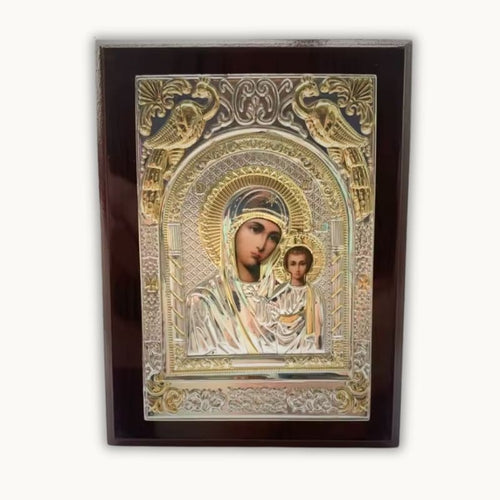
The most meaningful gifts for an Orthodox wedding are an icon of Christ or the Theotokos for the couple's home, an icon of their patron saints, or a prayer book. For the couple's new home, a beautiful icon for the prayer corner (krasny ugol) is a spiritually significant and lasting gift. Practical gifts and monetary envelopes are also common across most Orthodox cultural traditions.
To learn more about the liturgical seasons and feasts of the Orthodox calendar — and when weddings can and cannot be celebrated — see our guide to the Orthodox great feasts calendar.