

Reading time: 10 minutes
Who is the Orthodox priest? Why does he wear a long black robe in daily life and sumptuous embroidered vestments during the service? Can he marry? What is the difference between a deacon, a priest, and a bishop? Why do some wear a pectoral cross and others a medallion? This comprehensive guide answers all of these questions and opens the door to the hierarchy, the vocation, and the vestments of the Orthodox clergy — one of the most visible and least well-understood aspects of Eastern Christian tradition.
To understand the liturgical context in which the priestly ministry is exercised, our guide to the Divine Liturgy traces the structure of the eucharistic service in which the priest exercises his central ministry.
Table of Contents
- The three major orders of the Orthodox clergy
- The deacon: servant of the Church
- The priest: shepherd of the community
- The bishop: successor of the apostles
- The episcopal hierarchy: bishop, archbishop, metropolitan, patriarch
- Married clergy and monastic clergy: a fundamental distinction
- The everyday dress of the clergy
- The liturgical vestments of the priest, the deacon, and the bishop
- The liturgical colors and their meaning
- The priest as iconic presence
- FAQ
The Three Major Orders of the Orthodox Clergy
The Orthodox Church recognizes three major orders of the ordained clergy, established since apostolic times and confirmed by the first Ecumenical Councils:
- The episcopate — bishops (episkopoi, from the Greek episkopos, "overseer")
- The presbyterate — priests (presbyters, from the Greek presbyteros, "elder")
- The diaconate — deacons (diakonos, "servant")
There are also two minor orders — subdeacons and reader-chanters — who receive not ordination by laying on of hands (cheirotonia) but a special blessing (cheirothesia). Only bishops have the power to confer the sacrament of ordination at all levels, thereby preserving the unbroken apostolic succession from the apostles.
The organization of the Orthodox Church is both hierarchical and conciliar. It is hierarchical in that priests, deacons, and laypeople are expected to follow their bishop. But it is also conciliar in that there is no single superior position whom all bishops follow — rather, bishops meet together in synods and reach binding decisions through consensus. As one American Orthodox parish puts it: the Church is like a symphony orchestra, with Christ as the conductor. The bishop is not the conductor — he is part of the orchestra too, helping to keep everyone to tempo. All members of the Body of Christ, in their given offices, work together as the dwelling place of the Holy Trinity.
The Deacon: Servant of the Church
The word deacon comes from the Greek diakonos, meaning literally "servant." In the early Church, the seven first deacons were chosen by the apostles to "serve tables" at the community meals (Acts 6:2-4), freeing the apostles for prayer and the ministry of the Word. This dimension of concrete service has remained at the heart of the diaconal office.
In the Orthodox Church, the diaconate is not merely a stepping-stone to the priesthood — many deacons have no intention of ever becoming priests. They see it as a permanent office, a position for full or part-time service to the work of the Church. In the Orthodox liturgy the deacon plays an essential and highly visible role:
- He chants or reads the Gospel during the Divine Liturgy
- He pronounces the ektenias (litanies) — the long series of petitions to which the faithful respond "Lord, have mercy"
- He censes the altar, the iconostasis, the faithful, and the icons, under the direction of the celebrating priest
- He announces the key moments of the liturgy and directs the assembly
A deacon may not celebrate the sacraments by himself; he may not give blessings; he may not consecrate the Holy Gifts. His ministry is that of the proclaimed Word and of active service to the gathered community. A deacon cannot serve without the blessing of the presiding priest or bishop even to put on his vestments.
Within the Orthodox tradition, there are further distinctions: the protodeacon (first deacon of a cathedral), the hierodeacon (deacon-monk), and the archdeacon (the bishop's personal deacon, who ranks above all other deacons).
The Priest: Shepherd of the Community
The Orthodox priest is the ordinary shepherd of the parish community. His ministry is sacramental, pastoral, and prophetic. The Orthodox Christian Network summarizes the three duties of the priest as preaching, teaching, and healing: he presides over the Divine Services and sacraments; he teaches through Bible studies, catechism, and informal pastoral contact; and he heals through the sacraments of confession, anointing, and his pastoral accompaniment of the sick and dying.
Specifically, the Orthodox priest celebrates:
- The Divine Liturgy of the Eucharist — the center of his entire priestly life
- Baptism and Chrismation — including the First Communion of the newly baptized
- Confession (the sacrament of reconciliation)
- The marriage service (crowning)
- The holy unction (euchelaion) for the sick
- Funeral services and memorial offices for the departed
- The blessing of water, homes, icons, and liturgical objects
The priest's authority to lead, teach, and represent his people before God comes to him in the sacrament of ordination — not from the people, even though the ancient Church involved the people in the election of their clergy. Each parish altar holds an Antimension — a cloth signed by the bishop representing his permission for the parish to celebrate the Eucharist as part of the Church. Without this Antimension no priest can legitimately celebrate the Divine Liturgy.
The Bishop: Successor of the Apostles
The bishop stands at the top of the hierarchy of the sacrament of Holy Orders. He is the direct heir of the apostolic succession: every bishop has received the laying on of hands from another bishop, who received it in an unbroken chain going back to the apostles. It is precisely this succession that guarantees, for the Orthodox Church, the validity of the sacraments celebrated in every parish throughout the world.
The bishop alone can:
- Ordain deacons, priests, and bishops
- Consecrate the Holy Chrism (together with the Patriarch)
- Consecrate a new church or altar
According to the canons, at least two bishops are required to ordain another bishop. At each ordination, the ordaining bishop cries out "Axios!" — "He is worthy!" — and the congregation must respond in kind; if they do not, the ordination is considered invalid. This ancient practice of congregational assent reflects the Orthodox understanding that ordination is a gift to the whole Church, not just to the individual. The bishop carries the pastoral staff (paterissa), sign of his charge as shepherd.
The Episcopal Hierarchy: Bishop, Archbishop, Metropolitan, Patriarch
Within the episcopate, various titles distinguish offices and dignities:
- Bishop — the basic title, responsible for a diocese
- Archbishop — a senior bishop of an ecclesiastical province
- Metropolitan — bishop of a major metropolis; in many jurisdictions the metropolitan ranks above the archbishop
- Patriarch — primate of an autocephalous (independent) Church: Patriarch of Constantinople, Moscow, Antioch, Jerusalem, Serbia, Romania, Bulgaria, Georgia… The Patriarch of Constantinople holds the title Ecumenical Patriarch and is considered "first among equals" (primus inter pares) of the entire Orthodox world, without exercising universal jurisdictional authority over the other Orthodox churches.
There is also the title of auxiliary bishop (or vicar bishop), who assists a diocesan bishop without having his own diocese.
Married Clergy and Monastic Clergy: A Fundamental Distinction
One of the most frequently misunderstood aspects of the Orthodox clergy concerns celibacy — and it deserves a precise explanation, especially for readers from Protestant or Catholic backgrounds.
In the Orthodox tradition, the canonical rule is as follows:
- A married man may be ordained as a deacon or priest — provided he married before his ordination. He may not marry after being ordained.
- Bishops are required to be celibate — since the reforms of Emperor Justinian in the 6th century, bishops have been chosen from the celibate clergy, and for several centuries now almost exclusively from among monks.
- A single man ordained as a priest must maintain celibacy thereafter. Often the tonsure to the monastic state is given at the same time.
Contrary to a widely held assumption, Orthodox priests are not all celibate. The great majority of Orthodox parish priests are married men and fathers of families. The celibacy requirement applies only to the episcopate. A married priest whose wife dies may not remarry and must continue his ministry. He may in some cases be received into a monastery and become a monk.
The marriage of a priest is also bound by specific canonical requirements: it must be his first marriage (and his wife's first marriage), because the Orthodox Church sees the priest's family life as a direct expression of his pastoral character — the same qualities that make a good husband and father make a good parish priest.
The Everyday Dress of the Clergy
Outside the liturgy, Orthodox clergy are recognizable by their specific dress, which signals their belonging and their ordination:
The inner cassock (anteri / podriasnik)
The base garment, worn close to the body, is a long fitted robe, generally black. In Russian it is called the podriasnik; in Greek, the anteri or inner rason. It covers the body from the neck to the ankles. Like all the black garments of the clergy, it symbolizes death to the world and all worldly things, and the clergyman's renunciation of all earthly vanity.
The outer cassock (exorasson / ryassa)
Over the inner cassock, the priest wears a long, loose-fitting robe with wide, draped sleeves — the exorasson in Greek, the ryassa in Russian. This is the garment that gives the Orthodox priest his characteristic silhouette in public. It is not a liturgical vestment in the strict sense — the priest wears it in all his daily activities, including pastoral visits, confessions, and funeral services. It is also worn under all liturgical vestments during services.
The kamilavkion and veil (klobuk)
Depending on tradition, the priest wears a specific head covering: the cylindrical kamilavkion (purple, for Greek priests of dignity) or the klobuk (a black hat with a trailing veil, for monastic priests in the Slavic tradition). Bishops wear a white or decorated klobuk.
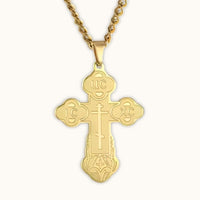
The pectoral cross
The priest wears a pectoral cross (enkolpion) on his chest, hung on a chain. It signals his ordination and identifies him as a priest in all his pastoral activities. The bishop's cross is generally more elaborate, often adorned with stones or enamels and may contain a relic — in which case it is called the Panagia, distinguishing the bishop from ordained priests who wear only a pectoral cross.
The Liturgical Vestments of the Priest, the Deacon, and the Bishop
During the Divine Liturgy and other sacramental services, the priest puts on a set of liturgical vestments in a precise order, each accompanied by a specific prayer. As St. Barbara Greek Orthodox Church expresses it: "When the celebrant wears his sacred vestments he is an instrument of God, through whom the Holy Spirit acts. Whatever he may be as an individual outside the church, when officiating he is the representative of Christ through whom the Grace of the Holy Spirit is given to the faithful." The order of vesting, from innermost to outermost:
The sticharion
A long white or gold robe reaching to the feet — the first vestment put on. The equivalent of the Latin alb. It symbolizes the "robe of salvation," the white garment every Christian receives on the day of their baptism. It reminds the wearer that the grace of the Holy Spirit covers him as with a garment of salvation and joy.
The epitrachelion
The priestly stole, worn around the neck and hanging in front of the chest, with the two bands joined together — which distinguishes it from the Latin stole worn crossed or straight. It is the indispensable sign of the priesthood: without the epitrachelion no celebration is possible. It symbolizes the outpouring of the Holy Spirit on the priest. A priest cannot celebrate any sacrament without it, even outside a formal service.
The epimanikia (cuffs)
Stiff cuffs laced onto the wrists, tied with a long cord. They serve a practical purpose — keeping the wide sleeves of the sticharion out of the way during the services — and a theological one: they remind the wearer that he serves not by his own strength but with the help of God. The prayer said when putting on the right-hand cuff is: "Your right hand, O Lord, is glorified in strength; your right hand, O Lord, has shattered the enemy." (Exodus 15:6-7) The prayer for the left: "Your hands have made me and fashioned me; give me understanding that I may learn your commandments." (Psalm 119:73)
The zone (belt)
A fabric belt worn over the epitrachelion, cinching the tunic. It symbolizes strength and endurance in the service of God, and recalls the linen belt worn by the priests of the Old Testament.
The phelonion
The outer vestment — the most visible and most characteristic garment of the Orthodox priest. A large, sleeveless conical chasuble (Greek tradition) or truncated trapezoid with a shorter front panel (Russian tradition), worn over all the other vestments. It symbolizes the scarlet robe with which the soldiers clothed Christ before his crucifixion, reminding the priest that he is invested with truth and must be a minister of truth. The prayer said when putting it on: "Your priests, O Lord, shall clothe themselves with righteousness, and your saints shall rejoice with joy." (Psalm 132:9) The phelonion descends from the Roman paenula — a large bell-shaped traveling cloak — adopted by the early Church in its first centuries as a liturgical garment.
Distinctions for the deacon
The deacon wears the sticharion and the orarion — a long, narrow band of brocade material draped over the left shoulder, hanging in front and behind. The orarion has seven crosses embroidered along its length. The deacon holds one end up when leading the litanies and wraps it over the shoulders at communion. It symbolizes the wings of angels, because the deacon represents the angelic presence in the liturgy. The priest's epitrachelion and the bishop's omophorion are specialized forms of the orarion.
The bishop's special vestments
The bishop does not wear the phelonion but the sakkos — a short, wide-sleeved tunic with bells sewn at the sides, inherited from the Byzantine imperial garment. It represents the same scarlet tunic as the phelonion. He also wears:
- The omophorion — a wide embroidered band worn around the shoulders, the pre-eminent sign of episcopal dignity. It symbolizes the lost sheep that Christ the Good Shepherd carries back on his shoulders. There is a Great Omophorion (worn from the beginning of the liturgy until the Gospel reading) and a Small Omophorion (worn from the Gospel to the end of the liturgy).
- The epigonation — a diamond-shaped piece of stiff cloth hanging from the right side, symbolizing the spiritual sword of the Word of God
- The mitre — a richly embroidered crown adorned with icons and surmounted by a cross, worn during the liturgy
- The pastoral staff (paterissa) — sign of his charge as shepherd and guide of the flock
- The Panagia — the episcopal breast medallion (often containing a relic), distinguishing the bishop from priests who wear only a pectoral cross
The Liturgical Colors and Their Meaning
The color of the phelonion (and of liturgical vestments generally) varies according to the liturgical season and the nature of the feast being celebrated:
- Gold / yellow — the dominant color for ordinary Sundays and feasts of the Lord; symbolizes divine glory and the uncreated light
- White — Pascha (Easter), Theophany (Epiphany), Transfiguration; symbolizes the light of the Resurrection
- Red — Pentecost and feasts of the martyrs; symbolizes the blood of Christ and the fire of the Holy Spirit
- Blue / purple — feasts of the Theotokos (Mother of God); symbolizes purity and heaven
- Green — feasts of ascetics and holy fools; symbolizes eternal life and hope
- Black / dark purple — Great Lent and Holy Week; symbolizes mourning and repentance
The Priest as Iconic Presence
Orthodox theology does not reduce the priest to an administrative or ritual function. OrthodoxWiki notes a striking theological observation: each ordination is also viewed as a kind of martyrdom. The Orthodox cleric agrees to be a servant of both Jesus Christ and of the people of the Church; many of the vestments are intended to remind him of this. The liturgical vestments, in this sense, are not regalia of honour but instruments of servitude.
The priest is himself a sign — a living image of Christ the Shepherd, made visible in the community by his ordination, his vestments, and his ministry. The faithful approach their priest in faith in his ministry and ask for his blessing — not because they honour his person, but because they recognise in him the grace of ordination. As the vesting prayers themselves express it, the priest acts not by his own strength, but as an instrument through whom the grace of the Holy Spirit reaches the faithful.
This theology of the priest's iconic presence is inseparable from the theology of the icon itself. To explore this dimension further, our complete guide to the Orthodox icon offers a comprehensive introduction to the role of the sacred image in Eastern Christian tradition.
FAQ — Questions about the Orthodox Priest
Can an Orthodox priest get married?
Yes — provided he marries before his ordination. The Orthodox canonical rule allows married men to be ordained as deacons and priests; a man may not, however, marry after being ordained. The great majority of Orthodox parish priests are married men and fathers of families. Only bishops are required to be celibate.
What is the difference between a priest, a hieromonk, and a hierarch?
A priest (or presbyter) is an ordained man, married or celibate, exercising his ministry in a parish. A hieromonk is a monk ordained to the priesthood — he is at once a monk and a priest. A hierarch generally designates a bishop drawn from the monastic state (which is almost universally the case in contemporary Orthodoxy).
What does "archimandrite" mean?
An archimandrite is an honorary title conferred on distinguished hieromonks (priest-monks), often superiors of major monasteries. It is the highest title of the monastic clergy below the episcopate. In the Slavic tradition, the equivalent honorary title for distinguished married priests is archpriest (or protopresbyter).
What does "Axios!" mean at an ordination?
Axios! (Greek: Ἄξιός, "He is worthy!") is the acclamation cried out by the ordaining bishop during the ordination ceremony. The congregation must join in this cry — if they do not, the ordination is considered invalid. It is an ancient form of congregational assent to the worthiness of the candidate, reflecting the Orthodox understanding that ordination is a gift given to the whole Church, not merely to the individual.
What is the difference between an Orthodox patriarch and the Pope?
An Orthodox patriarch is the primate of an autocephalous (independent) Church — he has no universal jurisdictional authority over other Orthodox churches. The Ecumenical Patriarch of Constantinople is "first among equals" (primus inter pares), which confers an honorary precedence but not governing power over the whole of Orthodoxy. The Pope, by contrast, exercises universal jurisdiction over the Roman Catholic Church — a fundamentally different ecclesiology.
How should you address an Orthodox priest?
In English-speaking Orthodox communities, a priest is typically addressed as Father [Name]. A bishop is addressed as Your Grace (bishop), Your Eminence (archbishop or metropolitan), or Your Beatitude (patriarch). In Slavic-tradition parishes you may also hear Vladyka for the bishop, a word meaning "Lord" or "Master."
Does an Orthodox priest receive a salary?
This varies by Church and country. In historically Orthodox countries (Greece, Russia, Romania…), priests may receive state or Church support. In English-speaking countries (the UK, USA, Australia…), priests typically live on the offerings of their faithful, sometimes supplemented by secular employment. Seminary training is required in most jurisdictions, with course of study generally running about three years.