

There is an old man in the Gospel of Luke about whom almost nothing is known — not his exact age, not his family, not his occupation — but about whom one essential thing is known: he waits. He has been waiting for decades, perhaps for an entire lifetime, for something he may never see. The Holy Spirit has promised him that he will not die before seeing the Christ of the Lord. And he waits. Every morning he enters the Temple. He looks into faces. He waits. And then, one day, a young woman enters carrying a newborn in her arms, and he knows. He steps forward, takes the child into his old arms, and speaks the words the Church will never cease singing: "Now, O Master, let your servant depart in peace." This old man's name is Simeon. And his story is at the heart of the feast the Orthodox Church celebrates on February 2.
The Holy Meeting of our Lord, God and Savior Jesus Christ — in Greek Hypapante tou Kyriou, "the meeting with the Lord" — is one of the Twelve Great Feasts of the Orthodox Church, the Dodekaorton. Celebrated every year on February 2 in the churches of the Gregorian calendar and on February 15 in those of the Julian calendar, it commemorates the encounter between the Christ child and the righteous Simeon in the Temple of Jerusalem, forty days after the Nativity. It is the last of the great feasts of the Nativity cycle — and, as we shall see, in many respects the most mysterious.
Simeon: a man who waited for the consolation of Israel
To understand the Meeting of the Lord, one must first understand Simeon. The Gospel of Luke (2:25–35) describes him in four words: "righteous and devout, waiting for the consolation of Israel." Righteous — that is, faithful to the Law. Devout — that is, in constant prayer. Waiting — that is, wholly turned toward something that has not yet arrived. These three qualities make Simeon the ideal figure of faithful Israel — the living summary of all those who have believed in the promises without seeing them fulfilled: Abraham, Moses, the prophets, all the righteous of the Old Covenant who lived in hope of a promise yet to come.
The patristic and liturgical tradition of Orthodoxy has enriched this spare Gospel portrait. According to some ancient texts, Simeon was one of the seventy translators of the Hebrew Bible into Greek — the authors of the Septuagint — and is said to have lived for several centuries. When translating the passage of Isaiah announcing that "the Virgin will conceive and bear a son" (Is 7:14), he reportedly wished to correct the word "virgin" to "young woman," considering the thing biologically impossible — and an angel stopped him, promising that he would live until he saw the fulfillment of that prophecy. Whether history or pious legend matters little: this account says something essential about the nature of faith — the faith that takes seriously what human reason considers impossible.
What is certain is that Simeon waited. And Simeon's waiting is the model of all Christian waiting — the permanent Advent of the Church that awaits the return of her Lord. When he takes the Child into his arms, it is all of waiting humanity, all the hope of history, that finally holds in its hands what it was made for.
Four figures, one encounter
The feast of the Meeting of the Lord brings four figures onto the stage, each carrying a distinct theological significance in the economy of salvation.
The Christ Child: the Lord who comes into His own Temple
The first figure is the most outwardly unassuming: a forty-day-old newborn, carried on an arm, incapable of speech. And yet He is the Lord of the Temple He is entering. In this gesture lies a striking paradox that Orthodox liturgy comments on at length: the Master of the house is carried in like a stranger into His own dwelling. The One who had ordered the construction of the first Temple by Solomon now arrives, as a small child, in that same Temple — nameless, dependent, silent. It is the same mystery of humility as the Nativity, but in a different setting.
Mary and Joseph: obedience to the Law
The second and third figures are Mary and Joseph. They come to fulfill two prescriptions of the Law of Moses: the purification of the mother forty days after the birth of a son (Lv 12:2–8), and the consecration of the firstborn male to the Lord (Ex 13:2; 13:11–13). The Mother of God, who has not sinned and therefore has no need of purification, nonetheless submits to this law in humility — and because Christ Himself submits to it. Their offering — "a pair of turtledoves or two young pigeons" (Lk 2:24) — is that of the poor, according to the Law. The Mother of God and the Son of God enter the Temple as the poor, without splendor, without escort, without any distinguishing sign.
Anna the prophetess: the voice of the Church to come
The fourth figure is often overlooked but theologically significant: Anna, the daughter of Phanuel, a widow for many years, who "did not depart from the Temple, worshipping with fasting and prayer night and day" (Lk 2:37). Anna embodies the ecclesial dimension of recognition — where Simeon is faithful Israel receiving the Messiah, Anna is the figure of the Church proclaiming the Savior's coming to all. She begins "speaking of him to all who were waiting for the redemption of Jerusalem" (Lk 2:38) — the first act of missionary proclamation of the Gospel.
The Nunc Dimittis: the canticle of a man who can die in peace
The theological and poetic summit of the event is the canticle of Simeon — known in the Latin tradition as the Nunc Dimittis, from the opening words of its Latin version — one of the most beautiful and beloved texts in the entire Christian tradition:
"Lord, now you are letting your servant depart in peace, according to your word; for my eyes have seen your salvation that you have prepared in the presence of all peoples: a light for revelation to the Gentiles, and for glory to your people Israel."
— Canticle of Simeon (Nunc Dimittis), Luke 2:29–32, Orthodox liturgical tradition
This canticle is sung in the Orthodox Church every evening at Compline — the night prayer before sleep. It is the prayer of the believer who has received Christ into his life and can now face night and death without fear. Simeon's "let me depart in peace" is the prayer of every Christian who holds Christ in their arms through faith and the sacraments and can now pass through death as Simeon passed through his long waiting: in peace.
Simeon then adds darker words, addressed to Mary alone: "Behold, this child is appointed for the fall and rising of many in Israel, and for a sign that is opposed — and a sword will pierce through your own soul also — so that thoughts from many hearts may be revealed." (Lk 2:34–35) This prophecy of the sword piercing Mary's soul is one of the keys of Orthodox Marian spirituality: the Mother of God is the first to carry the Cross of her Son — already forty days after his birth.
The hinge feast: between Christmas and Pascha
The Meeting of the Lord occupies a singular position in the Orthodox liturgical calendar: it is the hinge between the Nativity cycle and the Paschal cycle. Forty days after Christmas, it definitively closes the season of Christ's birth. And at the same time, Simeon's words about falling, rising and the sword already sound the accents of the Passion — Christmas is not only a feast of tenderness and light, it carries within itself the seeds of the Cross.
The Orthodox tradition sometimes calls the Meeting of the Lord the "feast at the midpoint" — not in a mathematical sense, but a spiritual one: it is the moment when the Church turns her gaze from the manger toward the Cross, from the wonder of Christmas toward the seriousness of the approaching Great Lent. In some monastic calendars, the Meeting of the Lord even opens a preparatory period leading into the Great Fast.
This hinge position is also expressed in the feast's double nature. The Meeting of the Lord is officially classified among the feasts of the Lord in the Orthodox calendar — not as a Marian feast. And yet its Troparion addresses the Mother of God ("Rejoice, O Full of Grace..."), and its liturgy honors both the Child and His Mother. It is one of the rare great feasts of the Dodekaorton that is fully both a feast of the Lord and a feast of the Theotokos at once.
Historical origins of the feast
The Meeting of the Lord is one of the oldest Christian feasts. It is attested in Jerusalem as early as the 4th century, where the pilgrim Egeria describes it in her Travel Diary (around 381–384) as an already established celebration, observed forty days after January 6 (Epiphany in Jerusalem) — that is, on February 14. After the relocation of Christmas to December 25, the feast settled on February 2.
In 542, Emperor Justinian gave the feast renewed importance. A devastating plague epidemic was ravaging Constantinople. According to tradition, a Christian received the inspiration to organize a great procession with lit candles in honor of the Meeting of the Lord — and the plague ceased. Justinian declared the feast official and universal throughout the Byzantine Empire and elevated it to the rank of the great feasts of the Lord. It is likely to this event that the tradition of blessed candles on Candlemas traces its origin — preserved in both East and West.
February 2: a fixed date in both calendars
The Meeting of the Lord is a fixed feast. The churches of the revised Julian calendar — the Ecumenical Patriarchate, Greek Orthodox Church, Romanian Orthodox Church, Patriarchate of Antioch — celebrate it on February 2. The churches of the Julian calendar — the Russian Orthodox Church, Serbian Orthodox Church, Georgian Orthodox Church, Church of Jerusalem — celebrate it on February 15 in the Gregorian reckoning, which corresponds to their Julian February 2. When the feast falls during Cheesefare Week (the week before Great Lent), the services receive a liturgy adapted according to the rules of the Typikon.
Liturgy and iconography
The services and hymns
On the eve of the feast (February 1), Great Vespers with Lity are celebrated. Three Old Testament readings are proclaimed: passages from Exodus, Leviticus and the Book of Numbers, concerning the consecration of the firstborn to the Lord, prefiguring the coming of Christ to the Temple. The Divine Liturgy on February 2 proclaims as its Epistle the passage from Hebrews 7:7–17 (Christ the high priest according to the order of Melchizedek) and as its Gospel that of Luke 2:22–40 — the complete account of the Meeting.
The Troparion of the Meeting of the Lord is addressed to the Mother of God — an unusual feature for a feast officially classified among the feasts of the Lord:
"Rejoice, O Full of Grace, Mother of God and Virgin, for from you has risen the Sun of Righteousness, Christ our God, enlightening those who dwell in darkness. Rejoice also, O righteous elder, who received in your arms the Liberator of our souls, granting us the Resurrection."
— Troparion of the Meeting of the Lord, Tone 1, Orthodox liturgical tradition
The Kontakion of the feast expresses the mystery of the encounter between the Old and the New Testament:
"You who sanctified the Virgin's womb by Your birth and blessed Simeon's hands as was fitting, have come early now to save us, O Christ our God. But grant peace amid the conflicts of nations and strengthen those who love You, O only Lover of mankind."
— Kontakion of the Meeting of the Lord, Tone 1, Orthodox liturgical tradition
The liturgical color proper to the Meeting of the Lord is white or Marian blue, according to local tradition. The Apodosis (leave-taking) of the feast is celebrated on February 9.
The icon of the Meeting of the Lord
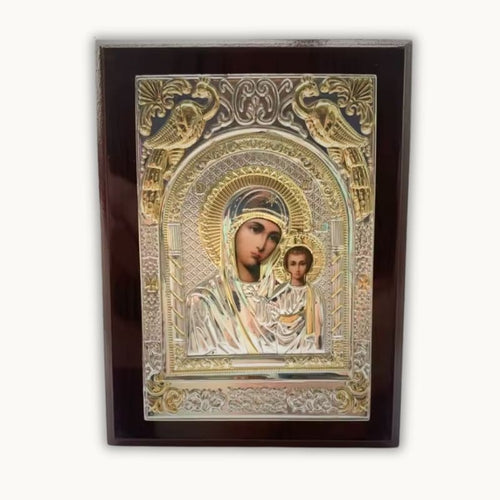
The icon of the Meeting of the Lord depicts the central Gospel scene in its full theological density. At the center, Simeon holds the Christ Child in his outstretched arms, veiled by a liturgical cloth — a sign that even his old hands are not worthy to touch the Body of the Lord directly. His face expresses a joy permeated by infinite peace. Facing him, the Mother of God reaches out her arms toward the Child with an expression at once joyful and touched with sorrow — she knows what Simeon has foretold her. Behind her, Joseph carries the two doves of the poor man's offering.
In the background, Anna the prophetess is depicted holding a scroll or with her hand raised in a gesture of prophecy. Behind Simeon, angels sometimes form an invisible court around the Child. The entire composition expresses the passage from one Covenant to another: two worlds touch — the Old Testament embodied by Simeon and Anna, the New Testament embodied by the Child and His parents. The encounter takes place in the Temple — neither outside the world nor outside history — but in the very place where God had established His dwelling among His people.
The tradition of blessed candles
The Meeting of the Lord is intimately linked to the tradition of candles. Both in Orthodox liturgy and in the Catholic tradition (Candlemas), the faithful bring their candles to church to have them blessed at the feast. This ancient tradition — whose origins trace back at least to the reign of Justinian — symbolizes Christ Himself, described by Simeon as "a light for revelation to the Gentiles" (Lk 2:32).
The candle blessed at the Meeting of the Lord is kept in the home throughout the year. It is lit at important moments — during evening prayers, in times of illness, storm or danger, at the deathbed of a loved one. It reminds every home that Christ is the light that does not go out — the light that Simeon held in his arms and that every Christian is called to carry through life.
The Meeting of the Lord in English-speaking Orthodox communities
In the United States, Canada, the United Kingdom and Australia, Orthodox parishes of various jurisdictions celebrate the Meeting of the Lord on February 2 with genuine liturgical joy. Unlike in parts of continental Europe, Candlemas has largely faded from the broader cultural consciousness in English-speaking countries — making the Orthodox celebration something of a quiet discovery for parishioners and inquirers who encounter it for the first time. Many priests take the occasion to give a homily on Simeon as a figure of patient faith, which resonates deeply with converts and lifelong Orthodox alike. The blessing of candles after the Divine Liturgy is particularly beloved in Russian, Romanian, Serbian and Greek communities: families bring candles that will be lit throughout the year — at baptisms, funerals, the first day of school, recovery from illness — carrying the light of the feast into the ordinary texture of daily life. For many Orthodox Christians in English-speaking countries, the Meeting of the Lord is one of the most quietly profound feasts of the entire year — the feast of those who have waited long and finally hold what they were made for.
FAQ — Frequently asked questions about the Meeting of the Lord
Why "Meeting" and not "Presentation" in the Orthodox tradition?
The Greek name Hypapante means literally "to go out to meet" — and it is this meaning that stands at the heart of the Orthodox feast. The Presentation is a legal rite reserved for firstborn males (as for Christ) — but this is not what the Orthodox feast primarily celebrates. It celebrates the meeting: the encounter between God made man and Simeon, between Christ and faithful Israel, between the New and the Old Testament, between promise and fulfillment. The term "Meeting" expresses the theological dynamic of the event far more richly than "Presentation."
Who was Simeon really?
The Gospel of Luke gives very little information about Simeon: he was righteous and devout, he was waiting for the consolation of Israel, and the Holy Spirit rested upon him. The Orthodox tradition sometimes identifies him with one of the translators of the Septuagint who is said to have lived for centuries awaiting the Messiah he had prophesied. The Orthodox Church commemorates him on February 3 — the day after the Meeting — as Saint Simeon the Just, the God-receiver (Theodochos).
Is the Meeting a feast of the Lord or a Marian feast?
Officially, in the Orthodox Typikon, the Meeting of the Lord is classified among the feasts of the Lord — not the Marian feasts. And yet its Troparion is addressed to the Mother of God, and the liturgy fully honors her. This ambiguity is deliberate: the feast says that Christ and His Mother are inseparable in the mystery of the Incarnation. One cannot honor the Child without honoring the one who carries Him; one cannot contemplate the Theotokos without contemplating the One she carries. The Meeting is therefore, in practice, both at once — which makes it a unique feast in the entire Dodekaorton.
When exactly is the Meeting of the Lord in 2027?
In 2027, the Meeting of the Lord is celebrated on Monday, February 2, 2027 by the Orthodox churches of the Gregorian calendar (Greek, Romanian, Antiochian, etc.) and on Sunday, February 15, 2027 by the churches of the Julian calendar (Russian, Serbian, Georgian).
How does one prepare for the feast of the Meeting of the Lord?
Preparation includes attending Great Vespers on the evening of February 1 and the Divine Liturgy on the morning of February 2. Confession and Holy Communion are recommended. It is traditional to bring candles for blessing during the Liturgy. Meditating on the text of Luke 2:22–40 — the complete account of the Meeting — and the Canticle of Simeon (Nunc Dimittis, Lk 2:29–32) prepares the heart for the depth of the feast.
Simeon can depart — and so can we
The Meeting of the Lord is perhaps the most intimate of all the great Orthodox feasts. It brings no crowds, no spectacular miracles, no cosmic manifestations. It brings an old man, a child, two outstretched arms, and a few words that say everything: "Now let me depart in peace, for my eyes have seen your salvation."
It is the feast of those who have waited long. The feast of those who have believed without seeing. The feast of those who, like Simeon, hold Christ in their arms through the sacraments and can now pass through life — and through death — in peace. Every Eucharist is a Meeting of the Lord: one holds the same Child, one speaks the same words — and can depart in peace.
In 2027, this feast will be celebrated on Monday, February 2 in all Orthodox churches of the Gregorian calendar. It is an appointment of light in the heart of winter — with old Simeon, with Anna the prophetess, with the Mother of God and her Child, in the half-darkness of a Temple into which the Light of the world has just made His entrance.
"Rejoice, O Full of Grace, Mother of God and Virgin, for from you has risen the Sun of Righteousness, Christ our God, enlightening those who dwell in darkness. Rejoice also, O righteous elder, who received in your arms the Liberator of our souls, granting us the Resurrection."
— Troparion of the Meeting of the Lord, Orthodox liturgical tradition