

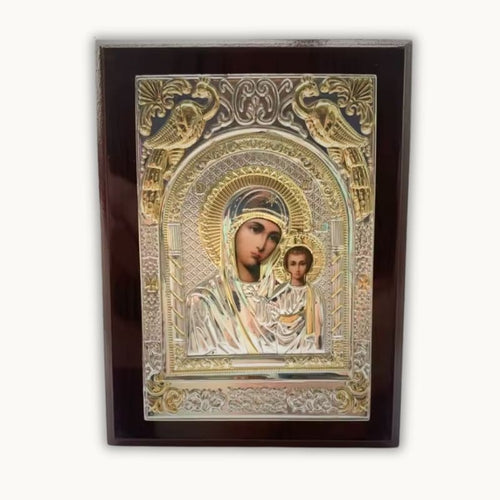

Nazareth. An ordinary house. A young woman alone in the silence. And then an angel enters — without knocking, without warning — and speaks a greeting no one has ever heard before: "Rejoice, O Full of Grace, the Lord is with you." A few seconds of silence. The angel waits. The whole world waits. All of human history, from Adam and Eve to this precise moment, waits. Because everything that follows depends on what this woman will answer — the Nativity, the Cross, the Resurrection, the Church, the salvation of humanity. And Mary says: "Let it be to me according to your word." And in that single instant, the Word of God takes flesh.
The Annunciation of the Most Holy Mother of God — in Greek Evangelismos tis Theotokou, "the good news made to the Mother of God" — is one of the Twelve Great Feasts of the Orthodox Church, the Dodekaorton. Celebrated every year on March 25, exactly nine months before the Nativity of Christ, it commemorates the moment of the conception of the Son of God in the womb of the Virgin Mary by the power of the Holy Spirit. It is not only a feast of the Mother of God: it is above all a feast of the Incarnation — the moment when eternity enters time, when God becomes man, when everything begins.
The Evangelismos: why this name says everything
The Greek name of the feast — Evangelismos — is of rare beauty and precision. It comes from the same root as the word Gospel: euangélion, the good news. The Annunciation is literally the good-news-ing — the moment when the greatest news in human history is announced to its first recipient.
This nuance matters. In the Orthodox tradition, the name of the feast places the emphasis not on the Announcement as Gabriel's act, but on the Good News as a reality — the Good News itself has arrived. Gabriel is only the messenger; what matters is what he brings. And what he brings is the Gospel before the Gospel: the conception of the Savior, the first syllable of a story whose final word is the Resurrection.
The liturgical hymns of the feast return to this theme constantly: "Today is the beginning of our salvation and the revelation of the mystery from eternity." This "today" of the liturgy is not the March 25 of any particular year — it is the eternal present of divine grace offering itself to every generation. At every Annunciation, the Church says: it is today that everything begins.
The dialogue in four movements: the scene that changes history
The account of the Annunciation in the Gospel of Luke (1:26–38) is one of the most meditated texts in the entire Christian tradition. Its narrative structure is of remarkable dramatic precision: four movements that together constitute the most decisive moment in human history.
First movement: Gabriel's greeting
"Rejoice, O Full of Grace, the Lord is with you." (Lk 1:28) It is the first word Gabriel addresses to Mary — and it is without precedent in all of Scripture. No other human being in the Old Testament was ever greeted by an angel in this way. Full of Grace (kécharitoménè in Greek) is a perfect passive participle — the one who has been filled with grace and continues to be. It is not rhetorical flattery: it is a description of what Mary truly is, of what she has been prepared to be since before her birth. The Orthodox tradition sees in this greeting the confirmation that Mary is the living dwelling of God — the place God prepared to receive His Son.
Second movement: Mary's troubled spirit
"But she was greatly troubled at the saying and tried to discern what sort of greeting this might be." (Lk 1:29) Mary's being troubled is theologically significant. It is not fear (that will be Gabriel's next word) — it is an interior disturbance, a deep movement of her whole person in the face of something she does not yet understand. The Fathers emphasize that this disturbance distinguishes her from a naïve or mechanical acceptance: Mary receives the message with the full intensity of a person who thinks, who feels, who does not say yes without understanding what she is accepting.
Third movement: Mary's question
"How will this be, since I am a virgin?" (Lk 1:34) This question is fundamental — and the Orthodox tradition insists: it is not an expression of doubt. It differs radically from Zacharias' reaction to the announcement of John the Baptist's birth ("How shall I know this?" — Lk 1:18), who is reproached for it. Mary does not ask for a sign: she asks for clarification on how the promise will be fulfilled, because she is resolved to cooperate with it. Her question is that of a person who is committing herself and wants to understand what she is accepting. It is the question of intelligent faith, not of skepticism.
Fourth movement: Mary's fiat
"Behold, I am the servant of the Lord; let it be to me according to your word." (Lk 1:38) It is the most important word in the entire Gospel — perhaps in all of human history. Fiat: let it be. In a single sentence, Mary says yes to God with everything she is. She says yes without knowing what it will cost her — the rumors in Nazareth, the flight into Egypt, the Cross, the sword Simeon has prophesied for her. She says yes in total freedom and total humility. And when she speaks this yes, the Word of God takes flesh within her. The Incarnation begins.
Mary's fiat: the human response that makes the Incarnation possible
Orthodox theology of the Annunciation revolves around a deep conviction that Saint Bernard of Clairvaux — in a celebrated text taken up by the Eastern patristic tradition — expressed with arresting force: God was waiting for Mary's yes. Not because He could not have acted without her, but because He chose not to — because the Incarnation, to be truly a reconciliation between God and humanity, had to be freely accepted by a human being. Mary represents all of humanity in this moment. Her fiat is humanity's yes to God.
The Orthodox tradition adds a cosmological dimension: Mary's fiat answers and undoes Eve's no. Where Eve had said no to obedience to God and yes to her own will, Mary says yes to God's will and no to her own fear. The Annunciation is God's answer to the Fall — and it is an answer that passes through the free consent of a woman. It is not by chance that the Church Fathers call Mary the New Eve, just as they call Christ the New Adam.
This freedom of Mary is essential to Orthodox theology. God does not impose Himself. God asks. And He waits for the answer. The liturgy of the Annunciation is permeated by this tension between the greatness of what is being asked and the total freedom of the one to whom it is asked. Every time the Troparion of the feast is sung, one celebrates not only the conception of Christ but also the human freedom that made that conception possible.
The feast of the Incarnation: nine months before Christmas
The Annunciation is, in the structure of the Orthodox liturgical calendar, exactly what its name suggests: the feast of the beginning. March 25 was chosen by the Church Fathers because it falls exactly nine months before the Nativity of Christ (December 25). This simple calculation reflects a deep theological conviction: Christ was conceived like every human being, was carried for nine months in His Mother's womb, and was born at the end of a real pregnancy. His humanity is real, complete, entire — not an appearance, not a disguise.
The Orthodox liturgical tradition sometimes calls the Annunciation the feast of the Incarnation rather than of the Annunciation — to underline that what is celebrated on this day is not primarily the act of the angel, but the entry of the Word of God into human flesh. A phrase from Matins sums it up: "The eternal mystery is revealed today; the Son of God becomes the Son of the Virgin." It is perhaps the most theologically dense formula in the entire Orthodox liturgical calendar.
A feast of joy in the heart of Great Lent
The Annunciation always falls, by its very nature, in a period of penitence or intense preparation — and this creates liturgical situations unique in the entire Orthodox calendar, without parallel anywhere else.
The date of March 25 can fall at any point during Great Lent, Holy Week, or even on Pascha itself. This last coincidence — the Annunciation falling on the Sunday of Pascha — is called Kyrio-Pascha ("the Lord's Pascha par excellence") and is considered an exceptional event, a sign of particular grace. It has occurred only a handful of times over the past several centuries.
In every case, the Annunciation is one of the very few feasts that does not yield to greater solemnities. Even if it falls on Good Friday, it is celebrated — with the liturgical adaptations required by the rules of the Typikon. And it is one of the only two days of Great Lent on which the eating of fish is permitted (the other being Palm Sunday). The joy of the Annunciation is great enough to lighten even the strictest Lenten fast — because it is on this day that humanity received the greatest of all news.
This tension between the feast's joy and the gravity of Lent is itself theologically significant. The Incarnation begins in a world of sin and penitence — not in a world already saved, but in one that needs saving. Mary's yes rings out in the silence of Lent like a light in the darkness: not despite the darkness, but within it.
March 25: a fixed date, a universal significance
The Annunciation is a fixed feast, always celebrated on March 25 in the churches of the revised Julian calendar — the Ecumenical Patriarchate, Greek Orthodox Church, Romanian Orthodox Church, Patriarchate of Antioch — and on April 7 in the churches of the Julian calendar — the Russian Orthodox Church, Serbian Orthodox Church, Georgian Orthodox Church, Church of Jerusalem. In 2027, the feast falls on Thursday, March 25, 2027 for the former and on Tuesday, April 7, 2027 for the latter.
The liturgy of the Annunciation
The Divine Liturgy of the Annunciation proclaims as its Epistle a passage from Hebrews 2:11–18 — the meditation on the mystery of the Incarnation: "For he who sanctifies and those who are sanctified all have one source. That is why he is not ashamed to call them brothers." The Gospel is that of Luke 1:24–38 — the complete account of the Annunciation. It is one of the very rare days of Great Lent on which the Divine Liturgy of Saint John Chrysostom is celebrated in place of the Liturgy of the Presanctified Gifts — a sign of the feast's exceptional solemnity.
The Troparion of the Annunciation is one of the most beautiful and most beloved in the entire Orthodox calendar:
"Today is the beginning of our salvation and the revelation of the mystery from eternity: the Son of God becomes the Son of the Virgin, and Gabriel announces this grace. Therefore, let us also cry out to the Mother of God with him: Rejoice, O Full of Grace, the Lord is with you."
— Troparion of the Annunciation, Tone 4, Orthodox liturgical tradition
The Kontakion of the Annunciation unfolds the same mystery centering it on Gabriel's word:
"To you, O Champion Leader, your city dedicates the victory hymns as an offering of thanks, for you have freed us from suffering. But as you have invincible power, deliver us from all kinds of dangers so that we may cry out to you: Rejoice, O unwedded Bride."
— Kontakion of the Annunciation, Tone 8, Orthodox liturgical tradition
The angelic greeting — "Rejoice, O Full of Grace" — is the origin of the most widely used Marian prayer of Eastern Christianity: the Eastern Ave Maria, called Raduysya in Church Slavonic or Chéré kécharitoménè in Greek. This prayer, which combines Gabriel's words with those of Elizabeth at the Visitation, is recited millions of times daily in Orthodox churches throughout the world — and every recitation renews the announcement of March 25. The liturgical color of the Annunciation is sky blue and gold, the Marian colors par excellence. The Apodosis (leave-taking) of the feast is celebrated on March 26.
The iconography of the Annunciation
The icon of the Annunciation is one of the richest and most symbolically dense in all of Orthodox iconographic art. It depicts the moment of the dialogue between Gabriel and Mary — but not merely as a historical scene: as a theophany, a divine revelation.
In the classical composition, Gabriel stands to the left of the icon in a movement toward Mary — one foot slightly forward, as if mid-stride, his right hand raised in a gesture of speech or blessing. His great outspread wings attest that he comes from heaven. His feet barely touch the ground — he is not quite of this world. To the right, Mary is depicted in one of two postures depending on the tradition: standing, holding in her hand the purple thread she was weaving for the Temple veil (a tradition drawn from the Protoevangelium of James), or seated at a lectern, in prayer or reading the Scriptures.
At the top of the icon, a heavenly segment allows a ray of light or a dove — the Holy Spirit — to descend toward Mary. This ray literally connects heaven to earth, the Trinity to the Virgin, eternity to time. The icon of the Annunciation depicts the precise instant at which heaven and earth touch each other for the first and definitive time.
Mary's facial expression is central: neither frightened nor enraptured, but in a pensive recollection — between the disturbance of the second movement and the acceptance of the fourth. Some icons even show a slight inclination of her head, as if she were bowing before God's will in the very gesture of the fiat.
The Canon of Matins: a masterwork of spiritual dialogue
The Annunciation is one of the very rare feasts of the Orthodox calendar whose liturgy includes a text of exceptional literary form: the Canon of Matins, composed by Saint Theophanes the Hymnographer (9th century) — Bishop of Nicaea, former monk of the Lavra of Saint Sabas in Jerusalem. This Canon is structured as a long poetic dialogue between the Archangel Gabriel and the Virgin Mary, in which each ode presents an exchange between the angel who announces and the woman who responds. It is a theological meditation in dramatic form — one of the summits of all Byzantine hymnography.
In this Canon, Gabriel opens each exchange with a series of poetic images drawn from the Old Testament — images that all prefigure Mary: the burning bush of Moses, Gideon's fleece, Jacob's ladder, the Ark of the Covenant, the luminous cloud. Mary responds each time with a meditation on the humility of her condition and the immensity of what is being asked of her. This liturgical dialogue transforms the recitation of the Canon into a genuine participation in the mystery of the Annunciation — the faithful do not listen from the outside; they enter the conversation.
The Annunciation in English-speaking Orthodox communities
In the United States, Canada, the United Kingdom and Australia, Orthodox parishes of various jurisdictions celebrate the Annunciation on March 25 with quiet but genuine liturgical depth. March 25 is not a public holiday in any English-speaking country, which means Great Vespers on the evening of March 24 and the Divine Liturgy on March 25 morning are the primary moments of celebration — often attended by a smaller, more intentional gathering of the faithful who make the effort on a weekday. This gives the Annunciation in English-speaking Orthodox life a particular character of intimate solemnity: those who come have chosen to come, and the feast is experienced as something personally chosen rather than culturally imposed. For many converts to Orthodoxy, the Annunciation is one of the most theologically striking feasts of the year — the four movements of the dialogue, the concept of Mary's fiat as the hinge of history, the paradox of a feast of Incarnation placed in the middle of a penitential fast all tend to resonate deeply with those coming from traditions that have not preserved this feast with the same theological richness. The Annunciation is also one of the most ecumenically resonant feasts in the Orthodox calendar: shared on the same date with Roman Catholics and many Anglican communities, it provides a natural moment of common Christian witness in the broader English-speaking world.
FAQ — Frequently asked questions about the Orthodox Annunciation
Why is the Annunciation also a feast of the Incarnation?
The Annunciation is the precise moment of the conception of Christ — and therefore the beginning of the Incarnation, the moment when the Word of God takes human flesh. The Nativity (Christmas) is the birth of Christ, nine months later. But the Incarnation — the union of the divine and the human in a single person — begins at the Annunciation. This is why the Orthodox tradition sometimes calls this day the "feast of the Incarnation of the Word" rather than simply the feast of the Annunciation. The essential thing did not happen in the manger of Bethlehem but in the house of Nazareth.
Why is Mary's fiat theologically so important?
Mary's fiat — "let it be to me according to your word" — is important because it shows that God chose not to impose Himself on humanity even to accomplish His plan of salvation. The Incarnation required the free consent of a human being. Mary represents all of humanity in this moment: her yes is the yes of creation to its Creator, the yes of humanity to its reconciliation with God. Without this freely spoken yes, the Word would not have become flesh. This conviction stands at the heart of Orthodox theology of human freedom and of the cooperation between divine grace and human will (synergeia).
What happens when the Annunciation falls on Good Friday?
It is one of the most exceptional liturgical situations in the Orthodox calendar. When March 25 falls on Good Friday, both feasts are celebrated together according to the complex rules of the Typikon. The Annunciation is not postponed — it is integrated into the Passion liturgy. This coincidence carries a profound theological meaning: the very day on which the conception of Christ is celebrated also commemorates His Crucifixion — birth and death of a single and same mystery of love. Some ancient theologians had calculated that Christ died on March 25 — the same day as His conception, forming a perfect circle of life and death.
What is the significance of Gabriel's "Rejoice"?
The Greek word Chaire (translated "Rejoice" in English, "Ave" in Latin) is the ordinary greeting in Greek — but in the mouth of an angel to a human being it takes on an entirely different dimension. It is an invitation to eschatological joy — the joy of the Kingdom beginning to arrive. This Chaire is taken up by the Church in the most widespread Marian prayer of the Christian East (Rejoice, O Full of Grace), and in the Troparion of the feast. Each time this word is sung, the angelic greeting is reproduced — one participates, in one's own measure, in the announcement of March 25.
When exactly is the Annunciation in 2027?
The Annunciation is a fixed feast: it is always celebrated on March 25 by the Orthodox churches of the Gregorian calendar. In 2027, this falls on Thursday, March 25, 2027. For the churches of the Julian calendar, it is celebrated on Tuesday, April 7, 2027.
The fiat that changed the world
The Annunciation of the Mother of God is perhaps the most vertiginous of all the great Orthodox feasts — because it is the moment when everything turns. Before Mary's fiat, there is a world waiting for its Savior. After Mary's fiat, the Savior is there — in a body of a few cells, in the womb of a young woman in Nazareth, but truly present, truly God made man, truly the beginning of the end of every separation between heaven and earth.
The Annunciation also says something essential about the way God acts: not by force, not by unilateral decree, but through a request and a waiting. He waits for Mary's yes. He waits for the yes of every Christian. The liturgy of the Annunciation is the invitation to say, like Mary: let it be to me according to your word — and to discover that this yes, like Mary's, transforms everything.
"Today is the beginning of our salvation and the revelation of the mystery from eternity: the Son of God becomes the Son of the Virgin, and Gabriel announces this grace. Therefore, let us also cry out to the Mother of God with him: Rejoice, O Full of Grace, the Lord is with you."
— Troparion of the Annunciation, Orthodox liturgical tradition