

There is a feast in the Orthodox liturgical calendar that does not belong to the Twelve Great Feasts of the Dodekaorton and yet is, among Slavic Orthodox Christians, one of the most beloved and widely celebrated of the entire year — an October feast that speaks of a veil, of tears, of protection and of mercy. This feast is called Pokrov (Church Slavonic: Покровъ), in English most commonly the Protection of the Theotokos or the Intercession of the Theotokos — and if you belong to or have encountered a Russian, Ukrainian, Serbian, Bulgarian or Romanian Orthodox community in America, Canada, the United Kingdom or Australia, you have almost certainly heard this name spoken with particular devotion.
For Orthodox converts in the English-speaking world, Pokrov is often one of the first feasts that reveals how much the Orthodox liturgical calendar differs from anything in their previous Christian experience — a feast entirely unknown in Protestant Christianity, barely present in Catholic consciousness, yet observed with an intensity in Slavic Orthodox communities that rivals Christmas and Pascha. This guide presents the feast in full: its name and etymology, its dates across different Orthodox calendars, the vision at its origin, its history from Constantinople to the Slavic world, its theological meaning, its icon, its folk traditions, and the particular experience of celebrating it in the English-speaking Orthodox world.
Table of contents
- Pokrov: name, etymology and date
- The vision at the Blachernae: the account of the apparition
- From Constantinople to Russia: the history of the feast
- The theological meaning: the Theotokos as intercessor
- The Pokrov icon
- The folk traditions of Pokrov
- Pokrov in the English-speaking Orthodox world
- FAQ — Frequently asked questions about Pokrov
Pokrov: name, etymology and date
The word Pokrov (Покровъ) comes from Church Slavonic and means literally veil, cloak or covering. In Slavic languages, the word carries both the meaning of "covering" and "protecting" — a semantic doubleness that reveals the theological heart of the feast already in its name. In the Hebrew of the Old Testament, the word seter (veil) also means, in its figurative sense, protection and shelter. The veil of the Mother of God is therefore not merely a piece of cloth spread over an assembly — it is the visible sign of an invisible reality: the maternal protection of the Theotokos over the faithful who seek her intercession.
The feast is known under several names in English, all in current use:
- The Protection of the Theotokos — the most common liturgical English translation
- The Intercession of the Theotokos — widely used in theological and academic contexts
- The Protecting Veil of the Theotokos — used particularly in ROCOR and some Antiochian parishes
- The Veil of Our Lady — occasionally used in Western Rite Orthodox communities
- Pokrov — the Slavic name used untranslated in most Russian, Ukrainian and Serbian parishes
- Σκέπη (Sképē) — Greek: shelter, protection; used in Greek Orthodox parishes
The dates of Pokrov across Orthodox calendars
| Church / tradition | Date of Pokrov | Calendar used |
|---|---|---|
| Russian, Ukrainian, Serbian, Bulgarian, Georgian | October 14 (Gregorian) = October 1 (Julian) | Julian calendar |
| Romanian, Antiochian and others (revised calendar) | October 1 (Gregorian) | Revised Julian calendar |
| Greek Orthodox | October 28 | Revised Julian calendar (own date) |
The October 28 date in the Greek Orthodox tradition deserves explanation for English-speaking readers unfamiliar with it. In 1952, the Holy Synod of the Church of Greece transferred the feast from October 1 to October 28 — the Greek national holiday of Ohi Day, commemorating Greece's refusal to surrender to the Axis powers in 1940. During the Greco-Italian War of 1940–1941, Greek soldiers reported numerous miraculous interventions attributed to the Theotokos; the Holy Synod chose to honor these by aligning the feast of her Protection with the national day of deliverance. In Greek-American parishes across the US, October 28 is therefore both a patriotic and a Marian feast — the Doxology includes hymns of thanksgiving for the protection of the Greek nation.
The vision at the Blachernae: the account of the apparition
The feast of the Protection of the Theotokos commemorates a vision that took place in Constantinople, in the celebrated Blachernae church, in the night of Sunday, October 1, 909 AD (some sources give 911 or 912). The Blachernae church was one of the greatest Marian sanctuaries of the entire Byzantine Empire — it housed, according to tradition, the veil (mamphorion) and belt of the Virgin Mary, brought from Jerusalem to Constantinople in the fifth century.
The visionary: Saint Andrew, the Fool for Christ
The vision was granted to Saint Andrew of Constantinople, called the Fool for Christ (Yurodiviy in Russian) — one of the most singular spiritual figures in the Orthodox tradition. Andrew was of Slavic origin, a freed slave, who had chosen to live in voluntary poverty and humiliation, feigning madness to conceal his holiness from the eyes of the world. This form of sanctity — holy foolishness, or foolishness for Christ — is characteristic of the Eastern Orthodox tradition and has no direct equivalent in Western Christianity, Catholic or Protestant.
Andrew lived on the streets of Constantinople, eating refuse, sleeping outdoors, despised and mocked by all. And it was to this man that the vision was granted — not to a bishop, not to a famous monk, but to the poorest of the city's poor. Pokrov announces from its very origin something essential: the Mother of God spreads her veil over the assembly of the humble, not over the powerful.
The account of the vision
In the night of October 1, 909, during a long all-night vigil at the Blachernae church, Saint Andrew was praying, absorbed in contemplation. At the fourth hour of the night, raising his eyes toward heaven, he beheld the Mother of God of great stature advancing into the church through the Royal Doors, surrounded by a retinue of saints: the Forerunner John the Baptist at her right, Saint John the Theologian at her left, and many other saints and angels clothed in white.
The Mother of God knelt and prayed at length with tears for the people gathered in the church. She then approached the altar, removed the luminous veil (mamphorion) from her head and spread it with both hands to cover the entire assembly of the faithful. The veil shone with a supernatural light, brighter than the sun, and both seers saw it remain spread above the people for a long time. Then the Mother of God rose into heaven with all the company of the saints, taking the veil with her.
Andrew asked his disciple Epiphanius — who was also present and had also seen the vision: "Do you see, brother, the Queen of the World and our Lady, praying for all the world?" And Epiphanius answered: "I see it, my spiritual father, and I am in awe."
The historical context: Constantinople under threat
The vision took place at a time of acute danger for the Byzantine Empire. Constantinople was under threat from an enemy siege — Byzantine and Russian sources speak of an attack by the Saracens, though some modern historians identify the threat as a raid by Slavic peoples or other invaders. The assembly gathered in the Blachernae church that night was praying for the city's deliverance. The vision of the Mother of God spreading her protecting veil was immediately understood as a sign of her intercession and divine liberation: the city was saved.
From Constantinople to Russia: the history of the feast
The vision at the Blachernae took place in Constantinople — a Greek city, capital of the Byzantine Empire — and yet, paradoxically, the feast of the Protection of the Theotokos was almost absent from the Greek liturgical tradition for centuries. It was in Russia that the feast was established, developed and handed on with unmatched fervor.
The establishment of the feast in Russia in the 12th century
The Pokrov feast was established in Russia in the 12th century under the holy prince Andrei Yurievich Bogolyubsky (1155–1174), Prince of Vladimir-Suzdal. Deeply devoted to the Mother of God, Prince Andrei had the Pokrov feast inscribed in the Russian liturgical calendar and built one of the most beautiful churches in the world in its honor: the Church of the Intercession on the Nerl (Pokrov na Nerli), erected in 1165 in the Vladimir plain at the confluence of the Nerl and Klyazma rivers.
The Church of the Intercession on the Nerl is considered one of the absolute masterpieces of medieval Orthodox architecture — a small white church of perfect proportions, alone in a floodplain, appearing to float on the grass and water. It is today a UNESCO World Heritage Site. By building this church in the name of the Pokrov, Prince Andrei Bogolyubsky was declaring that all of Russia placed itself under the protection of the veil of the Mother of God.
Pokrov in the Slavic tradition — and Saint Basil's Cathedral
Over the centuries, Pokrov became one of the feasts most deeply rooted in the culture and spirituality of all Slavic Orthodox peoples — Russians, Ukrainians, Serbians, Bulgarians, Belarusians. Hundreds of churches bear the name Pokrov in these countries. The most recognizable of all is Saint Basil's Cathedral on Red Square in Moscow — officially named the Cathedral of the Intercession of the Most Holy Theotokos on the Moat. Every visitor to Moscow who has photographed this onion-domed masterpiece has, without knowing it, stood before a church of the Pokrov. The feast penetrated into the most ordinary folk traditions — agricultural, matrimonial, seasonal — becoming a central reference point of the rural and domestic calendar, not only of the liturgical calendar.
The theological meaning: the Theotokos as intercessor
The feast of the Protection of the Theotokos expresses one of the most fundamental theological convictions of the Orthodox tradition: the Mother of God intercedes unceasingly for the world. She is not a figure of the past, honored for what she did two thousand years ago — she is a living and active presence, praying for the faithful before the throne of her Son with an efficacy that no other intercessor possesses.
The veil as gesture of intercession
In the vision at the Blachernae, the Mother of God does not deliver a speech or perform a spectacular miracle. She performs a simple, maternal, universal gesture: she spreads her veil over the assembly as a mother spreads a blanket over her children. This gesture is the gesture of intercession — to cover, to protect, to shelter. The Orthodox tradition sees in this gesture the image of what the Theotokos does permanently in prayer: she covers the Church with her intercession, she shelters the faithful under her mantle of mercy.
The Pokrov Liturgy expresses this in the Troparion with striking economy: "Today the faithful celebrate the feast with joy, illumined by thy coming, O Mother of God: beholding thy pure image, we fervently cry to thee: encompass us beneath the precious veil of thy protection; deliver us from every form of evil by entreating Christ, thy Son and our God, that He may save our souls."
Pokrov and the Virgin of Mercy: a bridge for converts
For Orthodox converts from Catholic backgrounds, there is a striking Western parallel to the Pokrov icon that helps make the feast immediately comprehensible: the Virgin of Mercy (Virgo Misericordiae) — the image in which the Virgin spreads wide her cloak to cover and protect a group of kneeling supplicants. This iconographic type first appeared in Western art around 1280 in Italy and became one of the most beloved Marian images of medieval and Renaissance Catholic piety. The theological intuition is identical: the Mother of God covers and protects those who seek her. The Pokrov tells this truth with a Slavic name and an Eastern tradition; the Virgin of Mercy tells it with a Latin name and a Western tradition — but the heart is the same. For converts from Catholic backgrounds, the Pokrov is not foreign: it is familiar theology in an unfamiliar form.
Pokrov and Psalm 91
The Orthodox tradition naturally connects Pokrov to Psalm 91 — one of the most frequently prayed psalms in the Orthodox tradition, especially at Compline: "He will cover you with His feathers, and under His wings you will find refuge." The veil of the Mother of God is the sensible image of this Psalm's shelter — not a metal shield, but a refuge of mercy, a protection of love. To place oneself under the Protection of the Theotokos is to recognize that true security comes from above — not from human strength, but from the intercession of the one who is closest to the Son.
The Pokrov icon
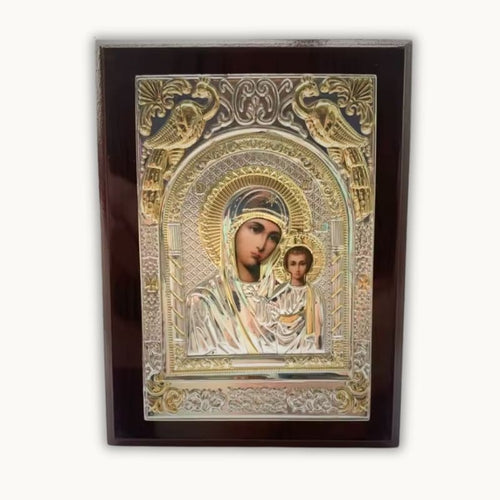
The Pokrov icon is one of the most recognizable in all Orthodox iconography. It typically depicts the scene of the Blachernae vision with several constant elements:
- The Mother of God in orant posture — arms raised in prayer — holding or spreading her luminous veil above the assembly
- The white or golden veil extended horizontally above the faithful, carried by angels in some versions
- Saint John the Baptist and Saint John the Theologian at her sides, in keeping with the account of the vision
- The assembly of the faithful in the lower portion of the icon — saints, bishops, angels and the Christian people gathered under the protecting veil
- Christ in glory blessing from the top of the icon in some versions
- Saint Romanus the Melodist — the great sixth-century hymnographer, holding an open scroll, whose feast falls on the same day as Pokrov (October 1)
There are two major iconographic traditions of the Pokrov: the Russian, in which the Mother of God is shown standing on a cloud or floating in the air, holding the veil in her own hands; and the Byzantine-Greek, rarer, in which she is shown at prayer in the apse of the Blachernae church. In both cases, the Pokrov icon says visually what the feast says liturgically: the Mother of God is there, present, praying, protecting.
The folk traditions of Pokrov
Beyond its liturgical and theological significance, Pokrov has generated in Slavic cultures an extraordinary richness of folk traditions — agricultural, matrimonial, seasonal — that make it one of the feasts most deeply embedded in everyday life.
Pokrov and the change of season
Pokrov falls on October 1 (or October 14 according to the Julian calendar) — a pivotal moment in the natural calendar of Eastern Europe, at the threshold between autumn and the approach of winter. In Russian and Ukrainian folk tradition, Pokrov marks the beginning of the peasant winter: the harvest is complete, the flocks return to the barns, the provisions are stored. The folk saying captures it with a striking image: "At Pokrov, winter covers the earth with its mantle." The white veil of the Mother of God and the first mantle of snow on the fields are the same image — two veils, two protections, two coverings.
Pokrov and marriage
In Slavic folk tradition, Pokrov is also the feast of young women and the beginning of the wedding season. The saying runs: "When Pokrov comes, it will cover the young girl's head" — an allusion to the bridal veil that the young woman wears at her wedding. In the Orthodox tradition, the bridal veil is itself a theological image: it evokes both the modesty of the bride and the divine protection over the new home. Young women prayed to the Mother of God at Pokrov for a husband — a tradition still observed in some regions of Ukraine and Russia.
Pokrov and the Cossacks
In the Cossack tradition — Ukrainian, Don Cossack, Kuban Cossack — Pokrov is the patronal feast par excellence. Cossack armies placed themselves under the protection of the Mother of God at Pokrov before their campaigns, and many Cossack fortresses and cathedrals bear her name under the Pokrov title. This warrior dimension of the feast is directly connected to the meaning of October 14 for contemporary Ukraine.
Pokrov in the English-speaking Orthodox world
In the United States, Canada, the United Kingdom and Australia, Pokrov is observed with very different degrees of familiarity depending on which Orthodox jurisdiction and community one belongs to. For Slavic-background communities it is a major feast; for converts and Greek-background communities it may be less familiar. Understanding this variety is itself part of understanding the Orthodox world in English-speaking countries.
Pokrov in American Orthodox parishes
In the United States, Pokrov is one of the most celebrated autumn feasts in Russian Orthodox, Ukrainian Orthodox, Serbian Orthodox and OCA parishes. Many American parishes are named after it — among the most prominent is the Holy Virgin Protection Cathedral, one of the oldest Russian Orthodox parishes in the country. In cities with large Slavic Orthodox communities — New York, Chicago, Pittsburgh, San Francisco, Cleveland, Detroit — the feast on October 14 is marked by festive Divine Liturgies, often followed by parish meals that gather the community in a spirit of thanksgiving. Ancient Faith Ministries — the leading English-language Orthodox podcast and media platform — has dedicated content to the Protecting Veil of the Theotokos, making the feast accessible to the growing convert population.
For Orthodox converts in America, Pokrov is often one of the first Marian feasts that genuinely surprises them — not just intellectually but spiritually. Nothing in most Protestant backgrounds introduces the idea that the Mother of God actively intercedes in history, appears to the humble, weeps for the people and spreads a visible veil of protection. Encountering this feast for the first time — the icon, the Troparion, the theological teaching about the Theotokos as living intercessor — is for many converts a moment of genuine discovery: Orthodoxy's relationship with the Mother of God is not devotional ornamentation but theological substance.
Pokrov in the United Kingdom
In the United Kingdom, Pokrov is celebrated in Russian, Serbian and Ukrainian Orthodox parishes across England, Scotland and Wales. Among the most established is the Intercession of the Holy Virgin Russian Orthodox Church in Manchester — one of the oldest Russian Orthodox parishes in the UK, named after the feast. In London, Russian and Ukrainian Orthodox parishes in Ennismore Gardens, Emperor's Gate and other locations celebrate the feast with full liturgical solemnity. Since 2022, the Ukrainian Orthodox communities in the UK have given the October 14 celebration new intensity: for the rapidly growing Ukrainian community in Britain — one of the largest in Western Europe since the beginning of the war — Pokrov on October 14 is simultaneously a feast of prayer and a moment of national solidarity.
Pokrov, Ukraine and the English-speaking world since 2022
Since Russia's invasion of Ukraine in February 2022, Pokrov has acquired a new and particularly poignant resonance in every English-speaking country with a significant Ukrainian community — which means, in practice, all of them. The October 14 date is simultaneously the Pokrov feast (Julian calendar) and Ukraine's Defender Day (Den Zakhysnykiv Ukrainy), a national holiday established in 2014 precisely because Pokrov was the traditional patronal feast of the Ukrainian Cossacks — the historical defenders of the Ukrainian land. For Ukrainian Orthodox communities in New York, Chicago, Toronto, London, Melbourne and Sydney, this double significance of October 14 has been lived with a depth of prayer and emotion rarely reached at any other moment of the liturgical year. At Pokrov services in Ukrainian Orthodox parishes across the English-speaking world from 2022 onward, the prayer for the protection of Ukraine has become inseparable from the theological meaning of the feast itself.
Pokrov and converts: encountering the Theotokos as intercessor
For converts to Orthodoxy in the English-speaking world, Pokrov presents a particular theological challenge and opportunity. Most Protestant backgrounds have no category for the active intercession of the saints — let alone of the Mother of God. The idea that she appears in churches, spreads her veil over the faithful, prays for the world with tears and is still doing so now — this is not merely unfamiliar; for many converts it is the most alien aspect of Orthodox theology they encounter. And yet Pokrov, approached without defensiveness, is precisely the feast that most directly addresses this theological gap. It does not ask for abstract theological assent to Marian doctrines — it tells a story: a man on the street, a church at night, a woman praying with tears, a veil of light. The theology is in the narrative, and the narrative is disarming.
Many converts report that Pokrov — precisely because it is a minor feast without the liturgical grandeur of Pascha or the Dormition — is the feast where their relationship with the Theotokos became personal for the first time. There is no canonical, doctrinal pressure at Pokrov. There is only a story, an icon and an invitation to stand under the veil.
FAQ — Frequently asked questions about Pokrov
When is the feast of the Protection of the Theotokos?
The feast of the Protection of the Theotokos is celebrated on different dates depending on the Orthodox tradition. Churches of the Slavic tradition (Russian, Ukrainian, Serbian, Bulgarian, Georgian) following the Julian calendar celebrate it on October 14 of the Gregorian calendar (their Julian October 1). Churches of the revised Julian calendar (Romanian, Antiochian) celebrate it on October 1. The Greek Orthodox Church celebrates it on October 28, a date transferred in 1952 to coincide with the Greek national holiday of Ohi Day.
Is Pokrov one of the Twelve Great Feasts?
No. Pokrov does not belong to the Twelve Great Feasts of the Dodekaorton. It is, however, one of the great feasts of the Orthodox Menologion and is ranked among the major feasts in the Slavic liturgical traditions — sometimes informally called the thirteenth great feast in Slavic piety, such is the intensity of its celebration. It is less prominent in Greek and Antiochian practice, though present in all Orthodox calendars.
Who was Saint Andrew the Fool for Christ?
Saint Andrew of Constantinople, called the Fool for Christ (Yurodiviy), is a tenth-century Orthodox saint of Slavic origin who lived on the streets of Constantinople in voluntary poverty and humiliation, feigning madness to conceal his holiness. The vision of the Mother of God spreading her veil over the Blachernae assembly was granted to him. He is commemorated on October 2 in the Orthodox calendar. The form of sanctity he represents — holy foolishness — is characteristic of the Eastern Orthodox tradition and has no direct equivalent in Western Christianity.
Why is Pokrov so significant for Ukraine?
October 14 is both the Julian-calendar date of the Pokrov feast and Ukraine's Defender Day — a national holiday established in 2014, chosen precisely because Pokrov was the patronal feast of the Ukrainian Cossacks, the historical defenders of the Ukrainian lands. The Mother of God of Pokrov has been for centuries the heavenly patroness of Ukrainian warriors, and since 2014 — then with intensified meaning since 2022 — this feast is observed in Ukraine and the Ukrainian diaspora worldwide as a moment of prayer for the divine protection of the nation.
What does the Pokrov icon depict?
The Pokrov icon depicts the Mother of God in orant posture (arms raised in prayer), holding or spreading a luminous veil over an assembly of the faithful. She is surrounded by saints — particularly John the Baptist and John the Theologian — and often accompanied by angels carrying the veil. In the lower portion of the icon, the assembly of the faithful is gathered under this protecting veil. Saint Romanus the Melodist is often depicted with an open scroll. The icon expresses visually the central theological conviction of Pokrov: the Mother of God prays constantly for Christians and covers them with her intercession.
Is Pokrov celebrated in non-Slavic Orthodox parishes?
Yes, though with varying intensity. In Antiochian Orthodox parishes — which tend to have high convert populations in the US and UK — Pokrov is observed liturgically but without the same cultural weight as in Russian or Ukrainian parishes. In Greek Orthodox parishes, it is celebrated on October 28 as noted above. In OCA (Orthodox Church in America) parishes, which draw from multiple ethnic backgrounds and have significant convert populations, Pokrov is increasingly well observed — a sign of the growing integration of the Slavic liturgical heritage into English-language Orthodoxy.
I'm a convert — how should I approach Pokrov?
The most honest answer is: come to the Liturgy if your parish celebrates it, stand before the icon, and listen to the Troparion. Do not worry about having the "correct" Marian theology sorted out in advance. Pokrov is not a doctrinal test — it is an invitation. The feast says: the Mother of God is praying for you, spreading her veil over you, whether or not you fully understand what that means yet. Many converts find that their relationship with the Theotokos grows most naturally not through theological study but through attending feasts like Pokrov — quietly, with open hands, under the veil.
Under the veil of the Mother of God
Pokrov is a feast that says something simple and something immense at the same time: you are not alone. Behind the veil spread in the Blachernae church on that October night in 909, the Orthodox Church sees the permanent gesture of the Mother of God toward humanity — a gesture of tears and prayer, of intercession and protection, that has never ceased since that moment and will not cease.
For Orthodox Christians in the English-speaking world — whether Russian, Ukrainian, Serbian, Romanian, Greek or convert of any background — to celebrate Pokrov in October is to enter this certainty: that a maternal and praying presence watches over the Church, that the veil of the Theotokos covers the humble and the persecuted, and that to ask the protection of the Mother of God is to take shelter in the prayer of the one who is closest to her Son.