

Reading time: 8 minutes
Prayer with the Orthodox prayer rope — also called tchotki, chotki, or komboskini — is one of the oldest and most living spiritual practices of the Eastern Christian tradition. Whether you are a beginner or a confirmed believer, praying with the Orthodox prayer rope can transform your relationship with God and anchor you in a simple, repetitive and deeply calming prayer. This guide traces the history of the Orthodox prayer rope, explains its meaning, and walks you through its concrete practice step by step.
What is an Orthodox Prayer Rope?
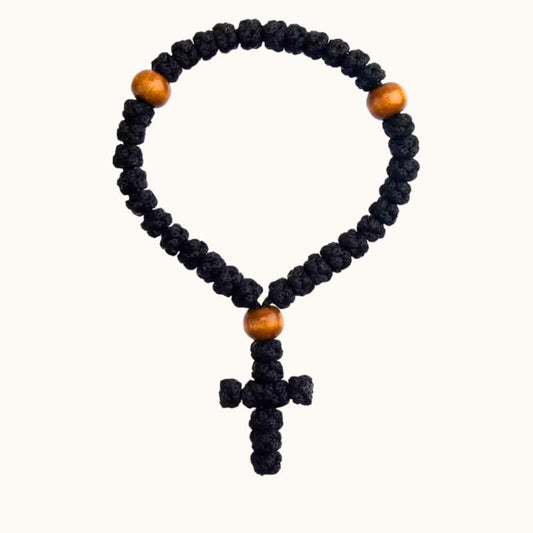
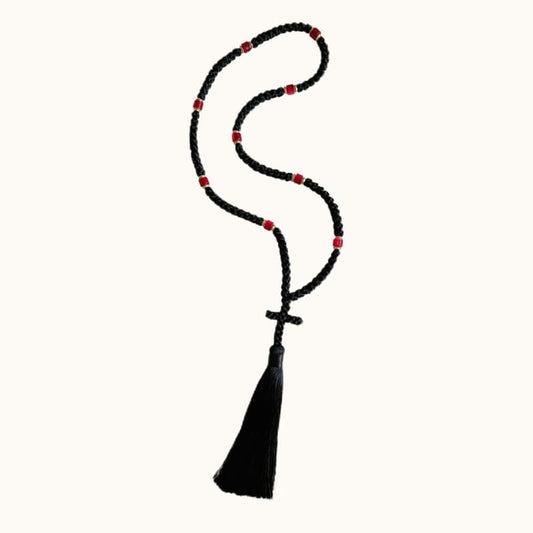
An Orthodox prayer rope is a hand-knotted prayer cord made of a precise number of knots — typically 33, 50 or 100 — on which the believer counts repetitions of the Jesus Prayer. It is far more than a religious accessory: it embodies a tradition of interior prayer reaching back to the earliest centuries of Christianity and remains today the most widely used prayer tool in the Orthodox Church, by monks and laypeople alike.
It is known by several names depending on linguistic tradition:
- Tchotki / chotki (чётки) — the Russian term, most common in Slavic Orthodox diaspora communities
- Komboskini (κομποσχοίνι) — the Greek term, literally "knotted cord"
- Brojanica — the Serbian and Bulgarian term
- Prayer rope / prayer knots — the English terms used in Orthodox parishes across the UK, USA, Canada and Australia
Unlike the Catholic rosary, which follows a fixed structure (mysteries, decades, Hail Marys…), the Orthodox prayer rope has no rigid structure. It is based on the free repetition of the Jesus Prayer. There is no meditation on mysteries, no alternation of different prayers: only regularity, concentration, and humility of heart matter.
What is the Origin of the Orthodox Prayer Rope?
The origin of the Orthodox prayer rope goes back to the 4th century in the monasteries of the Egyptian desert. Monastic tradition attributes its invention to St Macarius of Egypt — one of the great Desert Fathers — who was looking for a simple way to count the hundreds of prayers recited each day without being distracted by the counting itself.
The founding legend is striking: Macarius first used pebbles or simple knotted cords. But the devil, says the tradition, would continually undo the knots to disturb the prayer. Macarius then fashioned a cord whose knots were woven with nine small crosses — making each knot indestructible to the enemy. This is why every knot on the traditional tchotki is still today braided with nine interlocking crosses: the Orthodox prayer rope is literally a spiritual weapon — a "shield of crosses."
This tradition spread from the Egyptian deserts to the monasteries of Mount Athos, then throughout the entire Orthodox world — Russian, Serbian, Romanian, Greek — becoming the universal instrument of hesychast prayer. To learn more about the history of the Desert Fathers and Mount Athos from which this practice emerged, see our guide to Orthodox monasticism.
Why Knots and Not Beads?
The traditional Orthodox prayer rope is made of braided knots, not separate beads like the Catholic rosary. This distinction is not accidental. The multiple knots — each woven with nine small crosses — are indissoluble: they cannot accidentally come undone or slip. They symbolise the unity of prayer, its indissoluble character, its permanence.
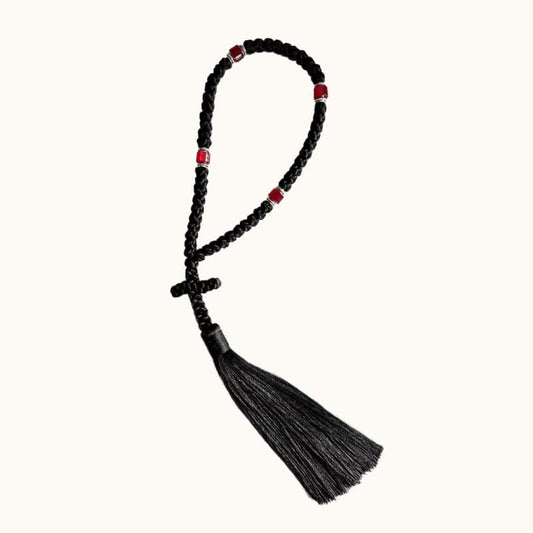
Modern tchotki also exist in wooden, amber or resin beads — particularly in the Greek and Romanian traditions where the komboskini can be more colourful and decorative. But the traditional monastic chotki, inherited directly from Mount Athos, is always black wool, hand-braided, sober and functional. The black colour recalls the renunciation of the world and the dying to self — core values of Orthodox monasticism.
How to Choose Your Orthodox Prayer Rope
The choice of format depends on your level of practice and the time you wish to devote to prayer:
Orthodox prayer rope with 33 knots
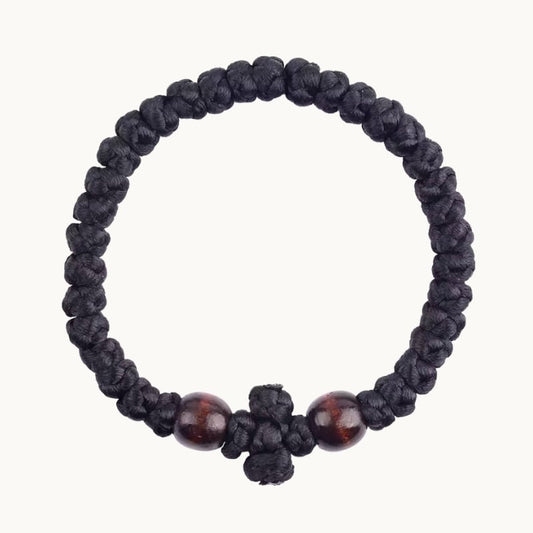
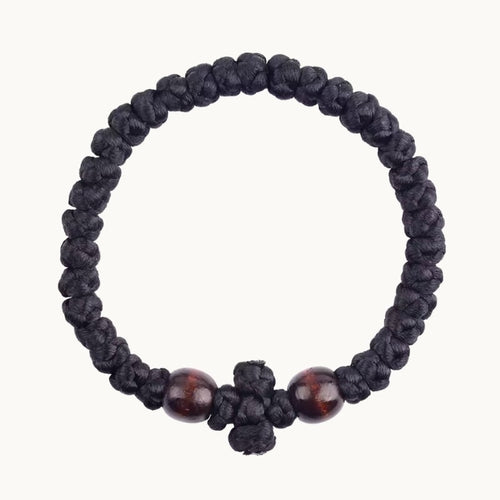
The 33-knot Orthodox prayer rope is the ideal format for beginners. Its 33 knots recall the 33 earthly years of Christ. It allows you to recite the Jesus Prayer a reasonable number of times — around 5 to 10 minutes of prayer — without discouragement. It is the natural entry point into tchotki practice for daily prayer. This format also exists as a chotki bracelet, worn on the wrist as a constant reminder of prayer throughout the day.
Orthodox prayer rope with 50 knots
The Greek Orthodox prayer rope with 50 knots is the traditional format of the Athonite komboskini. Hand-braided in black wool, it is sober and centred on the essential. It is the classic choice for morning or evening prayer and the preferred format in Greek monasteries.
Orthodox prayer rope with 100 knots
The 100-knot Orthodox prayer rope is aimed at more experienced practitioners who want to deepen their prayer. Used in many Russian monasteries for the daily prayer rule, it allows a 15–30 minute session of continuous Jesus Prayer. It is the format of monks, hermits, and laypeople engaged in a regular and intensive practice.

How to Pray with the Orthodox Prayer Rope
Praying with the tchotki is deeply simple and deeply demanding at the same time. The form is minimal; the interior is everything. Here is the practice step by step.
1. Prepare your heart and your space
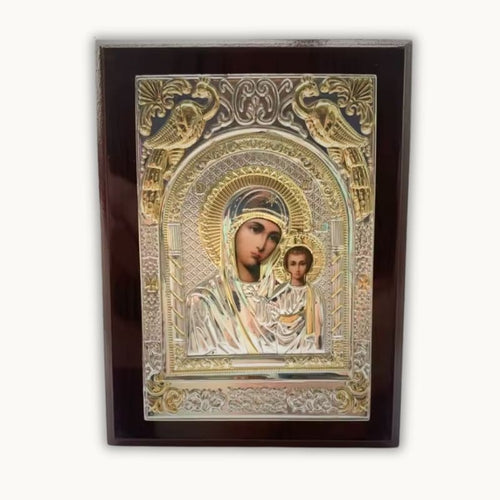
Before you begin, take a few moments to collect yourself. Choose a quiet place, conducive to recollection. Place an Orthodox icon or a candle nearby if it helps you to concentrate — our guide to the Orthodox icon explains why praying before an icon fosters interior presence. Sit or stand upright, back straight, in a stable position. Breathe slowly. Set aside your distractions.
2. The prayer to say
The heart of prayer with the Orthodox prayer rope is the Jesus Prayer:
"Lord Jesus Christ, Son of God, have mercy on me, a sinner."
Each knot corresponds to one repetition of this prayer. You may recite it interiorly or in a low voice. For beginners, a shorter form is equally legitimate according to the Fathers: "Lord Jesus Christ, have mercy on me", or simply "Lord Jesus." Do not change the formula too often — stability fosters internalisation. Make the sign of the cross at the beginning and end of your prayer. Our complete guide to the Jesus Prayer traces the history and theology of this prayer in depth.
3. Rhythm and inner attitude
Praying the Orthodox prayer rope is not a performance. It is not quantity that counts, but the presence of the heart. Some practical guidance:
- Start with a short rope (33 knots) if you are a beginner
- Pray 1–2 times a day: in the morning to anchor the day, in the evening to recollect it
- Let the prayer descend into your heart — avoid going too fast
- Do not try to "feel" anything: faithfulness is enough
- The long-term goal is to make the Jesus Prayer as natural and continuous as breathing — the "unceasing prayer" St Paul calls for (1 Thess 5:17)
4. Complementary prayers
The Jesus Prayer is central, but other invocations may accompany prayer according to tradition and liturgical season:
- Prayer to the Mother of God:
"Most Holy Mother of God, save us."
- Invocation to a patron saint:
"Saint Nicholas, pray to God for us."
- Trinitarian doxology:
"Glory to the Father, and to the Son, and to the Holy Spirit, now and forever, and to the ages of ages. Amen."
The important thing is to maintain regularity and a present heart, rather than multiplying prayers. The prayer rope is not a catalogue of texts — it is a path of union, a school of patience, humility and love.
The Orthodox Prayer Rope and Hesychasm: What is the Connection?
The Orthodox prayer rope is inseparable from the hesychast tradition — the great way of unceasing interior prayer running from the Desert Fathers to the Athonite monks of today. Hesychasm (hesychia in Greek: stillness, inner calm) aims to establish the soul in a constant awareness of God's presence, through the repetition of the name of Jesus until it becomes as natural as the heartbeat.
The prayer rope is the concrete instrument of this prayer: it frees the mind from counting so that it can focus entirely on the name being pronounced. Some advanced monks, particularly on Mount Athos, coordinate the recitation of the Jesus Prayer with their breathing — inhaling on "Lord Jesus Christ, Son of God" and exhaling on "have mercy on me, a sinner." This practice, described as early as the 13th century by Nicephorus the Hesychast, is however only a secondary aid: what matters first is always grace and humility of heart — not technique. As St Theophan the Recluse warned, breathing exercises pursued without grace lead only to physical strain.
FAQ — Frequently Asked Questions about the Orthodox Prayer Rope
What is the difference between an Orthodox prayer rope and a Catholic rosary?
The Catholic rosary follows a fixed structure with mysteries, decades of Hail Marys, and alternating prayers. The Orthodox prayer rope (tchotki) has no rigid structure: it is solely a counting tool for the free repetition of the Jesus Prayer. It is generally made of braided knots (not separate beads) and has no associated meditations. The prayer is simpler, more repetitive, and centred on a single act: invoking the name of Christ.
What is the tchotki?
The tchotki (also spelled chotki, from the Russian чётки) is the Russian name for the Orthodox prayer rope. It is a hand-braided prayer cord made of knots woven with nine small crosses, used to count repetitions of the Jesus Prayer. It is the Russian equivalent of the Greek komboskini and the Serbian brojanica.
What is the komboskini?
The komboskini (κομποσχοίνι) is the Greek name for the Orthodox prayer rope — literally "knotted cord." It is traditionally made of black wool, hand-braided, and most commonly comes with 33 or 50 knots. The Athonite komboskini — made in the monasteries of Mount Athos — is considered the most authentic and is widely sought by collectors and believers.
How many knots should an Orthodox prayer rope have?
There is no prescribed number. The most common formats are 33 knots (the 33 years of Christ — ideal for beginners), 50 knots (traditional Greek monastic format) and 100 knots (for more extended practice). Formats of 150 and 300 knots exist for intensive monastic use.
Can Orthodox Christians use prayer ropes?
Yes — and they have done so for far longer than the rosary has been associated with Catholicism in Western awareness. The Orthodox prayer rope (tchotki, komboskini) is a prayer tool native to the Eastern Christian tradition, used since the 4th century by the desert monks of Egypt and subsequently spread throughout the Orthodox world. It is an integral part of Orthodox spirituality, particularly in Athonite monasticism, and is recommended to all the faithful by the Church Fathers.
Why carry an Orthodox prayer rope with you?
Carrying a tchotki or a chotki bracelet is both a spiritual and a symbolic gesture. It is a constant reminder of God's presence in daily life and facilitates spontaneous prayer — at any moment, in any place, without requiring either a book or a particular place of prayer. This is precisely the advantage of the Jesus Prayer: it requires no external support other than the name of Christ and, optionally, the rope for counting. Our chotki bracelet is specifically designed for this discreet daily use.
How long does it take to pray the Orthodox prayer rope?
It depends on the number of knots and your personal pace. A 33-knot prayer rope takes roughly 5 to 10 minutes; a 100-knot rope takes on average 15 to 25 minutes. What matters is not duration but the attention of the heart during prayer. Begin with a shorter rope and lengthen the practice naturally as it becomes more familiar.
Can you pray the Orthodox prayer rope every day?
Yes — and the entire Orthodox tradition recommends it. Daily repetition of the Jesus Prayer is at the heart of the hesychast ideal: the "unceasing prayer" St Paul calls for (1 Thess 5:17). Even a few minutes a day — a 33-knot rope in the morning — is enough to begin anchoring prayer in ordinary life. With time and regularity, the prayer can deepen and internalise until it becomes as natural as breathing.
What prayer do you say with an Orthodox prayer rope?
The main prayer is the Jesus Prayer: "Lord Jesus Christ, Son of God, have mercy on me, a sinner." Shorter forms are possible: "Lord Jesus Christ, have mercy on me" or "Lord Jesus." Other invocations — to the Mother of God, to the saints — may accompany the main prayer according to tradition and liturgical occasion.
To go further in understanding Orthodox spirituality, our guide to the Divine Liturgy presents the eucharistic celebration at the heart of which the prayer rope practice is rooted, and our Orthodox feasts calendar situates the liturgical highlights of the year that accompany the practice of the tchotki.
Would you like to begin this prayer practice? Discover our collection of authentic Orthodox prayer ropes — 33-knot tchotki, 50-knot komboskini, 100-knot prayer rope — to accompany you in your moments of prayer.